


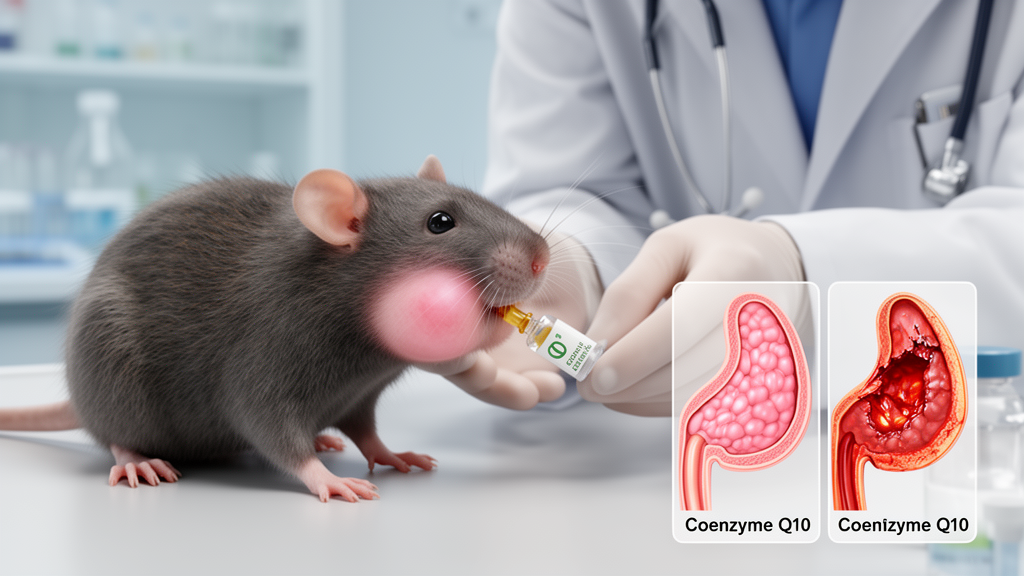
A six-week experiment in adult male rats found that coenzyme Q10 (CoQ10), administered alongside methotrexate, reduced several biochemical, histological, and ultrastructural signs of salivary-gland injury compared with methotrexate alone. Co-administration was associated with lower malondialdehyde and nitric oxide levels, higher glutathione and antioxidant-enzyme activities, reduced concentrations of the inflammatory cytokines tumor necrosis factor-alpha and interleukin-6, and better preservation of glandular architecture. The preclinical study, published in Scientific Reports, did not test CoQ10 in people or establish a clinical dosing regimen.
The researchers randomly allocated 24 adult male albino rats weighing 180–220 grams to four equal groups of six. The control group received no treatment, the CoQ10 group received CoQ10 alone, the methotrexate group received methotrexate alone, and the combined group received both compounds. Methotrexate was administered intraperitoneally at 20 mg/kg once a week, while CoQ10 was delivered orally by gastric gavage at 100 mg/kg/day.
Both treatments continued for six weeks, beginning with the period of methotrexate exposure. At the end, the parotid and submandibular salivary glands were collected and divided for biochemical analysis, light microscopy, and scanning and transmission electron microscopy. The sample-size calculation was based on data from a previous study and targeted 80% power to detect an effect size of 0.745 for methotrexate’s effect on salivary glands at a 5% significance level.
Group allocation was random. Tissues for histology were fixed in neutral buffered formalin, sectioned, and stained with hematoxylin and eosin or Masson’s trichrome; the latter was used to assess collagen deposition and fibrosis. Acinar area was quantified from randomly selected, non-overlapping microscopic fields, with a mean calculated for each animal.
Scanning electron microscopy examined gland-surface morphology, while transmission electron microscopy assessed intracellular structures such as nuclei, organelles, and secretory granules. Methotrexate produced a marked shift in the glandular redox environment. Compared with controls, rats receiving methotrexate had significantly higher concentrations of malondialdehyde (MDA), used as an indicator of lipid peroxidation, and total nitric oxide (NO).
Their reduced glutathione (GSH) level was significantly lower. Activities of the antioxidant enzymes superoxide dismutase (SOD), catalase (CAT), and glutathione peroxidase (GPx) also declined significantly, with the reported comparisons meeting p < 0.05. Animals receiving CoQ10 without methotrexate did not differ significantly from controls on these measures.
In the combined-treatment group, MDA and NO were significantly lower than with methotrexate alone, GSH was significantly higher, and SOD, CAT, and GPx activities were significantly restored relative to the methotrexate-only group, although the enzyme values remained slightly below control levels. The inflammatory measurements followed a similar pattern. Methotrexate significantly increased the concentrations of tumor necrosis factor-alpha (TNF-α) and interleukin-6 (IL-6) in salivary-gland tissue relative to control tissue.
CoQ10 alone produced cytokine concentrations that were not significantly different from those in controls. Adding CoQ10 to methotrexate significantly reduced both TNF-α and IL-6 compared with methotrexate alone, but the concentrations in the combined-treatment group remained moderately elevated compared with controls. The findings therefore show a reduction, rather than elimination, of the inflammatory response under the experimental conditions.
Oxidative-stress markers, antioxidant defenses, cytokines, and tissue morphology were assessed within the same treatment framework, although the study did not establish which molecular changes occurred first. Light-microscope examination showed normal glandular organization in untreated animals, including closely packed serous acini, recognizable intercalated, striated, and excretory ducts, narrow interstitial spaces, and minimal collagen in the normal connective-tissue septa. CoQ10 alone produced a comparable appearance, with preserved acinar and ductal organization and no reported inflammatory infiltration.
Methotrexate produced a contrasting pattern: lobular architecture became disorganized, interstitial spaces widened, acini were atrophied and difficult to distinguish, and inflammatory cells accumulated around congested blood vessels. Acinar cells showed cytoplasmic vacuolization, loss of normal cellular boundaries, and degeneration. Masson’s trichrome staining revealed increased collagen deposition in the connective-tissue septa and stroma, consistent with fibrotic changes in the methotrexate group.
Co-administration with CoQ10 substantially improved the light-microscope findings. Salivary glands in the combined-treatment group showed more regularly organized acini, narrower interstitial spaces, reduced vacuolization, and less inflammatory infiltration, with clearer striated, intercalated, and excretory ducts and more normal-appearing vessels. Masson’s trichrome staining showed less collagen than in the methotrexate-only group, although the authors described fibrosis as only partially attenuated.
Quantitatively, mean acinar area was 639.67 ± 37.73 in controls, 425.68 ± 145.41 with CoQ10 alone, 425.21 ± 201.32 with methotrexate plus CoQ10, and 212.68 ± 55.88 with methotrexate alone. The large standard deviations in both CoQ10-containing groups indicate substantial variation among animals, so the ordering of the means alone does not establish equivalence between those groups. Scanning electron microscopy extended the structural assessment to the gland surface.
Controls and CoQ10-only animals had intact surfaces with organized lobular contours, regular acinar outlines, and relatively normal interstitial spaces and excretory ducts. Methotrexate-treated glands showed rough, irregular surfaces, fissure-like defects, structural disorganization, and areas of tissue disruption. The surface in animals receiving methotrexate and CoQ10 was more regular, with fewer defects and partially restored lobular organization.
Transmission electron microscopy showed a similar divergence at the cellular level. Control and CoQ10-only acinar cells had intact nuclei, organized cytoplasm, abundant secretory granules, and well-maintained organelles. Methotrexate was associated with cytoplasmic disorganization, extensive vacuolization, fewer secretory granules, and disrupted cellular structures.
In the combined group, nuclei and cytoplasmic organization were better preserved and secretory granules were more visible, but mild vacuolization and incomplete recovery remained. The semi-quantitative fibrosis analysis was less decisive than the other measures. Scores were 1.83 ± 0.75 for methotrexate alone, 0.33 ± 0.52 for controls, 1.17 ± 0.75 for CoQ10 alone, and 1.17 ± 0.98 for combined treatment.
The overall Kruskal–Wallis test was significant at p = 0.041, and the control-versus-methotrexate comparison remained significant after Holm correction at p = 0.026. However, the direct comparison between methotrexate alone and methotrexate plus CoQ10 was not statistically significant at p = 0.687. Thus, while the histological appearance suggested reduced collagen accumulation with CoQ10, the semi-quantitative fibrosis score did not establish a statistically significant difference between the two methotrexate groups.
Together, the results support a protective effect of CoQ10 under the conditions of this experiment. CoQ10 is a lipid-soluble component of the mitochondrial electron transport chain and has antioxidant activity. In the study, concurrent administration was associated with lower MDA and NO, higher GSH, greater SOD, CAT, and GPx activities, and reduced TNF-α and IL-6 compared with methotrexate alone.
The parallel histological and electron-microscopy findings indicate that these biochemical differences accompanied better preservation of salivary-gland structure. The experiment used one dose of each compound, one six-week treatment period, and specified routes and schedules of administration. It did not directly measure salivary output or oral symptoms, nor did it directly assess apoptotic markers or molecular regulators of mitochondrial pathways.
Clinical evaluation would be needed to determine whether the experimental effect translates into human benefit. The study involved only adult male rats and a specific repeated-methotrexate model, so it cannot establish that CoQ10 supplementation would prevent dry mouth, oral infection, or other complications in patients receiving methotrexate. Co-administration began alongside methotrexate exposure rather than after established injury, and the experiment did not assess other doses, treatment durations, or formulations.
The authors also identify optimal dosing and long-term safety as unresolved questions.
Subject of Research: Preclinical evaluation of coenzyme Q10 against methotrexate-induced salivary-gland injury in male rats
Article Title: Coenzyme Q10 mitigates methotrexate induced salivary gland injury via antioxidant and anti-inflammatory mechanisms
Article References: Salem, E. M., Abdelfatah, O. M., Elnawawy, G., & Alghonemy, W. Y. (2026). Coenzyme Q10 mitigates methotrexate induced salivary gland injury via antioxidant and anti-inflammatory mechanisms. Scientific Reports, 16(1), Article 33323. https://doi.org/10.1038/s41598-026-73244-w
Image Credits: AI Generated
DOI: 10.1038/s41598-026-73244-w
Keywords: coenzyme Q10, methotrexate toxicity, salivary glands, oxidative stress, inflammation, antioxidants, rat model, tissue injury, histology, electron microscopy, Coenzyme, mitigates
Cite Scienmag News
Denise Maddox. (October 22, 2026). Coenzyme Q10 reduces methotrexate-induced salivary gland injury in male rats. Scienmag. https://scienmag.com/coenzyme-q10-reduces-methotrexate-induced-salivary-gland-injury-in-male-rats/
Denise Maddox. "Coenzyme Q10 reduces methotrexate-induced salivary gland injury in male rats." Scienmag, 22 October 2026, https://scienmag.com/coenzyme-q10-reduces-methotrexate-induced-salivary-gland-injury-in-male-rats/. Accessed 22 October 2026.
Denise Maddox. "Coenzyme Q10 reduces methotrexate-induced salivary gland injury in male rats." Scienmag. October 22, 2026. https://scienmag.com/coenzyme-q10-reduces-methotrexate-induced-salivary-gland-injury-in-male-rats/


