


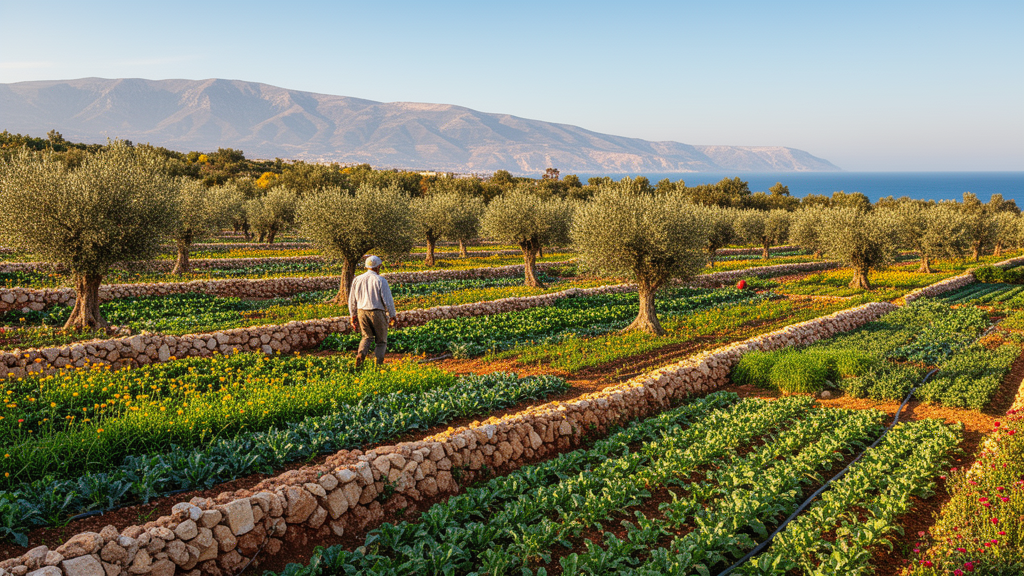
A cross-sectional study of 60 smallholder olive farms in the Elles locality of northwestern Tunisia found that systems combining olive trees, crops and livestock had the highest measured alignment with agroecological principles. Researchers classified 14 farms as olive monocultures, 13 as olive–crop systems, 15 as olive–livestock systems and 18 as fully integrated olive–crop–livestock systems. Their mean scores on the Characterization of Agroecological Transition index, or CAET, were 31.18%, 37%, 46% and 52%, respectively. The pattern was descriptive rather than evidence that diversification caused better outcomes, because the farms were assessed at one point in time and were not randomly assigned to production systems.
The investigation took place in Elles, a semi-arid locality in the Sers delegation of Tunisia’s Kef Governorate, where annual precipitation is approximately 350–450 millimetres and mean annual temperature is about 17–19 degrees Celsius. The area has shallow, calcareous soils, hot, dry summers and rainfed agriculture dominated by family farms. Most sampled households cultivated fewer than 10 hectares, and 82% lived on their farm plots. Olive orchards accounted for more than 90% of arboricultural land in the delegation, placing a locally important crop within a landscape of limited land, variable rainfall and recurrent exposure to drought.
Researchers administered a structured questionnaire through face-to-face interviews averaging about 45 minutes, supplemented by field observations to check reported practices. Farms were recruited through snowball sampling initiated with the local Agricultural Development Group, or GDA Elles, and expanded through farmer referrals. The resulting distribution reflected the settlement patterns of participating members and their networks rather than a probability-based sample. The CAET index uses 35 indicators grouped under 10 elements of agroecology: diversity, synergy, efficiency, recycling, resilience, culture and food traditions, co-creation and sharing of knowledge, human and social values, circular and solidarity economy, and responsible governance. Each indicator was scored from zero to four, and the 10 element scores were combined with equal weight to produce an overall percentage. Because the design was cross-sectional, the score represents a farm’s alignment at one point rather than measurable change over time.
Olive monocultures occupied the least aligned end of the index. Their CAET score of 31.18% was below the study’s 40% threshold for an incipient transition, and they recorded particularly low results for diversity, at 20%, synergy, at 13%, and recycling, at 21%. These farms averaged 3.5 hectares and were described as relying heavily on conventional tillage, synthetic fertilizers and pesticides, with little or no organic amendment. The contrast was not uniform across every measure: their efficiency score was 63%, slightly above the 61% recorded for fully integrated farms, showing that structural diversification did not directly determine every element of the index.
Olive–crop farms scored 37%, still below the 40% threshold, despite producing field crops, forage, horticultural crops or fruit trees alongside olives. Their mean area was 6.75 hectares, and household labour averaged three family members. Olive–livestock farms reached 46%, an intermediate position associated with recycling and resilience scores of 45% and 36%. These farms averaged only 1.8 hectares but combined olives with an average of 20 sheep and approximately one head of cattle, with about five family workers. Fully integrated olive–crop–livestock farms averaged 10.7 hectares, combined olives with crops and 37 sheep and seven cattle, and achieved 52%, placing them in the study’s 50–70% “active” transition range. Farmers and local stakeholders at a validation workshop broadly recognized this ordering, although the smaller workshop group could not independently validate every result.
Higher CAET scores were positively associated with several economic indicators in the sample. Monthly income averaged 1,349.7 Tunisian dinars for olive monocultures, 1,278.9 dinars for olive–crop farms, 2,319.3 dinars for olive–livestock farms and 4,892.1 dinars for fully diversified systems. Annual added value followed the same broad pattern, rising from 8,830.7 and 9,011 dinars in the first two types to 18,785.7 dinars in olive–livestock farms and 36,199.8 dinars in integrated farms. Spearman rank correlations between CAET and monthly income, productivity value and annual added value were 0.35, 0.30 and 0.25, respectively. These are associations, not causal effects; market conditions, labour availability, input and production costs, farm size and management could influence both agroecological scores and financial results.
Not every performance measure improved along the same gradient. Productivity value was highest in the olive–livestock group, at 14,153.5 dinars, compared with 4,910.7 dinars for monocultures, 2,584 dinars for olive–crop farms and 7,154.4 dinars for fully diversified farms. Agricultural biodiversity was highest in olive–crop systems, with an index value of 0.62, but only 0.13 in olive–livestock systems. Overall, the measured biodiversity index was moderately negatively correlated with CAET, at ρ = −0.26, while soil health had essentially no correlation with CAET, at ρ = 0.02. Mean soil-health ratings nevertheless occupied a narrow range from 6.2 to 6.8 out of 10. The results caution against treating aggregate agroecological alignment as a direct proxy for every environmental outcome, particularly because cross-sectional survey measures may miss slow changes in soil organic matter, biological activity, soil structure and water infiltration.
Social results likewise showed that transition scores did not automatically translate into inclusive benefits. The Women’s Empowerment in Agriculture Index had a weak, statistically non-significant correlation with CAET of −0.19, with a 95% confidence interval from −0.41 to 0.05. Forty-five of the 60 households scored zero on that indicator, and only seven were headed by women, leaving too few informative cases for separate analysis. Correlations with youth employment and dietary diversity were also weak. Youth employment averaged 15.6% in fully integrated farms but only 1.3–3.6% in the other three types. By contrast, internal CAET dimensions moved together more strongly: synergy, human and social values, diversity, recycling and co-creation of knowledge correlated with the overall index at ρ = 0.79, 0.78, 0.71, 0.71 and 0.71, respectively. These relationships support the view that ecological and social dimensions can develop together within individual farms, but they do not establish the direction of influence.
The study identifies a practical distinction between adding products to a farm and integrating them functionally. Olive–crop systems had more diversified output than monocultures, yet remained below the transition threshold because crops, trees and farm activities were not linked strongly enough through shared nutrient flows, residue use, biological regulation or coordinated management. The highest-scoring systems combined several activities in a structure that could recycle manure and biomass, connect livestock with crops and trees, and reduce reliance on external inputs. The researchers also identified barriers to wider adoption, including limited collective action, weak market integration, insufficient agricultural extension services and a lack of differentiated market outlets or price incentives. These institutional and market constraints may matter as much as technical feasibility when farmers assess the costs and benefits of changing their systems. Discussions with farmers, the GDA and local extension representatives helped contextualize these results, but participants reacted to analyses already framed by the research team and may have been influenced by social desirability.
Several limitations constrain how the findings can be applied. The sample was small, restricted to one locality and recruited through non-probability methods; with only 13–18 farms in each type, differences among groups are descriptive rather than formally confirmed statistical distinctions. The results do not represent Tunisia’s olive sector nationally, particularly because olive cultivation is more concentrated in central Tunisia. Farm size was not fully separated from diversification: fully integrated farms were the largest on average, although the smallest type, olive–livestock farms at 1.8 hectares, scored above the larger olive–crop group. Sensitivity analysis excluding the diversity and synergy elements produced a CAET-8 score highly correlated with the full index at ρ = 0.96, but the researchers could not determine separately whether the farm-type gradient remained intact under that calculation. The evidence therefore supports further evaluation of differentiated, locally adapted approaches, including stronger extension, training, collective organization and market coordination, but longitudinal or regression-based research would be needed to determine whether agroecological transition itself changes income, biodiversity, soil conditions or social outcomes over time.
Subject of Research: Assessment of agroecological transition and performance in 60 smallholder olive farms in northwestern Tunisia
Article Title: Agroecological transition in olive based farming systems among smallholder farms in northwestern Tunisia
Article References: Mejri, R., Oueslati Zlaoui, M., Gharbi, I., Souissi, A., Ferchichi, G., Soula, R., Dhehibi, B., & Dhraief, M. Z. (2026). Agroecological transition in olive based farming systems among smallholder farms in northwestern Tunisia. Frontiers in Sustainable Food Systems, 10, Article 1903591. https://doi.org/10.3389/fsufs.2026.1903591
Image Credits: AI Generated
DOI: 10.3389/fsufs.2026.1903591
Keywords: agroecology, olive farming, smallholder farms, Tunisia, farm diversification, crop–livestock integration, agricultural sustainability, semi-arid agriculture, rural livelihoods, agroecological transition, Agroecological, transition
Cite Scienmag News
Alan Morgan. (October 22, 2026). Diversified olive farms in northwestern Tunisia score higher on agroecology. Scienmag. https://scienmag.com/diversified-olive-farms-in-northwestern-tunisia-score-higher-on-agroecology/
Alan Morgan. "Diversified olive farms in northwestern Tunisia score higher on agroecology." Scienmag, 22 October 2026, https://scienmag.com/diversified-olive-farms-in-northwestern-tunisia-score-higher-on-agroecology/. Accessed 22 October 2026.
Alan Morgan. "Diversified olive farms in northwestern Tunisia score higher on agroecology." Scienmag. October 22, 2026. https://scienmag.com/diversified-olive-farms-in-northwestern-tunisia-score-higher-on-agroecology/


