


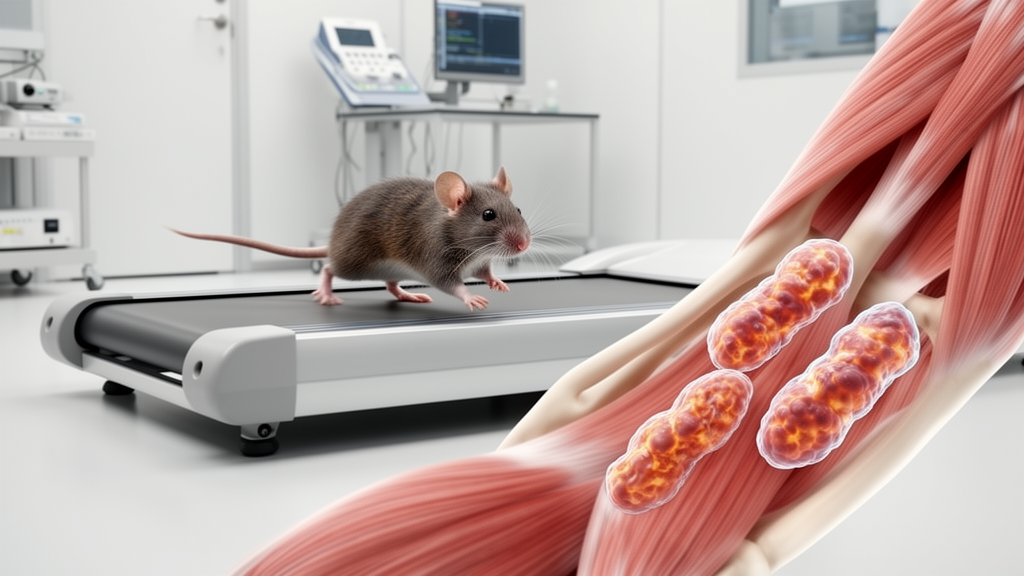
In a controlled mouse experiment, nine weeks of voluntary wheel running improved treadmill endurance and produced broad changes in skeletal-muscle gene expression, but it did not restore mitochondrial respiratory capacity in gastrocnemius plantaris muscle. Adult male C57BL/6 mice received either a normal-phosphate diet containing 0.6% inorganic phosphate or a high-phosphate diet containing 2.0% for 14 weeks. After five weeks, animals were assigned to sedentary conditions or given access to running wheels for the remaining nine weeks. Trained mice on the high-phosphate diet ran as long as their normal-phosphate-trained counterparts in a graded treadmill test, yet mitochondria isolated from their skeletal muscle continued to show reduced oxygen consumption. The study therefore separates an improvement in measured exercise performance from recovery of diet-associated cellular dysfunction.
The high-phosphate diet produced rapid phosphate loading. One day after the diet began, serum inorganic phosphate averaged 8.1 ± 1.4 mg/dL in high-phosphate-fed mice, compared with 5 ± 0.03 mg/dL in normal-phosphate-fed animals. Urinary phosphate was eightfold higher and fecal phosphate was threefold higher during each of the first two days. These elevated levels persisted throughout the experiment, with high-phosphate-fed mice maintaining higher urinary and fecal phosphate after 14 weeks. Beginning exercise did not materially change phosphate concentrations in serum, urine, or feces over the following two days, and no differences in phosphate clearance were detected between sedentary and trained animals within either diet. The mice thus continued to ingest and excrete substantially more phosphate regardless of activity level.
Mitochondrial impairment in skeletal muscle was detected after only five weeks of the high-phosphate diet. The researchers isolated mitochondria from gastrocnemius plantaris, a metabolically active muscle, and measured oxygen consumption with substrates linked to distinct respiratory pathways. With succinate under coupled conditions, high-phosphate-fed mice had significantly lower State 3 and maximal State 3U respiration than normal-phosphate-fed mice. In uncoupled assays using pyruvate and malate, respiration through electron-transport-chain complexes II through IV and through complex IV alone was also reduced. Mitochondria isolated from the liver did not differ significantly between diets at this stage. These measurements showed that mitochondrial respiratory changes were detectable in skeletal muscle at five weeks while they were not detectable in liver mitochondria under the same comparison.
The intervention began only after skeletal-muscle mitochondrial impairment had been established, making this an examination of exercise after dysfunction rather than prevention. Mice had access to in-cage running wheels for nine weeks, and their activity was recorded throughout. Normal-phosphate and high-phosphate groups ran similar distances per day and per week, indicating that the diet did not suppress voluntary activity. Exercise also changed body composition: trained mice had more lean mass and less fat mass than sedentary animals regardless of diet, while food consumption did not differ significantly among the four groups. The high-phosphate diet itself did not change body weight, lean mass, or fat mass. These results show that the exercise intervention was biologically effective even though it did not eliminate phosphate exposure.
After fasting for two to five hours, the mice underwent a graded forced-treadmill test. Trained animals ran longer than sedentary mice in both dietary groups, and blood lactate increased after the test in every group. Trained high-phosphate-fed mice and trained normal-phosphate-fed mice showed similar exercise durations, as well as similar pre- and post-exercise lactate responses. This differed from an earlier mouse study in which 12 weeks of a high-phosphate diet reduced exercise capacity. In the current experiment, the measured endurance outcome was no longer reduced after training, even though the mitochondrial assays still identified respiratory impairment. The authors noted that lower respiration does not always indicate dysfunction because it can also reflect adaptation to altered physiological demands, but persistent metabolic gene dysregulation and prior evidence of impaired sedentary exercise capacity supported their interpretation that the sustained respiratory reduction was pathological.
Direct assays of isolated mitochondria confirmed that the respiratory defect remained after training. High-phosphate-fed trained mice had significantly lower State 3 and State 3U respiration than normal-phosphate-fed trained mice when supplied with succinate under coupled conditions. Uncoupled respiration driven by pyruvate and malate was also reduced, including activity through complexes II–IV and complex IV alone. Fatty-acid oxidation was affected as well: when palmitoyl carnitine and malate were supplied, respiration through complexes II–IV was lower in high-phosphate-fed muscle mitochondria. Liver mitochondria showed no significant diet-related differences in coupled or uncoupled assays with succinate, pyruvate, or palmitoyl carnitine. Exploratory correlations found no relationship between daily running distance and skeletal-muscle respiration in the electron-coupling, electron-flow, or fatty-acid oxidation assays.
Several measurements nevertheless demonstrated that training had a biological effect. Mitochondrial DNA content increased in gastrocnemius plantaris from trained mice under both diets, consistent with exercise-associated mitochondrial biogenesis. At the same time, western blots found no significant differences in representative oxidative-phosphorylation proteins among the four groups after accounting for mitochondrial protein loading. Thus, the additional mitochondrial material observed with training did not correspond to restored oxygen consumption. The investigators also discussed possible contributors to preserved treadmill performance, including changes in the muscle–tendon unit, neural control, and cardiovascular function, but these mechanisms were not directly measured in the experiment and remain unresolved.
RNA sequencing showed that exercise broadly reprogrammed muscle regardless of diet, but it did not erase every high-phosphate-associated difference. Principal-component analysis separated exercised muscle from sedentary muscle, while exercised samples from the two diets clustered together. Comparing sedentary and trained normal-phosphate mice identified 9,467 differentially expressed genes; the same comparison under the high-phosphate diet identified 8,009. Common pathways affected by training included protein metabolism, translation, aerobic respiration, and signal transduction. Only 10 genes differed between exercised normal-phosphate and exercised high-phosphate muscles. More detailed comparisons indicated a partial rather than complete rescue: some genes shifted as they did with normal-phosphate exercise, while others retained diet-dependent changes. The molecular results were compatible with the continued mitochondrial impairment, even though the whole-animal endurance test did not reveal a diet-related difference among trained mice.
Several metabolic pathways remained disturbed under the combined high-phosphate and exercise conditions. Compared with the pattern of exercise-related changes in normal-phosphate mice, high-phosphate-fed trained muscle showed reduced expression of fatty-acid oxidation and lipid-signaling genes, including Mlycd, Acad11, Hadhb, Acox1, Bdh1, Cpt2, Pparα, Rxrβ, and Esrrα. Components of the α-ketoglutarate dehydrogenase complex and succinate dehydrogenase subunit A were also lower, while multiple glycolysis and glycogen-metabolism genes were downregulated. Reactome analysis identified immune and cytokine signaling in high-phosphate-fed trained muscle, including genes such as Tnf, Tifa, Il12b, and Plac8. These findings indicate that exercise generated familiar adaptive transcriptional changes without fully normalizing carbohydrate and fatty-acid metabolism under phosphate stress. Because the study measured RNA and did not directly quantify fuel flux or establish corresponding changes in protein abundance, the causal contributions of these pathways remain uncertain.
The experiment distinguishes dietary phosphate loading, whole-animal exercise performance, and mitochondrial function. Nine weeks of voluntary running produced a clear training response, including altered body composition, longer treadmill duration, increased muscle mitochondrial DNA, and extensive gene-expression changes. It did not normalize phosphate exposure, skeletal-muscle respiration, or all diet-sensitive metabolic pathways. The study involved male mice, a controlled high-phosphate diet, and exercise initiated after five weeks, so it cannot establish how the same sequence would affect women, humans, people already active before increasing phosphate intake, or other exercise regimens. It also did not determine whether exercise started before the diet, combined with dietary phosphate reduction, or a different training program would prevent the defect. The narrow but clear result is that restored treadmill endurance and molecular signs of adaptation did not amount to restored mitochondrial respiratory capacity in this mouse model.
Subject of Research: Effects of voluntary exercise on skeletal-muscle mitochondrial function in male mice fed a high-phosphate diet
Article Title: Exercise training does not mitigate high‐phosphate diet‐induced mitochondrial dysfunction in skeletal muscle in male mice
Article References: Sanders, H. F., Kolonay, D. W., Blackwell, J. A., Liu, J., Dobrski, I. R., Branch, D. A., Lefers, L. A., Kern, B. H., & Baskin, K. K. (2026). Exercise training does not mitigate high‐phosphate diet‐induced mitochondrial dysfunction in skeletal muscle in male mice. Physiological Reports, 14(20), Article e71139. https://doi.org/10.14814/phy2.71139
Image Credits: AI Generated
DOI: 10.14814/phy2.71139
Keywords: high-phosphate diet, skeletal muscle, mitochondrial respiration, exercise training, voluntary wheel running, male mice, muscle metabolism, RNA sequencing, phosphate loading, fatty-acid oxidation, Exercise, training
Cite Scienmag News
Juliet Wilcox. (October 21, 2026). Exercise fails to restore mitochondrial function in high-phosphate-fed male mice. Scienmag. https://scienmag.com/exercise-fails-to-restore-mitochondrial-function-in-high-phosphate-fed-male-mice/
Juliet Wilcox. "Exercise fails to restore mitochondrial function in high-phosphate-fed male mice." Scienmag, 21 October 2026, https://scienmag.com/exercise-fails-to-restore-mitochondrial-function-in-high-phosphate-fed-male-mice/. Accessed 21 October 2026.
Juliet Wilcox. "Exercise fails to restore mitochondrial function in high-phosphate-fed male mice." Scienmag. October 21, 2026. https://scienmag.com/exercise-fails-to-restore-mitochondrial-function-in-high-phosphate-fed-male-mice/


