


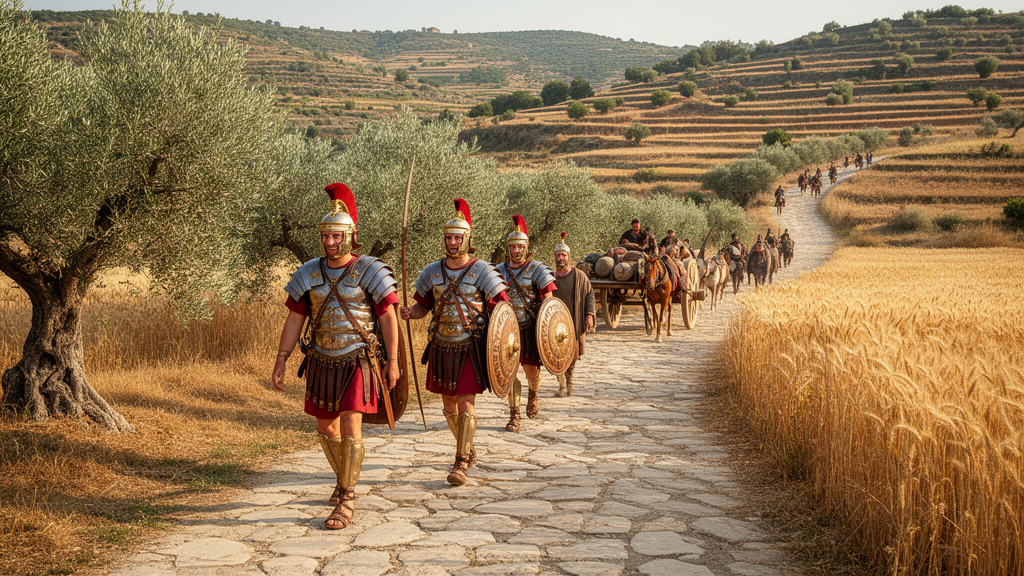
An international archaeogenomic study has found that Rome’s conquest of the Iberian Peninsula produced a large-scale demographic transformation, while migrations associated with the Suebi, Alans, Vandals and Visigoths in Late Antiquity introduced new ancestries without replacing most local communities. The researchers analyzed 243 ancient genomes from 31 archaeological sites, reconstructing population history across the peninsula from the 1st to the 8th centuries CE. Their results distinguish the extensive Mediterranean population movements associated with Romanization from the more limited demographic impact of later migrations.
Individual burials also reveal that political influence did not always correspond to foreign ancestry: migrant identities could be acquired through family, political and cultural alliances, and even closely related people could be separated by hundreds of kilometres. The study, published in Cell, is presented as the first systematic, large-scale archaeogenomic analysis of Roman and Late Antique Hispania. It combines ancient DNA with archaeological evidence to examine ancestry across different sites, social contexts and family relationships.
The analyzed remains span seven centuries and reveal a marked contrast between the relative genetic homogeneity of the Iron Age and the much greater diversity found among people living from the 1st to the 4th centuries CE. Its position between the Atlantic and the Mediterranean, together with its abundant natural resources, made the peninsula an important territory for the expanding empire. As Roman rule became established, people with ancestry from the eastern Mediterranean and North Africa joined the populations already living in Iberia.
The researchers describe the resulting society as a genetic mosaic connected to human networks across the Mediterranean, with ancestry diversity far greater than that recorded for the preceding Iron Age. This was not presented as the simple replacement of one population by another; instead, the evidence points to the expansion and mixing of multiple population components. Carles Lalueza-Fox, co-senior author of the study and director of the Natural Sciences Museum of Barcelona, said the findings show that “Romanisation was not only a political, linguistic and cultural transformation.” The ancient genomes also indicate that it was “a major demographic transformation,” connecting local Iberian populations with people whose origins lay in different parts of the Mediterranean.
The distinction is important because the emergence of Roman political authority and cultural practices is not being used as a proxy for genetic uniformity. The genomic data instead show that the empire’s influence drew together populations with measurably different ancestries and produced a substantially more heterogeneous society across Hispania. The demographic effect of the migrations that followed the weakening of Roman power was smaller.
From the 5th century onward, the study identifies individuals with Central and Northern European ancestry, particularly in archaeological contexts associated with the new political groups that established themselves in the peninsula. The Suebi, Alans and Visigoths arrived during or after the collapse of the Western Roman Empire, and their elite status and political authority gave them a lasting cultural and political presence. Yet most communities retained the diverse ancestry profile associated with the Hispano-Roman period.
The estimated genetic contribution of these groups ranges from 12% to 22%, depending on the region and social context, and admixture with local populations appears to have been gradual rather than a radical transformation of the peninsula’s genetic landscape. Pablo Carrión, the study’s first author, said the contrast between these processes was the most surprising feature of the results. Roman rule created an exceptionally diverse society through population movement across the Mediterranean, whereas the later migrations introduced new ancestries but had a much smaller overall demographic effect.
David Reich, a co-senior author, characterized the Iberian evidence as showing migration and new ancestries “but not population replacement or large-scale demographic impact.” The pattern differed from Britain and the Balkans, where post-Roman migrations are reported to have produced greater demographic effects. Sampling across the ancient record remains uneven, however, and the 243 genomes represent particular archaeological sites and periods rather than every community in the Iberian Peninsula. Genome analysis also allows the researchers to reconstruct individual histories that are obscured in population-level ancestry estimates.
Two genetically related siblings were buried at sites approximately 725 kilometres apart when measured along the Roman road network: one at ancient Augusta Emerita, now Mérida, and the other at Ildum, a Roman posting station near Castellón beside the Via Augusta. Both had entirely Central European ancestry and were probably first-generation migrants. Their kinship and the rich nature of their burials point to a possible route associated with the Suebian migration.
The burials of women associated with the so-called “Suebian princesses” complicate another traditional interpretation. Rich grave goods had previously led researchers to regard these women as members of a migrant elite that arrived from beyond the Roman Empire’s frontiers. Genomic evidence showed, however, that one of the women had local ancestry.
The finding supports the interpretation that the period’s elite networks included marriage alliances between Suebian and Hispano-Roman families. The deaths of several of these women within the same period may have been linked to a succession dispute in an elective monarchy, although the genetic results do not establish the cause or circumstances of their deaths. More generally, an identity associated with the Suebi or Visigoths did not necessarily indicate foreign ancestry because such an identity could also be acquired through family, political and cultural alliances.
The findings describe the ancient gene pool rather than a complete history of the peninsula’s population. People living in Late Antique Iberia were more genetically heterogeneous than present-day populations, indicating that the gene pool changed again during the medieval and post-medieval periods. The researchers associate those subsequent changes with a combination of Visigothic rule, the Islamic conquests, internal population movements and the expansion of Christian kingdoms.
These broad historical processes are not themselves outcomes demonstrated by the 243 genomes, whose principal coverage extends from the 1st to the 8th century CE. Reconstructing the complete genetic history would require additional medieval and post-medieval genomes, together with expanded sampling from northern Iberia and North Africa. Overall, the study demonstrates that major political changes do not necessarily leave equivalent genetic signatures.
Romanization profoundly altered the composition of Iberian society by bringing together people from across the Mediterranean and mixing their ancestries with established local populations. The elites of Late Antiquity, by contrast, exerted substantial political and cultural influence without replacing the peninsula’s population at the scale associated with Roman conquest. The 243 genomes from 31 sites provide a detailed view of that distinction, while individual cases show how migration, kinship and elite alliances operated within it.
The evidence is strongest for the sampled places and periods, and broader temporal and geographic coverage will be needed to complete the genetic history of the Iberian Peninsula.
Subject of Research: Ancient-DNA reconstruction of demographic change in Roman and Late Antique Hispania
Article Title: The arrival of the Suebi, Alans and Visigoths did not erase the deep genetic legacy of Roman Hispania
Article References: The arrival of the Suebi, Alans and Visigoths did not erase the deep genetic legacy of Roman Hispania. Original publication (Bibliographic details unavailable.)
Image Credits: AI Generated
DOI: Not provided
Keywords: ancient DNA, archaeogenomics, Iberian Peninsula, Roman colonization, Hispania, Suebi, Visigoths, Alans, population history, Mediterranean migration, arrival, erase
Cite Scienmag News
Courtney Benton. (October 21, 2026). Roman conquest transformed Iberia more than later Germanic migrations. Scienmag. https://scienmag.com/roman-conquest-transformed-iberia-more-than-later-germanic-migrations/
Courtney Benton. "Roman conquest transformed Iberia more than later Germanic migrations." Scienmag, 21 October 2026, https://scienmag.com/roman-conquest-transformed-iberia-more-than-later-germanic-migrations/. Accessed 21 October 2026.
Courtney Benton. "Roman conquest transformed Iberia more than later Germanic migrations." Scienmag. October 21, 2026. https://scienmag.com/roman-conquest-transformed-iberia-more-than-later-germanic-migrations/


