

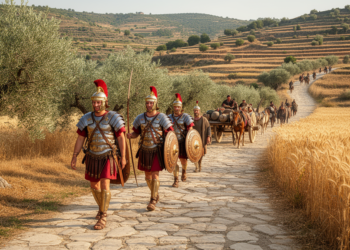
Roman conquest transformed Iberia more than later Germanic migrations
An analysis of 243 ancient genomes indicates that Roman rule transformed Iberia’s population, while later Suebian, Alan and Visigothic migrations ...
An analysis of 243 ancient genomes indicates that Roman rule transformed Iberia’s population, while later Suebian, Alan and Visigothic migrations ...

A new review shows how ancient pathogen genomics and palaeoproteomics together allow researchers to reconstruct not just which microbes infected ...
Genomes recovered from 18,000-year-old salmon vertebrae in a Spanish cave reveal that ancient Iberian salmon were genetically closer to British ...
Proteins preserved in ancient dental calculus show that Armenians consumed dairy for millennia while lactase persistence remained rare, pointing to ...
By sequencing DNA from ancient cave remains, museum specimens, and living bats, researchers have reconstructed more than two thousand years ...
Ancient DNA from unidentifiable bone fragments in Denisova Cave has revealed a previously unknown extinct bovine species related to yaks ...
New research combining ancient DNA and archaeology shows that genetic bottlenecks, human hunting and forest spread together drove the aurochs ...
A new pangenome graph tool called COSIGT uses cosine similarity to accurately genotype complex genomic loci from sequencing data as ...
New ancient genomes from Early Medieval Finland reveal nearly a thousand years of inland genetic continuity, a dramatic Scandinavian-driven shift ...
Strontium isotope analysis of 199 Bronze Age skeletons from central and southern Greece shows that five to ten percent of ...

Embark on a thrilling journey of discovery with Scienmag.com—your ultimate source for cutting-edge breakthroughs. Immerse yourself in a world where curiosity knows no limits and tomorrow’s possibilities become today’s reality!