


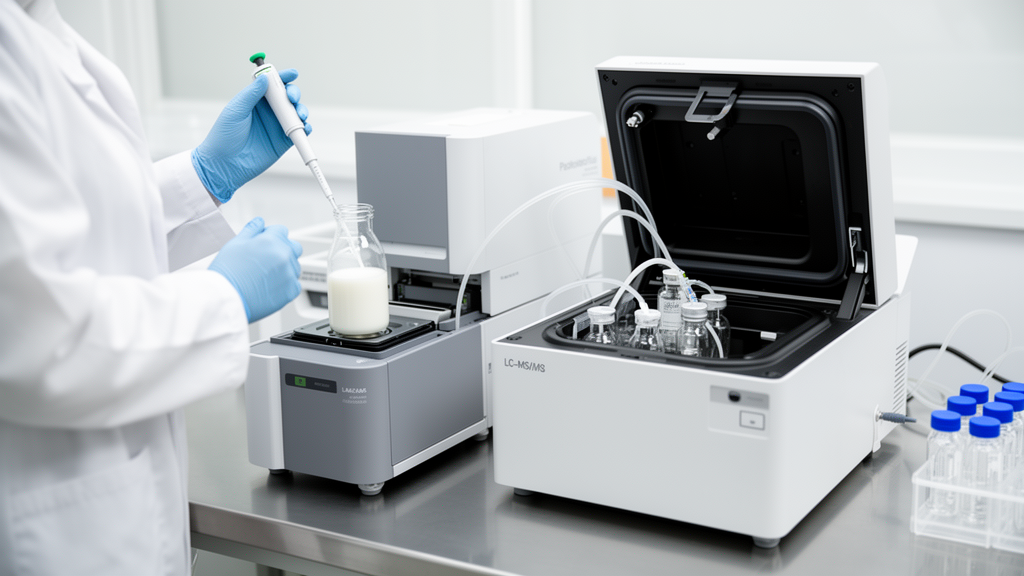
A highly sensitive liquid chromatography–tandem mass spectrometry method detected the opioid peptide beta-casomorphin 5 (β-CM5) in all five commercial pasteurized-milk samples examined in the study. The method combined solid-phase extraction, a stable isotope-labelled internal standard and multiple-reaction monitoring to identify and quantify small concentrations of the peptide. β-CM5 levels ranged from below the method’s quantification limit in one sample to 0.55 nanograms per gram in another, with the four quantifiable samples containing 0.12–0.16 ng/g. Separate experiments using milk subjected to industrial heat treatments found similar concentrations before and after treatment, indicating that the pasteurization conditions studied were unlikely to generate additional β-CM5.
The findings establish an analytical method capable of resolving concentrations below those measured in earlier studies, but they do not demonstrate that these low levels produce a biological effect in people. β-CM5 is a five-amino-acid opioid peptide with the sequence Tyr-Pro-Phe-Pro-Gly, derived from bovine beta-casein. It can be released from beta-casein during milk processing, particularly cheese making, and it can also be produced in the intestine by cleavage of the longer peptide beta-casomorphin 7 through the activity of dipeptidyl peptidase IV.
The peptide has higher affinity for the mu-opioid receptor than β-CM7. Although possible health effects of beta-casomorphins have been investigated, the evidence concerning β-CM5 and β-CM7 remains inconclusive. The study addresses an analytical gap rather than a clinical question: earlier LC–MS/MS methods did not detect β-CM5 in pasteurized, sterilized, ultra-high-temperature or in-bottle sterilized milk, while the peptide had been measured in raw milk at concentrations as high as 0.64 ng/g.
The investigators proposed that a method with greater sensitivity might reveal whether trace quantities were present but had fallen below earlier detection thresholds. For the commercial-product survey, the researchers collected full-fat pasteurized milk produced by five processing plants in Western Australia from supermarkets in the region. Fifty-gram portions were frozen at −20°C overnight and then freeze-dried before analysis.
A processor also supplied raw milk and two groups of industrially heated milk, treated at 62°C for five minutes and 72°C for five minutes. The raw milk came from a healthy herd and was held in airtight bags under cold conditions before treatment, an arrangement intended to minimize bacterial influence. The design allowed the team to compare five retail pasteurized-milk products and, separately, to assess whether the two commercial heat treatments changed β-CM5 concentration under controlled milk-handling conditions.
Sample preparation was a critical part of the method. For each milk sample, the researchers added 500 nanograms of β-CM5-d10, a stable isotope-labelled form of the peptide, before extraction. The milk was acidified to pH 4.5–4.6 with hydrochloric acid, allowing the milk’s casein proteins to precipitate.
After centrifugation at 10,000 times gravity for 10 minutes at 4°C, the supernatants were filtered and diluted. The filtrates were then passed through Strata-X-PRO solid-phase extraction cartridges, which retained the peptide while much of the interfering material was removed with 10% methanol in water. The β-CM5 was subsequently eluted with methanol, evaporated to dryness at 30°C and reconstituted in a water–methanol mixture.
A final 0.22-micrometre filtration step prepared the extracts for analysis. The isotope-labelled standard was introduced before extraction so that its response could compensate for peptide losses and analytical variability during preparation and measurement. The instrumental analysis used a UHPLC Nexera X2 system coupled to a Shimadzu LCMS-8045 triple-quadrupole mass spectrometer with electrospray ionization.
Separation was performed on a 100 × 2.1 millimetre C18 column with 1.7-micrometre particles at 35°C, using ultrapure water and methanol containing 0.1% formic acid as mobile phases. The flow rate was 0.4 millilitres per minute, and the injection volume was 5 microlitres. Data were acquired in positive-ion multiple-reaction monitoring mode.
For β-CM5, the transition from precursor mass-to-charge ratio 580.25 to product ion 173.10 was used for quantification, while 580.25 to 408.20 provided an identification transition. The corresponding transitions for the internal standard were 590.40 to 173.10 and 590.40 to 418.20. Quantification depended on the ratio of β-CM5 to internal-standard peak areas, linked to a calibration curve prepared over 0–100 ng/mL.
Identification required agreement in retention time and ion ratios, using a four-point identification approach and criteria cited by the authors. Across the five pasteurized-milk extracts, the measured multiple-reaction-monitoring ratios ranged from 35.01 to 45.49, within the permitted interval of 31.80–53.00. Retention-time differences between each milk sample and the standard ranged from 0.00 to 0.02 minutes, while calculated retention-time deviations ranged from 0.12% to 0.30%.
These combined chromatographic and mass-spectrometric criteria supported the identification of β-CM5 in the samples. The calibration was highly linear, with an R² value of 0.9997. The method limit of detection was 0.03 ng/g and the limit of quantification was 0.11 ng/g, both below the values reported in the previous study cited by the team.
PM1 contained 0.55 ± 0.05 ng/g, PM2 contained 0.16 ± 0.02 ng/g, PM3 contained 0.16 ± 0.01 ng/g, and PM4 contained 0.12 ± 0.01 ng/g, with each value reported as a mean and standard deviation from duplicate analyses. PM5 was below the quantification limit of 0.11 ng/g. The authors stated that the peptide might have been carried into pasteurized milk from raw milk, released by endogenous enzymes or produced through bacterial enzyme activity during storage or heat treatment.
They also considered differences in milk source, including beta-casein content and endogenous enzyme activity, as possible contributors to variation among brands. These mechanisms were proposed interpretations rather than experimentally separated causes, because the study did not directly measure the underlying enzyme activities or trace the peptide’s biological origin in every product. In the heat-treatment experiment, raw milk contained 0.11 ± 0.00 ng/g β-CM5.
Milk heated at 62°C for five minutes contained 0.13 ± 0.04 ng/g, while milk heated at 72°C for five minutes contained 0.10 ng/g, a result reported as below the quantification limit. These measurements were based on duplicate analyses and show no clear increase after either treatment. The authors therefore concluded that the industrial pasteurization conditions tested were unlikely to release β-CM5.
They also noted that β-CM5 corresponds to fragment f60–64 of beta-casein and could theoretically be generated by enzymes or heat treatment, but the observed values did not support substantial generation under the tested conditions. Because the raw milk was promptly processed and transported under cold conditions, the authors attributed its initial β-CM5 most plausibly to hydrolysis by endogenous proteases such as plasmin and cathepsins rather than bacterial enzymes. The measured concentrations were below the half-maximal inhibitory concentrations reported in earlier bioassay studies, and the authors stated that daily consumption of pasteurized milk was therefore unlikely to trigger opioid activity.
That conclusion must remain qualified: the study measured food concentrations and did not test absorption, metabolism, biological activity in human consumers or health outcomes. Earlier work cited in the paper also reported that β-CM5 was not generated during in-vitro gastrointestinal digestion. The new result does not resolve the broader uncertainty over possible effects of β-CM5 or β-CM7, nor does it establish that pasteurized milk poses an opioid-related risk.
Instead, it shows that trace β-CM5 can be detected in some pasteurized products with a more sensitive method and that the studied heat treatments did not measurably increase it. The research has important technical and interpretive limitations. Absolute extraction recovery for β-CM5 was not independently evaluated, and the stability of the peptide during freeze-drying and storage at −20°C was not separately measured.
Although the isotope-labelled internal standard was added before extraction and could compensate for losses thereafter, changes in β-CM5 before spiking could not be excluded. In addition, each milk brand was represented by one 50-gram sample. The duplicate analyses were performed on the same homogenized freeze-dried powder, so they were analytical replicates rather than independent biological or production-batch samples.
Inter-batch variability within a brand therefore remained unknown. The study supports the combination of LC–MS/MS, stable-isotope correction and solid-phase extraction as a sensitive approach for measuring β-CM5 in dairy foods. Its clearest empirical finding is that the peptide was present in the five commercial pasteurized-milk samples, at low levels, while pasteurization at the two tested conditions did not appear to generate it.
Subject of Research: Detection and quantification of beta-casomorphin 5 in pasteurized milk using LC–MS/MS
Article Title: A Sensitive LC–MS/MS Method for Quantifying Beta‐Casomorphin 5 in Pasteurized Milk
Article References: Nguyen, D. D., Solah, V., Daubney, S., Kowalczyk, M., & Hunt, W. (2026). A Sensitive LC – MS / MS Method for Quantifying Beta‐Casomorphin 5 in Pasteurized Milk. Food Science & Nutrition, 14(10), Article e72484. https://doi.org/10.1002/fsn3.72484
Image Credits: AI Generated
DOI: 10.1002/fsn3.72484
Keywords: beta-casomorphin 5, pasteurized milk, LC–MS/MS, mass spectrometry, solid-phase extraction, stable isotope standard, dairy analysis, food peptides, heat treatment, Sensitive, Method, Quantifying
Cite Scienmag News
Alan Morgan. (October 21, 2026). Sensitive LC–MS/MS Method Detects Beta-Casomorphin 5 in Pasteurized Milk. Scienmag. https://scienmag.com/sensitive-lc-ms-ms-method-detects-beta-casomorphin-5-in-pasteurized-milk/
Alan Morgan. "Sensitive LC–MS/MS Method Detects Beta-Casomorphin 5 in Pasteurized Milk." Scienmag, 21 October 2026, https://scienmag.com/sensitive-lc-ms-ms-method-detects-beta-casomorphin-5-in-pasteurized-milk/. Accessed 21 October 2026.
Alan Morgan. "Sensitive LC–MS/MS Method Detects Beta-Casomorphin 5 in Pasteurized Milk." Scienmag. October 21, 2026. https://scienmag.com/sensitive-lc-ms-ms-method-detects-beta-casomorphin-5-in-pasteurized-milk/


