


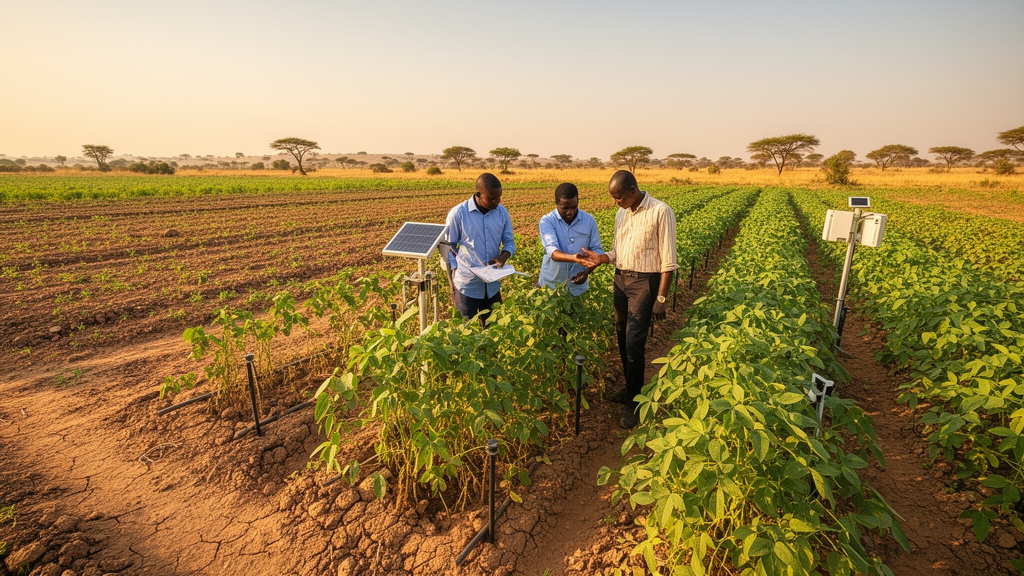
A systematic review of 190 studies concludes that drought-resilient soybean cannot be produced through a single gene, marker or breeding technology. For Tanzania and other rainfed regions of Sub-Saharan Africa, the most defensible pathway combines locally adapted germplasm, physiological phenotyping, multi-environment field testing and carefully selected genomic tools, supported by seed systems and extension services. The review found converging evidence for coordinated plant responses involving roots, water status, photosynthesis, osmotic adjustment, antioxidant defence, reproductive performance and stress-responsive signalling. It also found that many molecular and controlled-environment findings remain poorly validated under African field conditions.
The review followed Preferred Reporting Items for Systematic Reviews and Meta-Analyses 2020 guidelines and searched Web of Science Core Collection, Scopus, PubMed, ScienceDirect and Google Scholar for studies published from 1 January 2015 through 30 April 2026, the search cut-off. The search identified 1,200 records. After removal of 200 duplicates, researchers screened 1,000 titles and abstracts, assessed 425 articles in full text and retained 190 studies that met the eligibility criteria. The evidence was organized into 12 thematic areas: drought physiology, molecular genetics and genomics, quantitative trait locus mapping and genome-wide association studies, photosynthesis and reactive oxygen species regulation, marker-assisted selection, climate adaptation, agronomy and crop management, genomic selection, biochemical and omics research, root architecture, high-throughput phenotyping and artificial intelligence, and seed systems and socioeconomic dimensions.
The evidence base was concentrated on biological discovery. Thirty-four studies addressed drought physiology, while 29 examined molecular genetics and genomics. Far fewer investigated the practical links between breeding and adoption: 10 studies addressed root architecture, nine examined high-throughput phenotyping and artificial intelligence, and eight considered seed systems and socioeconomic dimensions. The authors classified evidence as moderate across most themes and preliminary to moderate for advanced phenotyping and deployment research. Because the included studies differed in drought intensity, timing, duration, experimental design, genetic background, phenotyping method and outcome, the team used thematic comparison, study-frequency counts and assessment of convergence rather than a formal quantitative meta-analysis.
Drought affects soybean through several connected processes. Water deficit impairs photosynthesis, transpiration, nutrient uptake and growth, while reproductive stress can restrict flowering, pod formation, seed number, seed weight and biological nitrogen fixation. Individual studies in the review reported yield losses approaching 50% when severe drought coincided with reproductive development, although losses varied substantially with stress intensity, duration, developmental stage, genotype and environment. Physiological responses included a higher root-to-shoot ratio, reduced leaf area, stomatal closure, lower gas exchange and chlorophyll loss. Plants also accumulated proline and soluble sugars and increased the activity of superoxide dismutase, catalase and peroxidases, while abscisic acid, ethylene and jasmonic acid participated in stress signalling. Some responses can be partly reversed after rehydration, but prolonged drought can leave persistent reductions in shoot growth and metabolism.
This complexity makes single traits unreliable as universal predictors of drought performance. Root depth may improve water acquisition in some soils, canopy wilting can indicate delayed dehydration in some genetic backgrounds, and osmotic adjustment may help maintain cellular function, but each effect depends on genotype and environmental conditions. The review also distinguished biological activity from breeding value. Candidate genes and genomic regions linked to DREB, WRKY, MYB, NF-YA and LEA regulatory networks, as well as abscisic-acid signalling, antioxidant protection, root growth and photosynthesis, were identified in molecular or transgenic studies. Yet the presence of a drought-responsive signal does not demonstrate that it will improve field yield or remain predictive across genetic backgrounds, locations and seasons. These findings therefore remain candidates requiring functional confirmation and field validation.
Breeding technologies have distinct and complementary roles. Conventional selection remains a feasible foundation for programmes with limited infrastructure because it can exploit natural variation and generate populations adapted to local conditions. Marker-assisted selection can accelerate the introduction of a major gene or a validated quantitative trait locus, but is less effective when drought adaptation is governed by many genes of small effect. Genome-wide association studies can locate trait-associated regions at high resolution, although they require large, diverse populations, dense marker coverage, precise phenotyping and multi-environment validation. Genomic selection is suited to complex polygenic traits, but prediction accuracy depends on sufficiently large and representative phenotypic and marker datasets, appropriate training populations, repeated phenotyping and computational capacity. The review treated these comparisons as contextual assessments of field reliability, genetic-gain potential, cost and infrastructure needs, not as a quantitative head-to-head performance test.
The practical consequence is a validation-first strategy rather than immediate adoption of imported genes, markers or advanced technologies. Globally, drought-adapted donors include Brazilian, North American, Indian, Chinese and African lines with variation in rooting, canopy wilting, nitrogen fixation, water-use efficiency and pod development. The African genotype TGX 1835-10E provides field-based evidence from Nigeria and Cameroon. Such materials offer useful pre-breeding diversity, but performance in one production system cannot be assumed to carry over to Tanzania. Candidates should be crossed with locally adapted, high-yielding parents and assessed for reproductive stability, yield potential and adaptive traits across contrasting moisture regimes. Trials spanning drought-prone and favourable environments over multiple seasons are needed to distinguish broadly adapted genotypes from those with narrow, site-specific advantages.
Environmental measurement must also become more precise. The Standardized Precipitation Index characterizes rainfall departures from a historical mean and is relatively simple to apply where precipitation records are limited. The Standardized Precipitation Evapotranspiration Index additionally incorporates atmospheric water demand, while soil-water indices and remote-sensing indicators provide other views of crop water stress. None measures soybean drought resilience on its own. The review supports combining meteorological and hydrological indices with root-zone soil moisture, canopy temperature, evapotranspiration, physiological measurements and yield. Such characterization helps define target environments, establish when and how drought occurred, and determine whether a genotype maintained performance under genuine water limitation. It also prevents crop-centred, physiological and environmental measures from being treated as interchangeable.
Promising agronomic measures remain complements rather than substitutes for adapted genetics. Mulching and reduced tillage may conserve soil moisture, while irrigation scheduling and soil-moisture monitoring can align water availability with crop demand, including during flowering and seed filling. The magnitude of these benefits varies with soil, climate, management intensity and genotype. The review found moderate support for combining drought-adapted varieties with climate-smart practices, but limited direct evidence that the components consistently produce synergistic gains. A defensible breeding pipeline would therefore measure yield, physiology, agronomy, economics and farmer preferences together rather than allowing one laboratory score or one controlled stress treatment to determine selection. Post-drought recovery may also merit assessment, because some genotypes regain leaf area, chlorophyll, root development or photosynthetic performance after rehydration, although recovery is trait- and genotype-dependent.
Seed delivery, extension and breeding infrastructure are also necessary if genetic gains are to reach farmers. Informal farmer-saved and grain-market systems supply an estimated 95–98% of legume seed in Sub-Saharan Africa, while certified seed remains limited. Extension-to-farmer ratios commonly range from about 1:2,500 to 1:5,000 across the region, and effective advisory coverage in Tanzania reaches only 10–30% of farming households, according to evidence synthesized in the review. Improved varieties therefore need multiplication, quality assurance, accessible markets and sustained advisory support if they are to affect productivity. Tanzanian soybean production, about 99% rainfed, has expanded in response to demand for feed, edible oil and industrial products, yet average yields remain far below global levels. The review’s central conclusion is that a resilient soybean variety is not merely a genotype with a promising drought trait; it is a genotype whose performance survives local conditions and reaches farmers through a functioning innovation system.
Subject of Research: A systematic review of biological, breeding and socioeconomic strategies for drought-resilient soybean production in Tanzania and Sub-Saharan Africa
Article Title: Toward drought-resilient soybean genotypes integrating global socioeconomic constraints genetic mechanisms and breeding priorities
Article References: Reuben, F. M., Dottey, C. M., Kudra, A. B., & Tryphone, G. M. (2026). Toward drought-resilient soybean genotypes integrating global socioeconomic constraints genetic mechanisms and breeding priorities. Discover Agriculture, 4(1), Article 318. https://doi.org/10.1007/s44279-026-00799-7
Image Credits: AI Generated
DOI: 10.1007/s44279-026-00799-7
Keywords: soybean, drought resilience, systematic review, plant breeding, genomic selection, phenotyping, multi-environment trials, Tanzania, Sub-Saharan Africa, seed systems, Toward, drought-resilient
Cite Scienmag News
Alan Morgan. (October 21, 2026). Soybean drought resilience requires field validation across African environments. Scienmag. https://scienmag.com/soybean-drought-resilience-requires-field-validation-across-african-environments/
Alan Morgan. "Soybean drought resilience requires field validation across African environments." Scienmag, 21 October 2026, https://scienmag.com/soybean-drought-resilience-requires-field-validation-across-african-environments/. Accessed 21 October 2026.
Alan Morgan. "Soybean drought resilience requires field validation across African environments." Scienmag. October 21, 2026. https://scienmag.com/soybean-drought-resilience-requires-field-validation-across-african-environments/


