

Wednesday, October 21, 2026
Science
No Result
View All Result
  • Login
  • HOME
  • SCIENCE NEWS
  • CONTACT US
  • HOME
  • SCIENCE NEWS
  • CONTACT US
No Result
View All Result
Scienmag
No Result
View All Result
Home Science News Technology and Engineering

Energy routing framework links alloy metastability to deformation pathways

October 21, 2026
in Technology and Engineering
Neil Sanderson
By Neil Sanderson Scienmag Editorial Profile - Materials Characterization
Reading Time: 3 mins read
0
Energy routing framework links alloy metastability to deformation pathways

Energy routing framework links alloy metastability to deformation pathways

65
SHARES
587
VIEWS
Share on FacebookShare on Twitter
ADVERTISEMENT

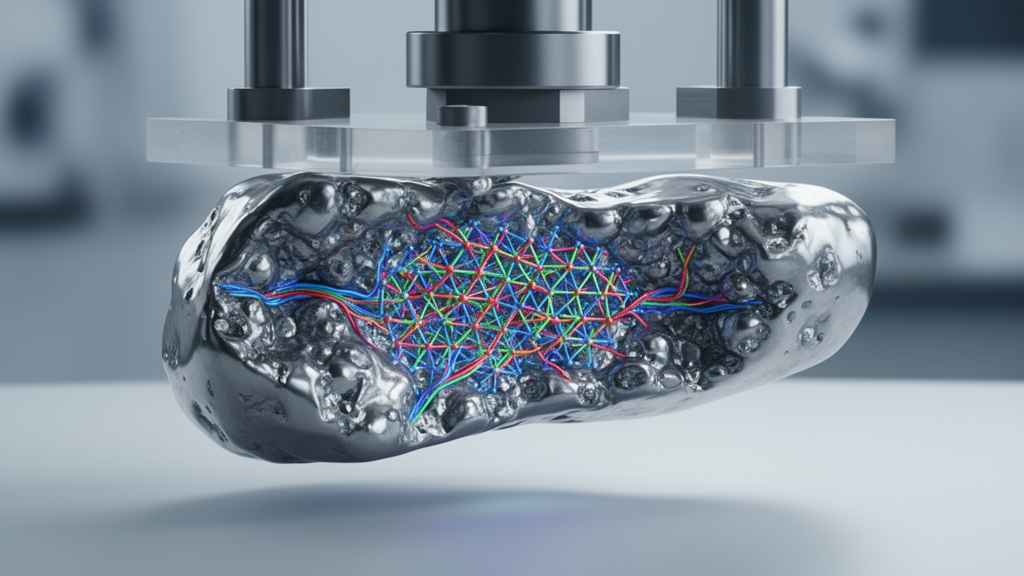
A strain-resolved energy-routing framework proposes that metastability in high-entropy alloys can be understood by tracking where mechanical work goes during deformation. Rather than treating transformation-induced plasticity, twinning-induced plasticity, stacking-fault-mediated deformation, and dislocation interactions as separate mechanisms, the framework unifies them through the partition, storage, and redistribution of energy. The authors present the approach in a 2026 invited viewpoint in the Journal of Materials Science.

High-entropy alloys can combine strength, ductility, and damage tolerance by shifting among deformation pathways as they are loaded. The review argues that the selection of a pathway is only one part of the story: what matters energetically is how much of the imposed work is converted into heat, how much remains stored in the evolving microstructure, and how those stored contributions are transferred from one channel to another. This reframes metastability as a strain-dependent routing problem rather than simply a competition among named deformation mechanisms.

At the center of the proposed framework are unstable fault energies, particularly the unstable twin fault energy and unstable martensite fault energy. The review connects these quantities to the accessibility of competing deformation pathways and, through them, to changes in the alloy’s internal energy-storage channels. Generalized stacking-fault energy theory, in situ diffraction, thermoplasticity, metastability engineering, and deformation-mechanism mapping are used to develop this interpretation. These links are presented as a conceptual and experimentally testable framework, not as a new demonstration of improved alloy performance.

Within the framework, mechanical work is partitioned between heat generation and retained microstructural energy. The retained portion receives effective contributions from dislocations, phase transformation, newly created interfaces, twins, and back-stress development. As deformation proceeds, these contributions evolve rather than remaining fixed. Their redistribution is proposed to sustain strain hardening, postpone Considère instability, and raise the work required to fracture a metastable alloy. In other words, the proposed explanation connects microstructural transformations with both the material’s response to increasing strain and its capacity to absorb tensile energy.

The framework also identifies variables that could be measured to test its predictions: transformed-phase fraction, twin-boundary density, interface density, dislocation density, and temperature evolution. Relating the evolution of these quantities to changes in energy partitioning would allow researchers to examine whether the proposed routes between storage mechanisms operate as expected. The viewpoint therefore offers a quantitative direction for alloy design, linking measurable microstructural states to the thermodynamic accounting of deformation.

Because the article is a review and framework proposal, its central claims do not by themselves establish that a particular high-entropy alloy will deliver greater strength, ductility, or damage tolerance. Its significance lies instead in providing a common energetic language for mechanisms that are often studied separately and for defining explicit connections between those mechanisms and measurable internal variables. The authors describe this approach as a thermodynamic basis for interpreting tensile energy absorption and a pathway toward designing future high-entropy alloys with improved strength–ductility synergy, while the proposed relationships remain subject to experimental testing.

Subject of Research: A strain-resolved framework for energy partitioning and metastability in high-entropy alloys

Article Title: A strain-resolved energy-routing framework for metastability in high-entropy alloys

Article References: Mukherjee, S., & Mishra, R. S. (2026). A strain-resolved energy-routing framework for metastability in high-entropy alloys. Journal of Materials Science. https://doi.org/10.1007/s10853-026-13912-4

Image Credits: AI Generated

DOI: 10.1007/s10853-026-13912-4

Keywords: high-entropy alloys, metastability, energy partitioning, deformation mechanisms, strain hardening, transformation-induced plasticity, twinning, dislocations, damage tolerance, materials thermodynamics, strain-resolved, energy-routing

Cite Scienmag News

Neil Sanderson. (October 21, 2026). Energy routing framework links alloy metastability to deformation pathways. Scienmag. https://scienmag.com/energy-routing-framework-links-alloy-metastability-to-deformation-pathways/

Neil Sanderson. "Energy routing framework links alloy metastability to deformation pathways." Scienmag, 21 October 2026, https://scienmag.com/energy-routing-framework-links-alloy-metastability-to-deformation-pathways/. Accessed 21 October 2026.

Neil Sanderson. "Energy routing framework links alloy metastability to deformation pathways." Scienmag. October 21, 2026. https://scienmag.com/energy-routing-framework-links-alloy-metastability-to-deformation-pathways/


Tags: damage tolerancedeformation mechanismsdislocationsenergy partitioningenergy storage and redistribution in alloysenergy-routingenergy-routing framework in materials sciencehigh entropy alloysHigh-entropy alloy deformation mechanismsin situ diffraction for alloy analysismaterials thermodynamicsmetastabilitymetastability in alloysmicrostructure evolution during deformationstacking-fault-mediated deformationstrain hardeningstrain-dependent deformation pathwaysstrain-resolvedthermoplasticity and alloy microstructuretransformation-induced plasticityTwinningtwinning-induced plasticity in alloysunstable fault energies in deformation
Share26Tweet16
Previous Post

VR physiology laboratory competency questionnaire validated in undergraduate students

Next Post

YOLOv5-LiDAR basketball robot reaches 97.85% detection accuracy in evaluation

Related Posts

YOLOv5-LiDAR basketball robot reaches 97.85% detection accuracy in evaluation
Technology and Engineering

YOLOv5-LiDAR basketball robot reaches 97.85% detection accuracy in evaluation

October 21, 2026
Reinforcement learning curbs drag in turbulent bluff-body wakes
Technology and Engineering

Reinforcement learning curbs drag in turbulent bluff-body wakes

October 21, 2026
Confidence-aware system combines Arabic text and images to flag hateful memes
Technology and Engineering

Confidence-aware system combines Arabic text and images to flag hateful memes

October 21, 2026
Copine-derived peptides advance tissue repair through programmable biomaterials
Science News

Copine-derived peptides advance tissue repair through programmable biomaterials

October 21, 2026
Weather-aware edge AI improves extreme-grid load forecasting
Science News

Weather-aware edge AI improves extreme-grid load forecasting

October 21, 2026
Machine learning predicts severe lung disease risk in extremely preterm infants
Technology and Engineering

Machine learning predicts severe lung disease risk in extremely preterm infants

October 21, 2026
Next Post
YOLOv5-LiDAR basketball robot reaches 97.85% detection accuracy in evaluation

YOLOv5-LiDAR basketball robot reaches 97.85% detection accuracy in evaluation

  • Mothers who receive childcare support from maternal grandparents show more optimized

    Mothers who receive childcare support from maternal grandparents show more parental warmth, finds NTU Singapore study

    27656 shares
    Share 11059 Tweet 6912
  • University of Seville Breaks 120-Year-Old Mystery, Revises a Key Einstein Concept

    1061 shares
    Share 424 Tweet 265
  • Bee body mass, pathogens and local climate influence heat tolerance

    682 shares
    Share 273 Tweet 171
  • Researchers record first-ever images and data of a shark experiencing a boat strike

    546 shares
    Share 218 Tweet 137
  • Groundbreaking Clinical Trial Reveals Lubiprostone Enhances Kidney Function

    531 shares
    Share 212 Tweet 133
Science

Embark on a thrilling journey of discovery with Scienmag.com—your ultimate source for cutting-edge breakthroughs. Immerse yourself in a world where curiosity knows no limits and tomorrow’s possibilities become today’s reality!

RECENT NEWS

  • YOLOv5-LiDAR basketball robot reaches 97.85% detection accuracy in evaluation
  • Energy routing framework links alloy metastability to deformation pathways
  • VR physiology laboratory competency questionnaire validated in undergraduate students
  • HLA variants linked to pediatric neuroblastoma risk and outcomes in review

Categories

  • Agriculture
  • Anthropology
  • Archaeology
  • Athmospheric
  • Biology
  • Biotechnology
  • Blog
  • Bussines
  • Cancer
  • Chemistry
  • Climate
  • Earth Science
  • Editorial Policy
  • Marine
  • Mathematics
  • Medicine
  • Pediatry
  • Policy
  • Psychology & Psychiatry
  • Science Education
  • Science News
  • Social Science
  • Space
  • Technology and Engineering

Subscribe to Blog via Email

Enter your email address to subscribe to this blog and receive notifications of new posts by email.

Join 5,150 other subscribers

© 2025 Scienmag - Science Magazine

Welcome Back!

Login to your account below

Forgotten Password?

Retrieve your password

Please enter your username or email address to reset your password.

Log In
No Result
View All Result
  • HOME
  • SCIENCE NEWS
  • CONTACT US

© 2025 Scienmag - Science Magazine

Discover more from Science

Subscribe now to keep reading and get access to the full archive.

Continue reading