

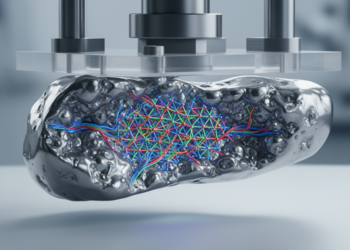
Energy routing framework links alloy metastability to deformation pathways
A review proposes tracking how mechanical work is stored, dissipated, and redistributed to explain metastability and deformation pathways in high-entropy ...
A review proposes tracking how mechanical work is stored, dissipated, and redistributed to explain metastability and deformation pathways in high-entropy ...

A laboratory study found that room-temperature high-pressure torsion strengthened an LPSO-dominated Mg-18Y-8Ni alloy through a combination of kink and dislocation ...
Five hours of aging gave a cold-rolled Fe-based medium-entropy alloy the highest ultimate tensile strength among the investigated cryogenic conditions, ...
Niobium-titanium-based body-centred cubic alloys retain high strength and fracture toughness at 20 kelvin because temperature-insensitive twinning and an omega-phase transformation ...
Molecular dynamics simulations show that a cobalt compositional gradient in CoCrNi medium-entropy alloys suppresses HCP phase transformation, promotes amorphization, intensifies ...
Electron backscatter diffraction reveals that plastic deformation in ordered Ni3Fe both multiplies general grain boundaries and strips special twin boundaries ...
Researchers have shown that copper-aluminum-copper laminates weaken and fracture along their thin intermetallic interface at elevated temperatures, revealing a critical ...
Researchers have shown that blending stiff alkali-resistant glass fibres with ductile polyethylene fibres in a low-clinker magnesia-slag binder produces crack-resistant, ...
A new finite element study shows that strain-hardening ultra-high-performance fiber-reinforced concrete jackets can restore up to 273 percent of the ...
Researchers at the Eastern Institute of Technology, Ningbo, developed a graph-based AI framework called GraphED that autonomously discovers interpretable constitutive ...

Embark on a thrilling journey of discovery with Scienmag.com—your ultimate source for cutting-edge breakthroughs. Immerse yourself in a world where curiosity knows no limits and tomorrow’s possibilities become today’s reality!