


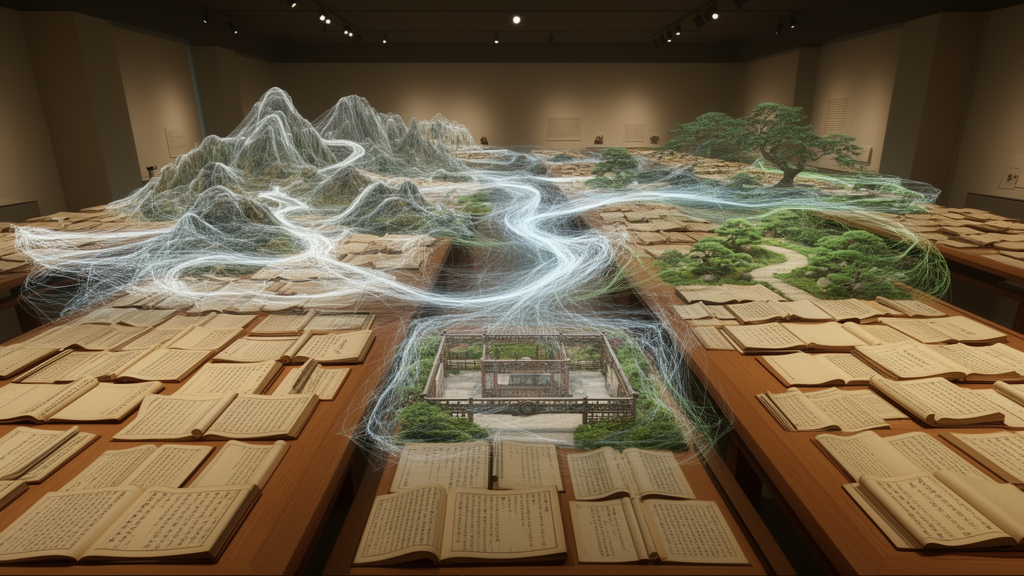
A computational analysis of 371,918 classical Chinese poems has identified five recurring spatial prototypes associated with built forms such as pavilions, terraces, towers, and compound architectural structures. The study assembled an auditable corpus from the Sou-yun poetry collection, identified 259,342 valid references to the Chinese terms tíng , tái , lóu , and gé , together with compound forms, and extracted structured semantic profiles for 247,574 poems. The researchers used a workflow combining deterministic rules, machine learning, and a large language model to group poems by the spatial characteristics associated with these architectural references.
The resulting profiles distinguished five prototype groups. The tíng group emphasized pause and close-range experiences in gardens or waterside settings. The tái profile was associated with elevation, ritual, and commemoration, while the lóu profile emphasized ascent, distant views, and river–urban atmospheres.
The gé group emphasized interior refinement, whereas the separate Compound group was distinguished by multi-trigger scenic assemblages. These aggregate profiles reveal measurable differences in the language used around different built-form families, although they do not imply that every poem containing a particular term described the same experience or function. The study therefore treats references to built space in poetry as a way to investigate how architectural forms were culturally perceived and represented over time, rather than as direct records of building design.
The researchers assessed whether the main prototype assignments depended on the chosen computational workflow through effect-size sensitivity tests, reruns using dated versions of the Qwen model, and cross-model replication with DeepSeek. Two independent experts who were blinded to the prototype assignments also performed coded assessment of the material. According to the reported analyses, these checks supported the retrieval validity of the selected poems and the principal prototype assignments, strengthening the evidence for the five-part classification without establishing a single interpretation for every text.
A site-specific demonstration applied the lóu profile to 1,195 records associated with Yellow Crane Tower. In this demonstration, the corpus-derived themes were translated into traceable themes for museum interpretation and possible digital heritage applications. The result is an interpretive framework connecting a large body of poetry with one named site, not a reconstruction of the tower’s original architecture.
Published as accepted, open-access research in npj Heritage Science , the study combines auditable corpus construction, model-assisted semantic extraction, sensitivity testing, cross-model replication, and blinded expert coding to show that recurring differences survive in the relationships among architectural vocabulary, movement, viewpoint, atmosphere, ritual, interiority, and scenic complexity.
Subject of Research: Computational identification of built-space patterns in classical Chinese poetry
Article Title: Heritage space prototypes in classical Chinese poetry
Article References: Yan, S., Zhang, R., Jia, B., Li, Z., Li, Q., Shen, C., Meng, X., & Pan, X. (2026). Heritage space prototypes in classical Chinese poetry. npj Heritage Science. https://doi.org/10.1038/s40494-026-03018-0
Image Credits: AI Generated
DOI: 10.1038/s40494-026-03018-0
Keywords: classical Chinese poetry, heritage science, spatial prototypes, large language models, text mining, built space, pavilions, towers, Yellow Crane Tower, digital heritage, Heritage, space
Cite Scienmag News
Courtney Benton. (October 21, 2026). AI analysis identifies five spatial traditions in 371,918 classical Chinese poems. Scienmag. https://scienmag.com/ai-analysis-identifies-five-spatial-traditions-in-371918-classical-chinese-poems/
Courtney Benton. "AI analysis identifies five spatial traditions in 371,918 classical Chinese poems." Scienmag, 21 October 2026, https://scienmag.com/ai-analysis-identifies-five-spatial-traditions-in-371918-classical-chinese-poems/. Accessed 21 October 2026.
Courtney Benton. "AI analysis identifies five spatial traditions in 371,918 classical Chinese poems." Scienmag. October 21, 2026. https://scienmag.com/ai-analysis-identifies-five-spatial-traditions-in-371918-classical-chinese-poems/


