


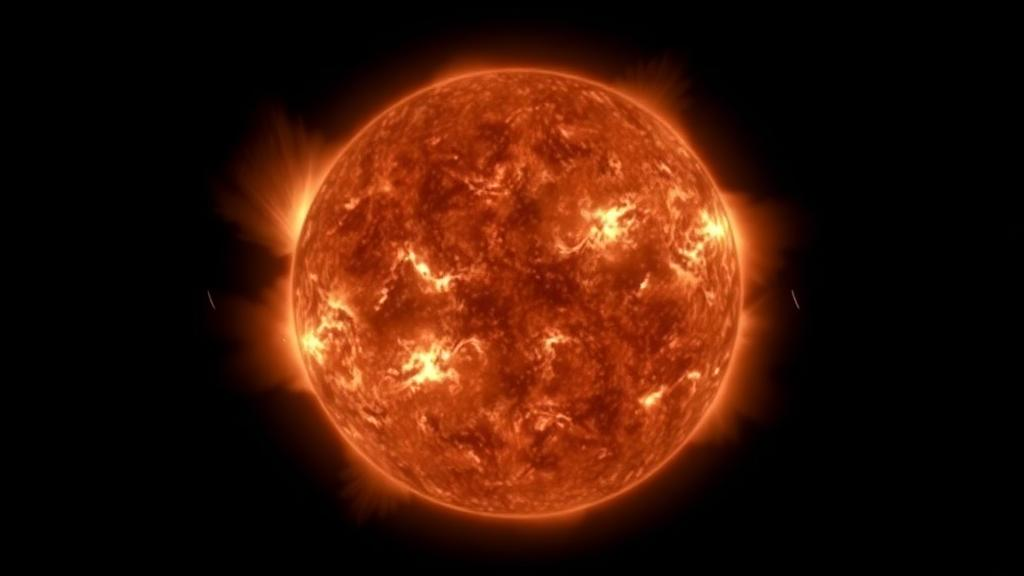
A multi-observable analysis of the X9.0-class solar flare in NOAA Active Region 13842 on 3 October 2024 found a coherent white-light brightening accompanied by coordinated transient responses in magnetic-field and velocity measurements derived from the same solar spectral line. The study, based on observations from the Solar Dynamics Observatory’s Helioseismic and Magnetic Imager, reported a mean brightening contrast of 2.5% within the white-light flare region and a peak pixel-wise contrast of 49.9%. The paper describes the event as the largest flare of Solar Cycle 25 to date, while limiting its conclusions to the observations and analysis of this particular active region and event.
The researchers used three complementary HMI data products derived from the Fe I 6173 Å spectral line: corrected continuum intensity, a line-of-sight magnetogram and a line-of-sight Dopplergram. The corrected continuum supplied the white-light signature, while the other two products allowed the team to examine whether transient magnetic and velocity signals occurred in the same area and at the same time. To separate flare-induced brightening from secular morphological changes in the tracked image stacks, the authors developed a per-pixel transient-detection metric and applied it to those sequences of observations.
The continuum analysis identified two ribbon-like brightening kernels with a combined area of 164 Mm², equivalent to 1.64 × 10¹⁴ m². At the same location, the magnetogram and Dopplergram showed transient excursions of approximately 17 G in absolute magnetic-field signal and 136 m s⁻¹ in absolute velocity signal. The authors interpret those two excursions as artifacts of flare-induced distortion of the Fe I 6173 Å spectral line rather than physical changes in the photospheric plasma. Their analysis therefore supports coordinated transient signatures across the three observables without treating the magnetogram and Dopplergram excursions as direct evidence of altered photospheric magnetism or plasma motion.
Spatial and temporal comparisons further connected the three transient footprints. Their Dice coefficients ranged from 0.34 to 0.44, compared with a random expectation of 0.10. The centroid separations were 1.4–1.6 Mm, amounts the researchers describe as a few percent of the footprint extent. The ordering of the signatures could be resolved at HMI’s 45-second cadence. The paper presents this overlap, small centroid separation and temporal synchronization as a strong multi-observable confirmation of the white-light flare. The available evidence also highlights a central limitation: because all three data products originate from the same spectral line, apparently simultaneous changes in intensity, magnetogram signal and Dopplergram signal can reflect shared instrumental or spectral effects and require careful interpretation.
Subject of Research: Multi-observable analysis of the X9.0 white-light flare in NOAA Active Region 13842
Article Title: White-light flare in AR 13842: a multi-observable analysis of the 2024 October 3 X9.0 event
Article References: Naufal, L., Herdiwijaya, D., & Irwanto, D. (2026). White-light flare in AR 13842: a multi-observable analysis of the 2024 October 3 X9.0 event. Astrophysics and Space Science, 371(10), Article 124. https://doi.org/10.1007/s10509-026-04649-2
Image Credits: AI Generated
DOI: 10.1007/s10509-026-04649-2
Keywords: X9.0 solar flare, NOAA Active Region 13842, white-light flare, Solar Cycle 25, Solar Dynamics Observatory, Helioseismic and Magnetic Imager, Fe I 6173 Å, solar magnetism, Dopplergram, spectral-line distortion, White-light, flare
Cite Scienmag News
Grant Pearson. (October 21, 2026). SDO Analysis Confirms Coordinated Signatures of an X9.0 Solar Flare. Scienmag. https://scienmag.com/sdo-analysis-confirms-coordinated-signatures-of-an-x9-0-solar-flare/
Grant Pearson. "SDO Analysis Confirms Coordinated Signatures of an X9.0 Solar Flare." Scienmag, 21 October 2026, https://scienmag.com/sdo-analysis-confirms-coordinated-signatures-of-an-x9-0-solar-flare/. Accessed 21 October 2026.
Grant Pearson. "SDO Analysis Confirms Coordinated Signatures of an X9.0 Solar Flare." Scienmag. October 21, 2026. https://scienmag.com/sdo-analysis-confirms-coordinated-signatures-of-an-x9-0-solar-flare/


