


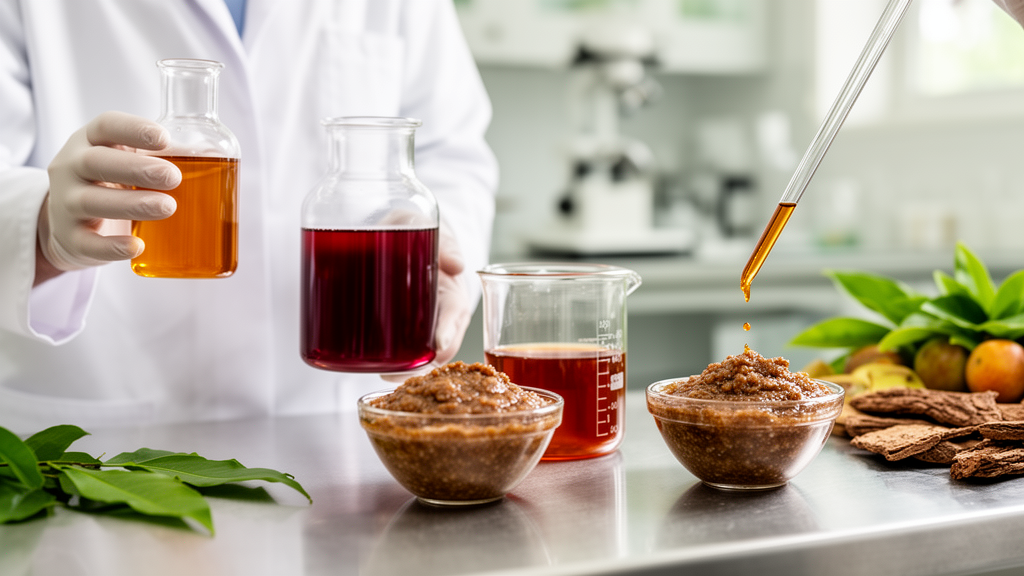
The study examined dried cacay leaves, the solid residue left after extracting cacay oil, moriche mesocarp and endocarp flours, cacay oil, and copaiba oleoresin collected in the region. It measured total phenolics and flavonoids, assessed antioxidant capacity with the ABTS and FRAP assays, tested the pasting behavior of selected flours, and used principal component analysis to compare the samples. Cacay flour showed the clearest thickening and gelation potential, while moriche fractions displayed the strongest antioxidant responses despite having little useful viscosity in their native form.
The research was designed as a laboratory assessment of plant materials with potential value for agro-food, cosmetic, and pharmaceutical applications. The researchers did not test the materials in people, and their results do not establish clinical benefits. Instead, they characterized chemical composition and two practical properties: the capacity of phenolic and flavonoid compounds to respond to antioxidant assays, and the way flour suspensions behave when heated and cooled.
The distinction matters because a material can be rich in measurable plant compounds without being well suited to a particular industrial formulation. The study therefore combined compositional measurements with viscoamylography rather than treating a single chemical value as a complete measure of usefulness. Cacay press-cake flour produced the most distinct pasting profile among the three flours tested experimentally.
Its peak viscosity was 98 Brabender units, compared with 400–600 units for the wheat-flour reference range reported in the study, and its final viscosity reached 184 units. The flour began to gelatinize at approximately 82.3 °C and showed a setback of 116 units, an increase in viscosity during cooling that indicates a tendency to retrograde. The authors interpreted this profile as moderate rather than high thickening power, but potentially suitable for products requiring smooth texture, cooling stability, and shape retention, including some gels and baked goods.
The comparison did not make cacay a replacement for wheat: its peak viscosity remained below the reference range and below values reported for quinoa and oca in the discussion. The two moriche fractions behaved very differently from the wheat reference and from cacay. Flour made from the orange mesocarp registered a peak viscosity of 4 Brabender units, a final viscosity of 0, and a pasting temperature of about 33.2 °C. Flour from the white, parchment-like endocarp recorded a peak viscosity of 0, final viscosity of 1, and pasting temperature of approximately 30.4 °C. Neither material developed a meaningful viscosity peak or gel during the thermal cycle, and both had zero setback.
The researchers said the findings indicated that these fractions do not function as native starch-based thickeners or gelling agents. The absence of direct starch-composition and structural analyses means the biological or processing cause cannot yet be assigned with certainty; possible explanations include low starch content, degraded starch, or disruption of molecular order during processing and drying. Chemical measurements showed that moriche could nevertheless be valuable for a different reason.
The orange mesocarp flour contained 14.69 ± 0.72 micromoles of gallic acid equivalents per gram for total phenolics, while the white endocarp flour contained 12.25 ± 0.41 micromoles per gram. Their ABTS antioxidant capacities were 19.05 ± 1.65 and 17.45 ± 1.76 micromoles of Trolox equivalents per gram, respectively. FRAP values were similarly high at 18.35 ± 2.59 micromoles per gram for the orange fraction and 20.47 ± 1.59 micromoles per gram for the white fraction.
These results were obtained from three independent replicates and are reported on a dry-weight basis. The study identifies the moriche fractions as promising sources of bioactive compounds for further formulation or extraction research, but it does not show that the measured antioxidant activity produces a health effect in humans. Cacay leaves had the highest total phenolic content in the study, at 28.87 ± 2.90 micromoles of gallic acid equivalents per gram.
Their flavonoid concentration was 3.66 ± 0.76 micromoles of catechin equivalents per gram, while ABTS and FRAP values were 14.81 ± 1.99 and 16.14 ± 1.93 micromoles of Trolox equivalents per gram. The relationship between total phenolics and antioxidant response was not universal, however. Press-cake flour contained 8.96 ± 1.46 micromoles of gallic acid equivalents per gram and 1.03 ± 0.17 micromoles of catechin equivalents per gram, yet its ABTS value was only 0.67 ± 0.10 micromoles of Trolox equivalents per gram.
Its FRAP value was 2.85 ± 0.22 micromoles per gram. The authors noted that Folin–Ciocalteu measurements can include phenolics bound to cell-wall material, whereas ABTS and FRAP measure particular radical-scavenging or electron-transfer responses that may differ depending on extraction and chemical structure. Total flavonoid concentrations were low across the analyzed plant matrices, ranging from 1.03 ± 0.17 to 4.37 ± 0.40 micromoles of catechin equivalents per gram.
The orange moriche mesocarp had the highest value in that range, while the white moriche fraction was close behind. The authors interpreted the lower flavonoid values relative to total phenolics as evidence that phenolic acids, rather than flavonoids, dominated the measured profile. The press-cake flour also contained 34.8% protein, 12.5% lipid, and 20.1% dietary fiber, according to the study, indicating that its broader value may lie in nutritional and formulation attributes rather than antioxidant capacity.
Those macronutrient values were compositional findings and did not establish biological efficacy or suitability as a complete nutritional substitute for other ingredients. Among the two lipid-rich matrices, copaiba oleoresin had higher total phenolic content and antioxidant capacity than cacay oil in the reported comparisons. Copaiba oleoresin contained 3.11 ± 0.15 micromoles of gallic acid equivalents per liter of total phenolics, compared with 1.47 ± 0.67 micromoles per liter for cacay oil.
Its total flavonoid concentration was 1.35 ± 0.86 micromoles of catechin equivalents per liter, slightly above the 1.09 ± 0.06 micromoles per liter in cacay oil, although the difference was not significant under the study’s analysis. ABTS values were 0.76 ± 0.08 versus 0.39 ± 0.02 micromoles of Trolox equivalents per liter, and FRAP values were 6.45 ± 0.66 versus 4.81 ± 0.09 micromoles per liter. The researchers attributed the higher phenolics and antioxidant readings to the oleoresin’s more concentrated polar and resinous fraction, while also noting that FRAP and ABTS rely on different assay mechanisms and stoichiometries.
Principal component analysis summarized the contrast among the three flour matrices. The first component accounted for 97.1% of the total variation. Cacay press-cake flour occupied the negative side of that component and was associated with peak, final, and setback viscosity, reflecting its measurable thickening and structural behavior.
The moriche orange and white flours clustered near the vectors for total phenolics, flavonoids, ABTS, and FRAP, reflecting their stronger assay-based antioxidant responses. The authors described this separation as an inverse relationship between technological functionality and antioxidant composition in this set of samples. That relationship should not be generalized beyond the materials tested: the PCA included only the three flour matrices, and the authors cautioned that its interpretation was therefore not broadly generalizable.
Cacay press-cake flour appears more relevant to technological formulation because it develops moderate viscosity and measurable setback during cooling, although its antioxidant activity is low and its performance remains below the wheat reference. The moriche fractions show negligible native thickening behavior but comparatively high ABTS and FRAP responses, positioning them more naturally as candidates for bioactive-compound extraction or further formulation work. Copaiba oleoresin offers a third profile, combining higher lipid-matrix values for phenolics and antioxidant capacity with a slightly higher flavonoid concentration than cacay oil.
The study’s principal limitation is its narrow mechanical characterization: without starch quantification or microstructural analysis, the reasons for the moriche flours’ lack of viscosity remain unresolved. The results provide a laboratory foundation for further work, not proof of commercial performance, safety, clinical benefit, or readiness for any specific food, cosmetic, or pharmaceutical product.
Subject of Research: Bioactive compounds and viscoamylographic properties of Colombian Orinoquia non-timber forest products
Article Title: Research studies on the bioactive compound profile of non-timber products from the Colombian Orinoquia region
Article References: Peñarrieta, J. M., Miranda-Flores, D., Zambrano-Moreno, E. L., Nieto-Calvache, J. E., & Alonso-Gómez, L. A. (2026). Research studies on the bioactive compound profile of non-timber products from the Colombian Orinoquia region. Frontiers in Nutrition, 13, Article 1971878. https://doi.org/10.3389/fnut.2026.1971878
Image Credits: AI Generated
DOI: 10.3389/fnut.2026.1971878
Keywords: Orinoquia, non-timber forest products, cacay, moriche, copaiba, phenolic compounds, antioxidant capacity, viscoamylography, flour functionality, bioeconomy, Research, studies
Cite Scienmag News
Alan Morgan. (October 21, 2026). Orinoquia forest products reveal contrasting antioxidant and thickening potential. Scienmag. https://scienmag.com/orinoquia-forest-products-reveal-contrasting-antioxidant-and-thickening-potential/
Alan Morgan. "Orinoquia forest products reveal contrasting antioxidant and thickening potential." Scienmag, 21 October 2026, https://scienmag.com/orinoquia-forest-products-reveal-contrasting-antioxidant-and-thickening-potential/. Accessed 21 October 2026.
Alan Morgan. "Orinoquia forest products reveal contrasting antioxidant and thickening potential." Scienmag. October 21, 2026. https://scienmag.com/orinoquia-forest-products-reveal-contrasting-antioxidant-and-thickening-potential/


