


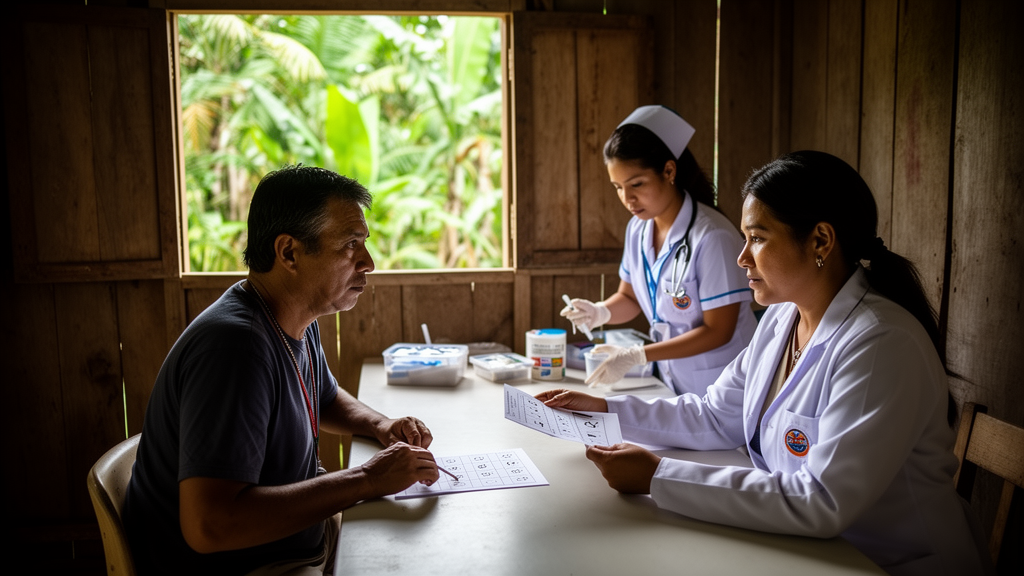
Neurocognitive impairment was identified in 48 of 71 adults living with HIV in a socially vulnerable cohort in Manaus, Brazil, according to a descriptive cross-sectional study with prospective recruitment. The participants were receiving antiretroviral therapy and had achieved viral suppression. Under the study’s operational algorithm, the screening-based prevalence of neurocognitive impairment was 67.6%.
Among participants classified as impaired, those whose impairment also affected instrumental activities of daily living had less favorable socioeconomic profiles and lower CD4+ T-cell counts than those classified with asymptomatic impairment. Because the findings came from brief cognitive and functional assessments at one clinic, they do not constitute a population-wide prevalence estimate or formal diagnoses of HIV-associated neurocognitive disorders. The researchers enrolled 72 people living with HIV at the Tropical Medicine Foundation Dr. Heitor Vieira Dourado between January 2023 and December 2024, and 71 completed the study assessments.
The median age was 51 years, with an interquartile range of 44.75 to 61.25 years. Sociodemographic and clinical information was collected through questionnaires, while brief cognitive testing comprised the International HIV Dementia Scale, the Mini-Mental State Examination and the Montreal Cognitive Assessment. The Lawton Instrumental Activities of Daily Living scale assessed functional performance.
Participants with impaired performance on at least one cognitive instrument but preserved instrumental daily living were classified as having asymptomatic neurocognitive impairment. Those with both impaired cognitive performance and reduced instrumental activity were classified as having impairment with functional impact. Anxiety and depressive symptoms were assessed with the Hospital Anxiety and Depression Scale but were not used to assign the impairment categories.
Neurocognitive impairment was more common among participants with lower income, lower educational attainment, systemic arterial hypertension and affective symptoms. Within the group classified as impaired, functional impact was associated with less favorable socioeconomic circumstances and lower CD4+ T-cell counts. Immune recovery was evaluated using current and historical CD4+ T-cell counts obtained from participants’ medical records.
These are observational associations in a relatively small, clinic-based sample, not evidence that poverty, lower education, hypertension, affective symptoms or immune status caused the impairment. The cross-sectional design also could not determine whether cognitive problems preceded enrollment, developed during treatment or reflected HIV-specific processes. The authors noted that the operational categories were based on screening and functional performance rather than a formal diagnostic assessment for HIV-associated neurocognitive disorders, or HAND.
The study examined a setting in which several documented features of the cohort could coincide: social and economic vulnerability, viral suppression through antiretroviral therapy, existing medical conditions and differences in immune recovery. The investigators did not test an intervention, and the study did not demonstrate that any particular care strategy prevented or reversed cognitive decline. Their conclusion was instead that integrated approaches addressing factors such as earlier HIV diagnosis, sustained antiretroviral therapy, social vulnerability, vascular risk factors, mental-health symptoms and functional decline may be important for this population.
That conclusion is consistent with the reported associations, although establishing which factors are causal would require evidence beyond the cross-sectional analysis. For people living with HIV, the results indicate that neurocognitive problems may remain relevant even when treatment has suppressed viral replication. The finding is also important for interpreting the measurements themselves: three brief cognitive instruments and a functional scale were used to create operational categories, and 67.6% should therefore be understood as the proportion classified as impaired within this treated cohort, not as a measurement of clinically confirmed HAND.
Anxiety and depressive symptoms, hypertension, socioeconomic conditions and CD4+ counts appeared alongside impairment in the analysis, but the supplied study cannot determine how much each factor contributed to the observed pattern. The clearest result is thus a high frequency of screening-defined impairment in the participants studied, together with an association between more extensive functional impairment, poorer socioeconomic circumstances and lower CD4+ T-cell counts.
Subject of Research: Screening-defined neurocognitive impairment among socially vulnerable adults living with HIV in Manaus
Article Title: Prevalence and risk factors of HIV-associated neurocognitive impairment in a vulnerable amazonian population: the impact of socioeconomic status and immune recovery
Article References: da Silva, C. R., Takatani, M., Queiroz, K. L. G. D., de Souza Colares, R., Chirano, L. A. R., Pereira, F. R., Pinheiro, R. D. S., Xavier, T. D. S., Guimarães, A. C., dos Santos, E. V. V., Matos, J. V. P., Barrionuevo, M. D. S. B., de Melo, M. M., de Souza, J. M., dos Reis, M. F., de Lima Ferreira, L. C., Chaves, Y. O., & Nogueira, P. A. (2026). Prevalence and risk factors of HIV-associated neurocognitive impairment in a vulnerable amazonian population: the impact of socioeconomic status and immune recovery. BMC Infectious Diseases. https://doi.org/10.1186/s12879-026-14331-1
Image Credits: AI Generated
DOI: 10.1186/s12879-026-14331-1
Keywords: HIV, neurocognitive impairment, antiretroviral therapy, viral suppression, CD4 T cells, cognitive screening, socioeconomic status, Manaus, Amazonian population, cross-sectional study, Prevalence, risk
Cite Scienmag News
Ophelia Keating. (October 21, 2026). Screening-defined neurocognitive impairment frequent in vulnerable Amazonian HIV cohort. Scienmag. https://scienmag.com/screening-defined-neurocognitive-impairment-frequent-in-vulnerable-amazonian-hiv-cohort/
Ophelia Keating. "Screening-defined neurocognitive impairment frequent in vulnerable Amazonian HIV cohort." Scienmag, 21 October 2026, https://scienmag.com/screening-defined-neurocognitive-impairment-frequent-in-vulnerable-amazonian-hiv-cohort/. Accessed 21 October 2026.
Ophelia Keating. "Screening-defined neurocognitive impairment frequent in vulnerable Amazonian HIV cohort." Scienmag. October 21, 2026. https://scienmag.com/screening-defined-neurocognitive-impairment-frequent-in-vulnerable-amazonian-hiv-cohort/


