

Wednesday, October 21, 2026
Science
No Result
View All Result
  • Login
  • HOME
  • SCIENCE NEWS
  • CONTACT US
  • HOME
  • SCIENCE NEWS
  • CONTACT US
No Result
View All Result
Scienmag
No Result
View All Result
Home Science News Earth Science

Integrating satellite observations for annual rainfall frequency analysis in Kalar district

October 21, 2026
in Earth Science
Violet Maxwell
By Violet Maxwell Scienmag Editorial Profile - Natural Hazards
Reading Time: 3 mins read
0
Integrating satellite observations for annual rainfall frequency analysis in Kalar district

Integrating satellite observations for annual rainfall frequency analysis in Kalar district

65
SHARES
587
VIEWS
Share on FacebookShare on Twitter
ADVERTISEMENT

A case study in Kalar district, in the Kurdistan Region of Iraq, found that satellite-based precipitation estimates could augment an incomplete ground-station record and support statistical analysis of extreme annual rainfall. Researchers analyzed daily rainfall data from 1990 through 2023, a 34-year period representing Kalar’s transitional semi-arid climate. Missing values accounted for 4.7% of the historical record overall and 12.3% during 1990–1999, the particularly data-scarce decade.

To address those gaps, the study combined the historical observations with precipitation products from NASA’s POWER satellite dataset. The researchers first evaluated the augmentation method against the available ground records. The comparison produced a strong relationship, with an R² of 0.9454 and a regression slope of 0.951.

These results indicate that the satellite-based values closely reproduced the measured rainfall record wherever direct comparisons could be made. The study then used the combined series to construct annual total rainfall aggregates for extreme-value analysis. To estimate rainfall return periods, the researchers fitted both Gumbel and Generalized Extreme Value, or GEV, distributions to the annual totals.

Kolmogorov–Smirnov and Anderson–Darling statistical tests favored the GEV model. Its Anderson–Darling value was 0.354, compared with 0.381 for Gumbel. The authors associated the superior fit with the GEV distribution’s ability to capture the heavy-tailed behavior of the region’s erratic precipitation.

These are model comparisons based on the Kalar record; the reported results do not establish that the same distribution will provide the best fit for other districts or climatic settings. The GEV model estimated a 100-year return-period annual rainfall total of 778.6 mm for Kalar, with a 95% confidence interval extending from 690.0 mm to 895.0 mm. This is a statistical estimate of an unusually wet annual rainfall total, not a direct observation of an event that has already occurred.

The analysis also revealed a widening disparity between extremely wet and dry years. The authors described this pattern as consistent with broader climate-change projections for the Eastern Mediterranean, but the case study alone does not quantify how much of Kalar’s historical variability is attributable to climate change or determine how future rainfall totals will evolve. The study’s scope is explicitly local: it covers Kalar district in the Garmian region, and the authors note that the results remain specific to the area’s local topography.

The work demonstrates a validated framework for combining NASA/POWER precipitation estimates with incomplete station records and then applying extreme-value models to annual rainfall. The findings may inform water-resource management, reservoir design, and drought-resilience planning in similar data-scarce environments, but the reported estimates should not be treated as continent-wide values or automatically transferred to regions with different rainfall regimes and physical settings.

Subject of Research: Satellite-assisted extreme-rainfall analysis in Kalar district, Kurdistan Region

Article Title: Integrating satellite observations for annual rainfall frequency analysis in data-scarce semi-arid regions: a case study of Kalar district, Kurdistan Region

Article References: Hussein, S. S., & Abdulla, F. R. (2026). Integrating satellite observations for annual rainfall frequency analysis in data-scarce semi-arid regions: a case study of Kalar district, Kurdistan Region. Theoretical and Applied Climatology, 157(11), Article 734. https://doi.org/10.1007/s00704-026-06665-2

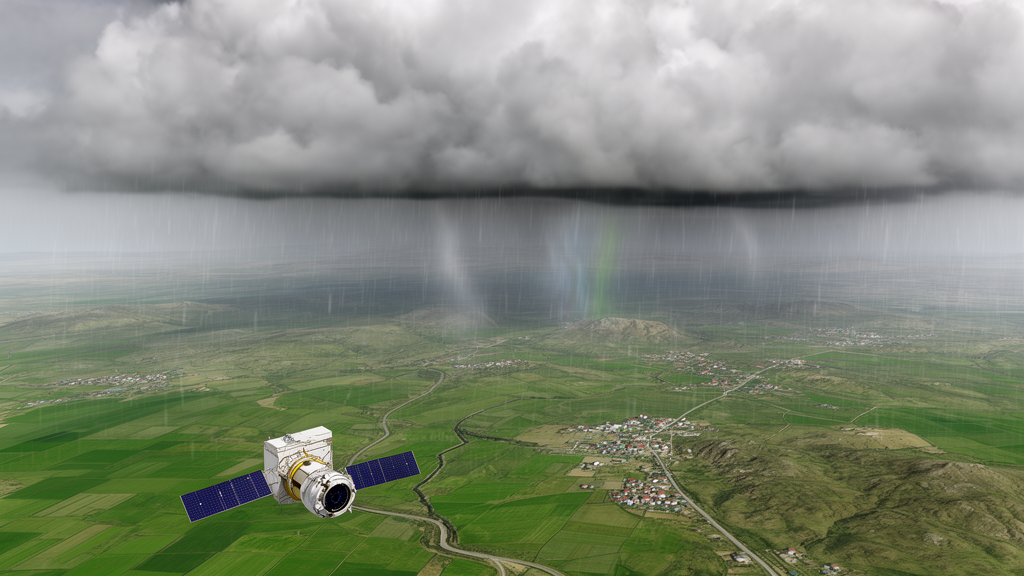
Image Credits: AI Generated

DOI: 10.1007/s00704-026-06665-2

Keywords: rainfall extremes, satellite precipitation, NASA POWER, Kalar district, Kurdistan Region, semi-arid climate, extreme-value modeling, GEV distribution, water-resource planning, Garmian region, Integrating, satellite

Cite Scienmag News

Violet Maxwell. (October 21, 2026). Integrating satellite observations for annual rainfall frequency analysis in Kalar district. Scienmag. https://scienmag.com/integrating-satellite-observations-for-annual-rainfall-frequency-analysis-in-kalar-district/


Violet Maxwell. "Integrating satellite observations for annual rainfall frequency analysis in Kalar district." Scienmag, 21 October 2026, https://scienmag.com/integrating-satellite-observations-for-annual-rainfall-frequency-analysis-in-kalar-district/. Accessed 21 October 2026.

Violet Maxwell. "Integrating satellite observations for annual rainfall frequency analysis in Kalar district." Scienmag. October 21, 2026. https://scienmag.com/integrating-satellite-observations-for-annual-rainfall-frequency-analysis-in-kalar-district/

Tags: annual rainfall frequencyextreme value statistical analysisextreme-value modelingGarmian regionGEV distributionground station rainfall dataGumbel and GEV distribution modelingheavy-tailed rainfall distributionintegratingKalar districtKalar district climate analysisKurdistan RegionNASA POWERNASA POWER satellite datasetrainfall data gap filling methodsrainfall extremesrainfall return period estimationSatellitesatellite precipitationsatellite precipitation estimatessatellite-ground data validationsemi-arid climatesemi-arid climate rainfall trendswater resource planning
Share26Tweet16
Previous Post

Screening-defined neurocognitive impairment frequent in vulnerable Amazonian HIV cohort

Next Post

Kerala rainfall erosivity declined across most grid cells from 1901–2020

Related Posts

Kerala rainfall erosivity declined across most grid cells from 1901–2020
Earth Science

Kerala rainfall erosivity declined across most grid cells from 1901–2020

October 21, 2026
Ecological coastal park restoration sharply cuts carbon and resource use
Earth Science

Ecological coastal park restoration sharply cuts carbon and resource use

October 21, 2026
Sharing economy research shifts toward environmental sustainability
Earth Science

Sharing economy research shifts toward environmental sustainability

October 21, 2026
Lake Sediments Link 4,500-Year Fire History to Moisture Variability
Earth Science

Lake Sediments Link 4,500-Year Fire History to Moisture Variability

October 21, 2026
Weekly 1-km satellite dataset maps two macroalgal blooms in China’s marginal seas
Earth Science

Weekly 1-km satellite dataset maps two macroalgal blooms in China’s marginal seas

October 21, 2026
Controlled study links moisture to freeze-thaw pore changes in saline soils
Earth Science

Controlled study links moisture to freeze-thaw pore changes in saline soils

October 21, 2026
Next Post
Kerala rainfall erosivity declined across most grid cells from 1901–2020

Kerala rainfall erosivity declined across most grid cells from 1901–2020

  • Mothers who receive childcare support from maternal grandparents show more optimized

    Mothers who receive childcare support from maternal grandparents show more parental warmth, finds NTU Singapore study

    27656 shares
    Share 11059 Tweet 6912
  • University of Seville Breaks 120-Year-Old Mystery, Revises a Key Einstein Concept

    1061 shares
    Share 424 Tweet 265
  • Bee body mass, pathogens and local climate influence heat tolerance

    682 shares
    Share 273 Tweet 171
  • Researchers record first-ever images and data of a shark experiencing a boat strike

    546 shares
    Share 218 Tweet 137
  • Groundbreaking Clinical Trial Reveals Lubiprostone Enhances Kidney Function

    531 shares
    Share 212 Tweet 133
Science

Embark on a thrilling journey of discovery with Scienmag.com—your ultimate source for cutting-edge breakthroughs. Immerse yourself in a world where curiosity knows no limits and tomorrow’s possibilities become today’s reality!

RECENT NEWS

  • Preclinical study finds PTPN12 restrains colorectal cancer immunity
  • Kerala rainfall erosivity declined across most grid cells from 1901–2020
  • Integrating satellite observations for annual rainfall frequency analysis in Kalar district
  • Screening-defined neurocognitive impairment frequent in vulnerable Amazonian HIV cohort

Categories

  • Agriculture
  • Anthropology
  • Archaeology
  • Athmospheric
  • Biology
  • Biotechnology
  • Blog
  • Bussines
  • Cancer
  • Chemistry
  • Climate
  • Earth Science
  • Editorial Policy
  • Marine
  • Mathematics
  • Medicine
  • Pediatry
  • Policy
  • Psychology & Psychiatry
  • Science Education
  • Science News
  • Social Science
  • Space
  • Technology and Engineering

Subscribe to Blog via Email

Enter your email address to subscribe to this blog and receive notifications of new posts by email.

Join 5,150 other subscribers

© 2025 Scienmag - Science Magazine

Welcome Back!

Login to your account below

Forgotten Password?

Retrieve your password

Please enter your username or email address to reset your password.

Log In
No Result
View All Result
  • HOME
  • SCIENCE NEWS
  • CONTACT US

© 2025 Scienmag - Science Magazine

Discover more from Science

Subscribe now to keep reading and get access to the full archive.

Continue reading