


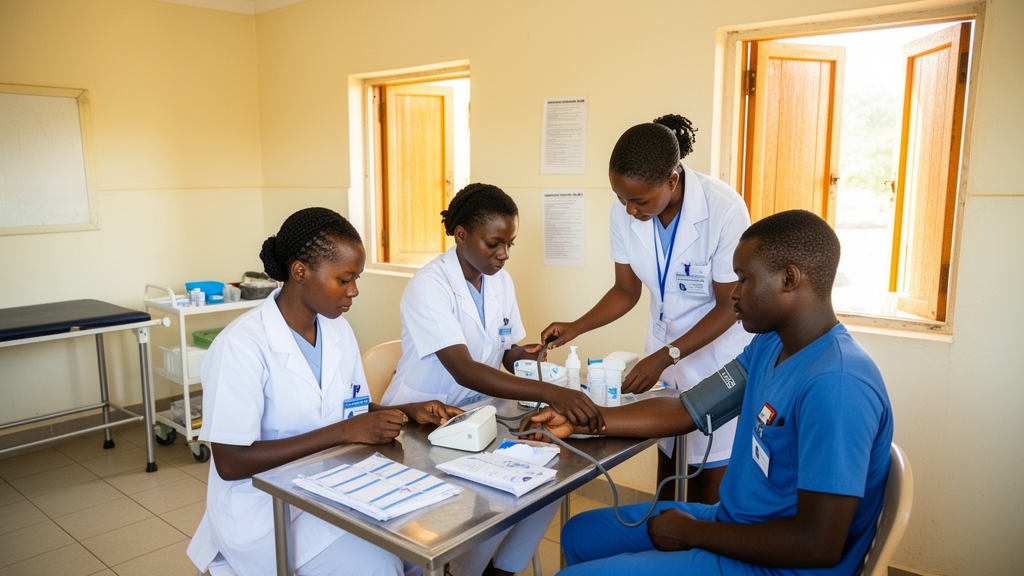
A mixed-methods, cross-sectional study in four Zambian districts found that 42% of 859 primary health care trainees, interns, volunteers and early-career workers met the study’s definition of employment readiness. Readiness increased with age, higher educational attainment and participation in work-based roles, while no significant association was detected with sex or rural, peri-urban or urban residence. Volunteers and early-career workers had the highest adjusted odds of reporting readiness, followed by interns, suggesting that exposure to structured work settings was more strongly associated with perceived employability than basic demographic categories.
The study was a secondary analysis of data collected for the Africa Health Collaborative in Lusaka, Kafue, Kitwe and Ndola. It combined a digital questionnaire completed by 859 people with 64 key-informant interviews and five focus group discussions involving educators, employers, regulators, professional associations and health workers. Participants came from nine tertiary training institutions and four health facilities offering internships or early-career placements. Programmes represented medicine, nursing, public health, environmental health, pharmacy, clinical medicine, physiotherapy, midwifery and related primary health care disciplines.
Employment readiness was operationalised narrowly but transparently: respondents had to report that they felt prepared for the labour market and say that they had prepared a curriculum vitae. On that basis, 357 participants were classified as employment-ready and 502 were not. Readiness was reported by 27% of respondents aged 18–24, 53% of those aged 25–29, 75% of those aged 30–34 and 66% of respondents aged 35 or older. The descriptive pattern persisted in multivariable logistic regression, with adjusted odds ratios of 2.05 for ages 25–29, 4.31 for ages 30–34 and 3.28 for ages 35 or older, each compared with the youngest group.
Education and career status were also strongly associated with readiness. Respondents with undergraduate education or higher had nearly three times the odds of readiness compared with diploma holders, with an adjusted odds ratio of 2.91 and a 95% confidence interval of 1.89–4.48. Volunteers and early-career professionals had 17.55 times the odds of readiness compared with students, with a 95% confidence interval of 8.56–36.00, while interns had 2.97 times the odds, with a 95% confidence interval of 1.39–6.38. These are associations from a cross-sectional model and do not establish that internships or volunteering caused later employment or objectively improved competence.
District differences were observed, although the analysis cannot explain their causes. Compared with Kitwe, participants in Kafue had 3.22 times the adjusted odds of reporting readiness and those in Lusaka had 2.49 times the odds. The estimate for Ndola was also elevated, at 2.11, but did not meet the study’s threshold for statistical significance. The model reported a pseudo-R-squared of 0.2019, and a Hosmer–Lemeshow test did not indicate poor calibration, with a p-value of 0.9191. The survey also found that blended-learning participants were more likely to report readiness than those receiving exclusively in-person instruction, although only three respondents attended purely online programmes, making that category too small for a robust comparison.
Competency results exposed a gap between what participants knew and how confident they felt about applying their skills. Most respondents described themselves as very knowledgeable about their general training area, but their mean confidence across six technical domains was only 2.21 on a four-point scale. Communication scored highest at 2.42, followed by critical thinking at 2.26. Networking was lowest at 2.08, while technical skills scored 2.15 and leadership 2.19. The six-item scale had acceptable internal consistency, with Cronbach’s alpha of 0.78. These measures were self-reported, but interviews helped identify concerns that some training placed too much emphasis on theory and provided too little supervised practice with real patients.
Interviews and focus groups pointed to uneven training quality, weak regulation and insufficient clinical exposure as important barriers. Participants described concerns about training institutions prioritising enrolment and graduation over practical competence, alongside inadequate infrastructure and variable supervision. Some trainees reported short or poorly organised attachments and differences between classroom teaching and real workplace settings. Respondents also described anxiety about performing procedures, handling patients and entering an unfamiliar professional environment. These findings concern the sampled institutions and districts and cannot be assumed to describe every Zambian training programme or placement.
Employment was only one stage of the pathway examined: retention depended heavily on working conditions. Key informants cited staff shortages, heavy workloads, dilapidated facilities, limited equipment, low remuneration and a lack of incentives for difficult locations. Contract instability, including delays in absorbing volunteers and uncertainty over continued funding, added to the problem. Limited study leave, sponsorship and career progression restricted further education, while inadequate recognition and mentorship reduced morale. Participants described poor conditions and growth prospects as contributing to migration from public services; non-governmental organisations were viewed as offering more attractive support, including education opportunities and stronger work-life arrangements.
The study also found interest in employment beyond conventional clinical posts. Respondents most often preferred hospital facilities, selected by 80.7%, followed by non-governmental organisations at 66.5%, community settings at 40.5% and overseas work at 30.5%. They also identified opportunities in health education, community awareness, occupational health and safety, environmental management, entrepreneurship, private clinics, policy and sustainable development. The authors argue that primary health care should therefore be viewed as an employment ecosystem rather than a narrow set of clinical occupations, while stressing that career guidance, regulation, training quality and working conditions remain necessary for that ecosystem to support both services and workers.
Several limitations constrain what can be concluded. The cross-sectional design captures perceptions at one point and cannot establish causal relationships or track changes in readiness, job acquisition or retention over time. Employment readiness depends on self-reported confidence and possession of a curriculum vitae rather than standardized competency tests, employer evaluations or confirmed employment. Social-desirability and response biases may therefore influence the findings. The four districts were purposively selected because they host relevant training and employment institutions, the survey was concentrated in urban areas and the sample cannot fully represent remote rural health systems. The evidence supports closer attention to regulated training, supervised internships, mentorship, career progression and employment conditions, but longitudinal studies would be needed to show which pathways actually produce sustained jobs and better health services.
Subject of Research: Determinants of youth employment readiness in Zambia’s primary health care workforce
Article Title: Youth employment in the primary health care ecosystem in Zambia: barriers and opportunities
Article References: Mwila, G., Lakati, A., Sakanga, V., Bulanda, D., Mkandawire, L., Omogi, J., Banda, L., Gatumia, B., Abdi, O., Agukoh, A., Matiang’i, M., & Masibo, P. (2026). Youth employment in the primary health care ecosystem in Zambia: barriers and opportunities. Frontiers in Health Services, 6, Article 1869977. https://doi.org/10.3389/frhs.2026.1869977
Image Credits: AI Generated
DOI: 10.3389/frhs.2026.1869977
Keywords: Zambia, youth employment, primary health care, health workforce, employment readiness, internships, training quality, workforce retention, Youth, employment, primary, health
Cite Scienmag News
Ophelia Keating. (October 21, 2026). Workplace exposure linked to youth employment readiness in Zambia’s health system. Scienmag. https://scienmag.com/workplace-exposure-linked-to-youth-employment-readiness-in-zambias-health-system/
Ophelia Keating. "Workplace exposure linked to youth employment readiness in Zambia’s health system." Scienmag, 21 October 2026, https://scienmag.com/workplace-exposure-linked-to-youth-employment-readiness-in-zambias-health-system/. Accessed 21 October 2026.
Ophelia Keating. "Workplace exposure linked to youth employment readiness in Zambia’s health system." Scienmag. October 21, 2026. https://scienmag.com/workplace-exposure-linked-to-youth-employment-readiness-in-zambias-health-system/


