


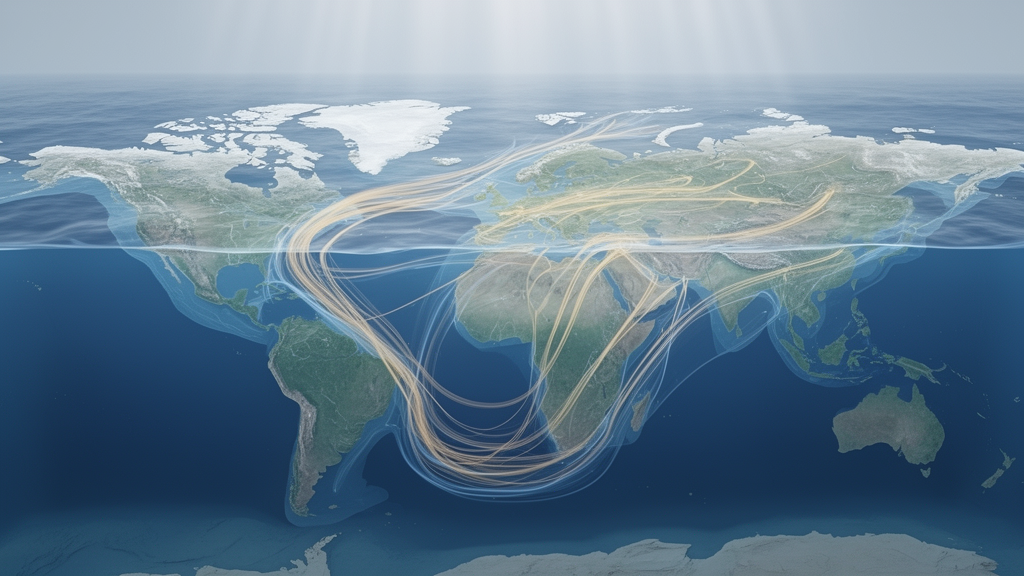
Climate models consistently project that the Atlantic Meridional Overturning Circulation, or AMOC, will weaken under future greenhouse-gas forcing, but a new analysis of 15 Coupled Model Intercomparison Project Phase 6 models suggests that the decline may not spread across the Atlantic at a constant rate. The researchers found that weakening generally begins in the subpolar North Atlantic and propagates southward, while the speed of that propagation tends to diminish as the circulation becomes weaker. In the high-emissions SSP5-8.5 scenario, the multi-model mean propagation gradient declined from about 3.0 to 1.4 degrees of latitude per year. The study examined historical simulations and four future scenarios spanning 1900 to 2100, using both depth-based and density-based representations of the circulation.
The AMOC carries warm, salty surface water northward, where it cools, densifies and sinks before returning southward as cold, deep water. The researchers calculated overturning strength at every latitude from 30° S to 65° N and expressed future changes as percentage reductions from a 1850–1899 reference. Ten-year running means were used to suppress short-term variability. To trace the basin-wide signal, they identified the first year in which a specified weakening threshold was exceeded at each latitude. A threshold spanning a particular percentage decline therefore formed a line across the Atlantic, and the slope of that line provided an estimate of how quickly the weakening signal moved southward.
Under the SSP5-8.5 scenario, the 5% weakening threshold took roughly three decades to travel from its northern onset to 30° S. The 25% threshold required about 45 years in depth space and 55 years in density space. Density space, which organizes circulation according to water density and therefore represents high-latitude water-mass transformation more directly, placed the origin of weakening farther north: between 51° and 61° N, compared with 45° and 51° N in depth space. The 25% threshold was reached in 2035 in the density-space analysis and in 2047 in the depth-space analysis. South of 40° N, however, the two representations produced broadly similar propagation speeds.
This difference matters for the potential use of high-latitude measurements as precursors of change farther south. In the density-space analysis, the model-average timing of 25% weakening at the latitude represented by the OSNAP array, around 57° N, preceded its appearance at the RAPID array near 26.5° N by 17 years under SSP5-8.5. The corresponding lead in depth space was only about five years. Even when the comparison began at 45° N, density space retained an 11-year lead over 26° N, compared with eight years in depth space. These are model-based lead times rather than validated forecasts of the real ocean, but they suggest that density-based indicators could provide a more useful framework for early-warning research.
Future forcing altered not only the magnitude of AMOC decline but also the structure of its propagation. By the end of the century, multi-model mean weakening at 51° N reached 63% in SSP5-8.5 and 41% in SSP1-2.6. At 26° N, the corresponding values were 47% and 32%, while at 30° S they were 25% and 22%. Under SSP5-8.5, a 25% decline emerged around 2036 at 51° N, 2055 at 26° N and 2095 at 30° S. The lower-emission scenarios, SSP1-2.6 and SSP2-4.5, showed a continuous reduction in propagation gradient as thresholds increased, whereas the higher-emission SSP3-7.0 and SSP5-8.5 cases tended toward a plateau at stronger levels of weakening.
That contrast may reflect two kinds of adjustment, the authors said. Under weaker forcing, the decline in propagation speed could progressively constrain weakening to the North Atlantic, preventing a strong southern signal from developing. Under stronger forcing, the circulation may reach a state in which a relatively constant minimum propagation speed persists. The analysis does not establish which process causes the slowdown, and the authors cautioned that it is unclear whether reduced propagation is itself responsible for the more geographically limited response or is a consequence of it. Pairwise comparisons also showed that differences among scenarios often became evident only after 2050, while some lower-emission experiments temporarily exhibited more weakening than higher-emission ones, likely reflecting model variability and scenario-specific aerosol forcing rather than a simple emissions-response relationship.
Individual models did not behave uniformly. In 10 of the 15 models, the weakening gradient decreased as the AMOC declined; two of those models, CESM2-WACCM and TaiESM1, eventually formed a plateau. CanESM5 and EC-Earth3 instead showed increasing gradients, while ACCESS-CM2, IPSL-CM6A-LR and MRI-ESM2-0 displayed no clear directional trend. Among models with multiple ensemble members, CNRM-CM6-1, MIROC6 and UKESM1-0-LL reproduced the overall slowing pattern. CanESM5 propagated weakening relatively slowly and almost uniformly, whereas IPSL-CM6-1 produced irregular threshold lines that made a simple linear slope less reliable. Ensemble averaging generally produced smoother, more coherent signals than individual realizations, highlighting the importance of internal variability in determining when a threshold is crossed.
The authors proposed that the slowing of AMOC weakening is consistent with an advective mechanism. A gradient of roughly 2 degrees of latitude per year corresponds to an approximate propagation speed of 0.6 centimetres per second, far too slow to be explained by internal Kelvin-wave propagation, which can travel at around 1 metre per second. A more plausible pathway is the transport of density anomalies by the mean circulation, including the Deep Western Boundary Current and interior routes. As the AMOC weakens, the pressure gradients that drive these currents may also weaken, reducing the speed at which the weakening signal travels. Supporting this interpretation, models with a historically stronger AMOC initially propagated the low-threshold weakening signal faster, although the relationship was statistically significant only at thresholds of 10% or less and should not be treated as a firm law.
Several limitations restrict how directly the findings can be applied to the real ocean. All 15 models used coarse, approximately 1-degree grids that did not resolve ocean eddies. Higher-resolution models may represent boundary currents and wave-mediated adjustment more accurately, potentially producing faster propagation than these results suggest. Ten models supplied only one ensemble member, and those models’ threshold lines could be distorted by multi-decadal variability. The method also depends on the chosen historical reference, which is imperfect because early observations are sparse. Nevertheless, the study demonstrates that AMOC weakening is not simply a simultaneous basin-wide reduction. It emerges first at high northern latitudes, then spreads southward at a rate that can change with forcing and model behavior, adding a new dimension to projections and to the search for possible early indicators of a major circulation change.
Subject of Research: Latitudinal propagation and changing speed of projected AMOC weakening in CMIP6 models
Article Title: AMOC weakening across latitude and time in CMIP6 future scenarios
Article References: Ashton-Key, H., Mecking, J., Marsh, R., Drijfhout, S., Oltmanns, M., & Sanchez-Franks, A. (2026). AMOC weakening across latitude and time in CMIP6 future scenarios. Ocean Science, 22(5), 3245-3286. https://doi.org/10.5194/os-22-3245-2026
Image Credits: AI Generated
Keywords: AMOC, Atlantic Ocean, CMIP6, climate models, ocean circulation, North Atlantic, climate scenarios, early warning signals, model projections, weakening, across, latitude
Cite Scienmag News
Violet Maxwell. (October 21, 2026). CMIP6 models reveal a slowing southward spread of AMOC weakening. Scienmag. https://scienmag.com/cmip6-models-reveal-a-slowing-southward-spread-of-amoc-weakening/
Violet Maxwell. "CMIP6 models reveal a slowing southward spread of AMOC weakening." Scienmag, 21 October 2026, https://scienmag.com/cmip6-models-reveal-a-slowing-southward-spread-of-amoc-weakening/. Accessed 21 October 2026.
Violet Maxwell. "CMIP6 models reveal a slowing southward spread of AMOC weakening." Scienmag. October 21, 2026. https://scienmag.com/cmip6-models-reveal-a-slowing-southward-spread-of-amoc-weakening/


