

Wednesday, October 21, 2026
Science
No Result
View All Result
  • Login
  • HOME
  • SCIENCE NEWS
  • CONTACT US
  • HOME
  • SCIENCE NEWS
  • CONTACT US
No Result
View All Result
Scienmag
No Result
View All Result
Home Science News Medicine

MRI links Crohn’s disease to coordinated brain changes

October 21, 2026
in Medicine
Cassandra Pierce
By Cassandra Pierce Scienmag Editorial Profile - Systems Neuroscience
Reading Time: 3 mins read
0
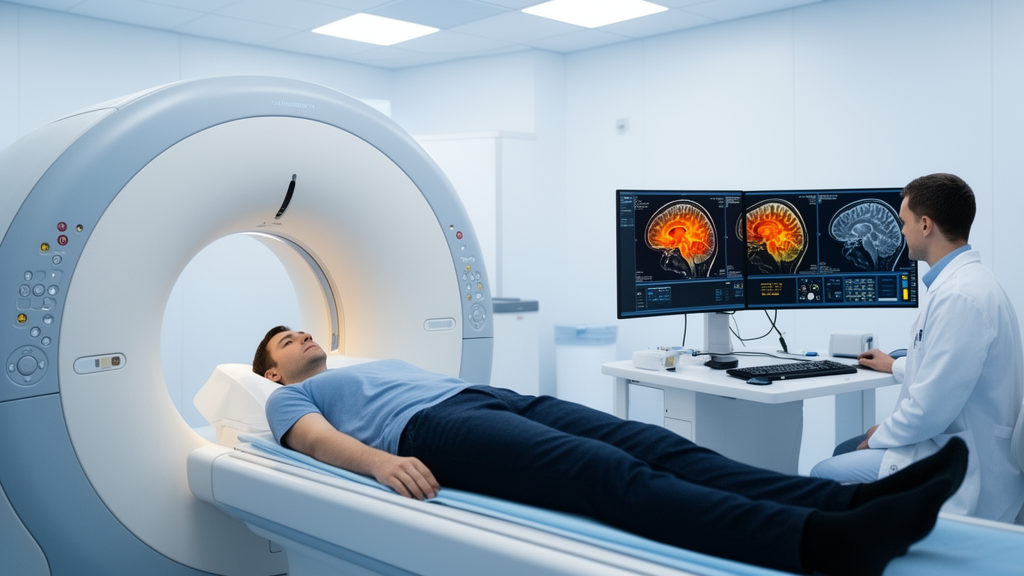
MRI links Crohn’s disease to coordinated brain changes

MRI links Crohn’s disease to coordinated brain changes

65
SHARES
587
VIEWS
Share on FacebookShare on Twitter
ADVERTISEMENT

A multimodal MRI study of 100 people with Crohn’s disease and 50 healthy controls found coordinated differences in brain structure and resting-state functional signals, with the affected regions showing spatial correspondence to dopaminergic, serotonergic, noradrenergic and opioid systems. The researchers combined structural MRI data measuring gray matter volume with resting-state functional MRI data analyzed using fractional amplitude of low-frequency fluctuations, or fALFF, through multimodal canonical correlation analysis and joint independent component analysis.

The joint analysis identified one component that discriminated between patients and controls across both imaging modalities. Its structural measure, gray matter independent component 1, remained significantly different after false-discovery-rate correction at P = 0.028, while its functional counterpart, fALFF independent component 1, remained significant at P = 0.001. The spatial pattern involved the thalamus, default mode network, insula, sensorimotor cortex, occipital lobe, cerebellum and frontal regions. This shared component indicates that the structural and functional signals varied together across the two MRI measures rather than being interpreted separately.

The analysis also found a functional component, fALFF independent component 3, that differed between Crohn’s disease and control groups without being identified as part of the joint component. Its distribution included the cerebellum and extensive frontal areas, and the group difference was significant after correction at P = 0.009. The two functional components were strongly correlated across the sample, with r = 0.883 and FDR-corrected P < 0.001. This statistical relationship does not establish that Crohn’s disease caused either pattern, nor does it show that one component produces the other.

Clinical variables were linked to the imaging components in different ways. The joint gray matter component was negatively correlated with disease activity, with r = −0.430 and FDR-corrected P < 0.001, meaning that lower component values were associated with greater disease activity in this sample. The joint functional component was positively correlated with quality of life, at r = 0.261 and FDR-corrected P = 0.031. These are cross-sectional associations among the participants and should not be interpreted as evidence that a particular MRI pattern is a validated biomarker, treatment target or consequence of Crohn’s disease.

The researchers then used JuSpace to compare the imaging patterns with spatial reference maps of neurotransmitter-related systems. The shared components corresponded to distributions involving dopamine, serotonin, noradrenaline and opioid systems. Because this comparison relied on normative maps rather than direct measurements of neurotransmitter levels or receptor binding in participants, the results show spatial correspondence rather than proof of neurotransmitter involvement as a causal mechanism. The study therefore provides preliminary evidence for coordinated structural–functional brain patterns in Crohn’s disease and a framework for relating those patterns to clinical measures and established neurotransmitter-system maps, while remaining limited by the sample-based, observational nature of the analysis and the indirect nature of the neurotransmitter comparison.

Subject of Research: Multimodal MRI analysis of brain changes in Crohn’s disease

Article Title: Multimodal CCA + joint ICA reveals fused gray matter volume and resting-state functional alterations with neurotransmitter associations in Crohn’s disease

Article References: Yin, Y., Luo, M., Ou, D., Zhou, Z., Wang, X., & Liu, J. (2026). Multimodal CCA + joint ICA reveals fused gray matter volume and resting-state functional alterations with neurotransmitter associations in Crohn’s disease. Journal of Translational Medicine. https://doi.org/10.1186/s12967-026-09101-1

Image Credits: AI Generated

DOI: 10.1186/s12967-026-09101-1

Keywords: Crohn’s disease, brain MRI, gray matter volume, resting-state fMRI, fALFF, neurotransmitter mapping, gut–brain axis, multimodal analysis, disease activity, Multimodal, joint, reveals

Cite Scienmag News

Cassandra Pierce. (October 21, 2026). MRI links Crohn’s disease to coordinated brain changes. Scienmag. https://scienmag.com/mri-links-crohns-disease-to-coordinated-brain-changes/

Cassandra Pierce. "MRI links Crohn’s disease to coordinated brain changes." Scienmag, 21 October 2026, https://scienmag.com/mri-links-crohns-disease-to-coordinated-brain-changes/. Accessed 21 October 2026.

Cassandra Pierce. "MRI links Crohn’s disease to coordinated brain changes." Scienmag. October 21, 2026. https://scienmag.com/mri-links-crohns-disease-to-coordinated-brain-changes/


Tags: brain MRIbrain regions affected in Crohn’sbrain structure and function in Crohn’sCrohn’s diseaseCrohn’s disease brain changesdefault mode network alterationsdisease activitydopaminergic and serotonergic system involvementfALFFfractional amplitude of low-frequency fluctuationsgray matter volumegray matter volume in Crohn’sgut-brain axisjointjoint independent component analysis in neuroimagingmultimodalmultimodal analysismultimodal MRI in Crohn’s diseaseneurobiological links to Crohn’s diseaseneurotransmitter mappingresting-state fMRIresting-state fMRI in Crohn’srevealsstructural and functional MRI correlation
Share26Tweet16
Previous Post

Retrospective colorectal cancer study links nerve invasion to metastasis

Next Post

Diet Linked to Skin Cancer Prevention After Solid Organ Transplant

Related Posts

Retrospective colorectal cancer study links nerve invasion to metastasis
Medicine

Retrospective colorectal cancer study links nerve invasion to metastasis

October 21, 2026
Three admission indicators distinguish ruptured intracranial aneurysms
Medicine

Three admission indicators distinguish ruptured intracranial aneurysms

October 21, 2026
Gail Cornwall Wins NIH Grant to Test Protein-Based Inheritance
Medicine

Gail Cornwall Wins NIH Grant to Test Protein-Based Inheritance

October 21, 2026
Psychiatric nurses’ depressive-symptom screens linked to violence and shift burden
Medicine

Psychiatric nurses’ depressive-symptom screens linked to violence and shift burden

October 21, 2026
Prone surgery in child with Alport syndrome managed with supraglottic airway
Medicine

Prone surgery in child with Alport syndrome managed with supraglottic airway

October 21, 2026
Research report: A case report: an 11-year-old boy with peripheral T-cell lymphoma presenting after a five-year indolent inguinal lymphadenopathy
Medicine

Research report: A case report: an 11-year-old boy with peripheral T-cell lymphoma presenting after a five-year indolent inguinal lymphadenopathy

October 21, 2026
Next Post
Diet Linked to Skin Cancer Prevention After Solid Organ Transplant

Diet Linked to Skin Cancer Prevention After Solid Organ Transplant

  • Mothers who receive childcare support from maternal grandparents show more optimized

    Mothers who receive childcare support from maternal grandparents show more parental warmth, finds NTU Singapore study

    27656 shares
    Share 11059 Tweet 6912
  • University of Seville Breaks 120-Year-Old Mystery, Revises a Key Einstein Concept

    1061 shares
    Share 424 Tweet 265
  • Bee body mass, pathogens and local climate influence heat tolerance

    682 shares
    Share 273 Tweet 171
  • Researchers record first-ever images and data of a shark experiencing a boat strike

    546 shares
    Share 218 Tweet 137
  • Groundbreaking Clinical Trial Reveals Lubiprostone Enhances Kidney Function

    531 shares
    Share 212 Tweet 133
Science

Embark on a thrilling journey of discovery with Scienmag.com—your ultimate source for cutting-edge breakthroughs. Immerse yourself in a world where curiosity knows no limits and tomorrow’s possibilities become today’s reality!

RECENT NEWS

  • Campus butterflies and spiders show stable diversity across an urbanization gradient
  • Scoping review maps invasive bacterial infections and colonic tumors regionally
  • Almería potters tailored clay, glazes and colorants by function
  • GFPT1 silencing curbs aggressive esophageal cancer cell behavior through ER stress

Categories

  • Agriculture
  • Anthropology
  • Archaeology
  • Athmospheric
  • Biology
  • Biotechnology
  • Blog
  • Bussines
  • Cancer
  • Chemistry
  • Climate
  • Earth Science
  • Editorial Policy
  • Marine
  • Mathematics
  • Medicine
  • Pediatry
  • Policy
  • Psychology & Psychiatry
  • Science Education
  • Science News
  • Social Science
  • Space
  • Technology and Engineering

Subscribe to Blog via Email

Enter your email address to subscribe to this blog and receive notifications of new posts by email.

Join 5,150 other subscribers

© 2025 Scienmag - Science Magazine

Welcome Back!

Login to your account below

Forgotten Password?

Retrieve your password

Please enter your username or email address to reset your password.

Log In
No Result
View All Result
  • HOME
  • SCIENCE NEWS
  • CONTACT US

© 2025 Scienmag - Science Magazine

Discover more from Science

Subscribe now to keep reading and get access to the full archive.

Continue reading