

Wednesday, October 21, 2026
Science
No Result
View All Result
  • Login
  • HOME
  • SCIENCE NEWS
  • CONTACT US
  • HOME
  • SCIENCE NEWS
  • CONTACT US
No Result
View All Result
Scienmag
No Result
View All Result
Home Science News

400°C cotton-stalk wood vinegar most strongly enhanced pig-manure compost humification

October 21, 2026
in Science News
Morgan Morrow
By Morgan Morrow Scienmag Editorial Profile - Bacteriology
Reading Time: 2 mins read
0
400°C cotton-stalk wood vinegar most strongly enhanced pig-manure compost humification

400°C cotton-stalk wood vinegar most strongly enhanced pig-manure compost humification

65
SHARES
587
VIEWS
Share on FacebookShare on Twitter
ADVERTISEMENT

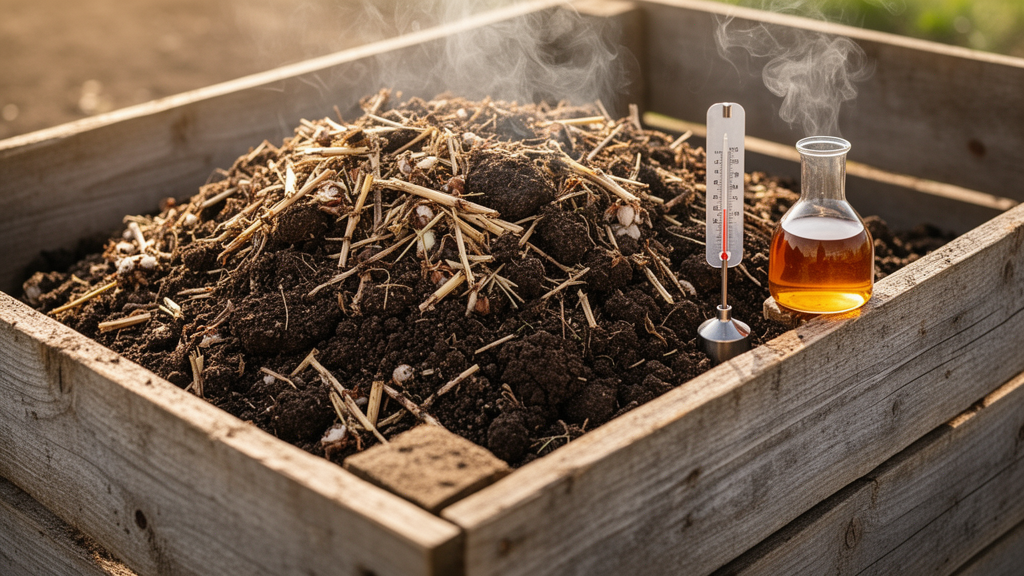
Cotton stalk-derived wood vinegar added during co-composting increased the humification of pig manure, with the formulation produced at 400°C showing the strongest measured outcome among four pyrolysis temperatures tested. Researchers compared an untreated control with compost amended using wood vinegars prepared at 300, 400, 500 and 600°C. All four wood vinegar treatments significantly improved the humification level relative to the control, while the 400°C treatment achieved the highest humic acid content: 23.360 grams per kilogram on day 15 of composting.

The study examined how pyrolysis temperature affected the transformation of compounds that can serve as humification precursors and how those chemical changes coincided with microbial community succession. Wood vinegar is a liquid product of biomass pyrolysis and contains multiple chemical components that can supplement humification precursors. The authors state that the yields of these components are significantly influenced by pyrolysis temperature, making the four additives a way to compare formulations with different compositions during pig-manure co-composting.

Inter-component correlation analysis and Fourier-transform infrared two-dimensional correlation spectroscopy indicated that the 400°C treatment promoted coordinated transformation of aromatic and nitrogenous precursors. The authors interpreted these results as evidence that this treatment accelerated condensation and polymerization reactions involved in humification. The same treatment produced the highest ratio of humic-like to protein-like fluorescence components, reaching 2.88:1. These chemical and spectroscopic observations accompanied the higher humic acid measurement, linking the treatment-specific precursor transformation with the strongest reported humification response.

Metagenomic analysis also distinguished the microbial response associated with the 400°C treatment. It enriched microorganisms assigned to the phyla Pseudomonadota, Actinobacteria and Bacillota, while the metabolic profiles indicated greater carbon metabolism and activity associated with glyoxylate and dicarboxylate metabolism. Taken together, the findings connect changes in humification precursors with succession in the compost microbial community: the 400°C wood vinegar treatment was associated both with chemical evidence of accelerated condensation and polymerization and with a microbial profile supporting those processes.

The reported result applies to cotton stalk wood vinegar prepared at 400°C and used as an additive in pig-manure co-composting. It does not establish that the same formulation would be equally effective with other feedstocks, at industrial scale or under different environmental conditions. Within the reported comparison of four pyrolysis temperatures, however, the study identifies 400°C wood vinegar as the most effective tested additive for enhancing compost humification, with the highest measured humic acid content, the strongest humic-like to protein-like fluorescence ratio and the most favorable reported microbial metabolic response.

Subject of Research: Effects of cotton stalk wood vinegar pyrolysis temperature on precursor transformation, microbial succession and humification in pig-manure co-composting.

Article Title: Precursor transformation and microbial responses during compost humification regulated by wood vinegar produced at different pyrolysis temperatures

Article References: Liu, J., Zhao, M., Xu, W., Li, S., Xue, Z., Yang, G., Gao, D., Yu, H., Lian, X., Chen, L., & Zhou, L. (2026). Precursor Transformation and Microbial Response in Compost Humification Regulated by Wood Vinegar at Different Pyrolysis Temperatures. Frontiers in Chemistry, 14, 1912238. https://doi.org/10.3389/fchem.2026.1912238

Image Credits: AI Generated

DOI: 10.3389/fchem.2026.1912238

Keywords: compost humification, cotton stalk, wood vinegar, pyrolysis temperature, pig manure, humic acid, microbial succession, metagenomics, aerobic composting, Precursor, transformation, microbial

Cite Scienmag News

Morgan Morrow. (October 21, 2026). 400°C cotton-stalk wood vinegar most strongly enhanced pig-manure compost humification. Scienmag. https://scienmag.com/400c-cotton-stalk-wood-vinegar-most-strongly-enhanced-pig-manure-compost-humification/


Morgan Morrow. "400°C cotton-stalk wood vinegar most strongly enhanced pig-manure compost humification." Scienmag, 21 October 2026, https://scienmag.com/400c-cotton-stalk-wood-vinegar-most-strongly-enhanced-pig-manure-compost-humification/. Accessed 21 October 2026.

Morgan Morrow. "400°C cotton-stalk wood vinegar most strongly enhanced pig-manure compost humification." Scienmag. October 21, 2026. https://scienmag.com/400c-cotton-stalk-wood-vinegar-most-strongly-enhanced-pig-manure-compost-humification/

Tags: aerobic compostingbiomass pyrolysis and humification precursorschemical composition of wood vinegar at different temperaturesco-composting with wood vinegar additivescompost humificationcotton stalkcotton stalk-derived biomass pyrolysiseffects of biomass-derived liquids on compost qualityenhancement of compost humic acid contentFourier-transform infrared spectroscopy in compost analysishumic acidmetagenomicsmicrobialmicrobial community succession during compostingmicrobial successionnitrogenous and aromatic compound transformation in compostingoptimizing pyrolysis conditions for compost enhancementpig manurepig manure compost humificationprecursorpyrolysis temperaturetransformationwood vinegarwood vinegar pyrolysis temperature effects
Share26Tweet16
Previous Post

Case Report Confirms Gastric Leiomyosarcoma in a 4-Year-Old Horse

Next Post

Morphological study identifies probable first Miocene Selaginella macrofossil in Dominican amber

Related Posts

Two new spider wasps lift China’s Episyron count to eight species
Biology

Taxonomic review describes two new Episyron species and three new records for China

October 21, 2026
Ancient Spike Moss Trapped in Dominican Amber Fills 20-Million-Year Gap
Science News

Morphological study identifies probable first Miocene Selaginella macrofossil in Dominican amber

October 21, 2026
Case Report Confirms Gastric Leiomyosarcoma in a 4-Year-Old Horse
Science News

Case Report Confirms Gastric Leiomyosarcoma in a 4-Year-Old Horse

October 21, 2026
Research report: Radiative forcing variability and its moderation during a cyclonic event: a case study
Earth Science

Research report: Radiative forcing variability and its moderation during a cyclonic event: a case study

October 21, 2026
Spinal Hsp90 Blockade Boosts Morphine Pain Relief via DUSP15 in CGRP Neurons
Medicine

Mouse study links spinal Hsp90 inhibition to enhanced morphine pain relief through DUSP15 in CGRP neurons

October 21, 2026
Rarest Velvet Worm on Earth Found Alive Again in Jamaican Cave After 50 Years
Biology

Five cave velvet worms observed in Pedro Cave; Swansea records remain probable

October 21, 2026
Next Post
Ancient Spike Moss Trapped in Dominican Amber Fills 20-Million-Year Gap

Morphological study identifies probable first Miocene Selaginella macrofossil in Dominican amber

  • Mothers who receive childcare support from maternal grandparents show more optimized

    Mothers who receive childcare support from maternal grandparents show more parental warmth, finds NTU Singapore study

    27656 shares
    Share 11059 Tweet 6912
  • University of Seville Breaks 120-Year-Old Mystery, Revises a Key Einstein Concept

    1061 shares
    Share 424 Tweet 265
  • Bee body mass, pathogens and local climate influence heat tolerance

    682 shares
    Share 273 Tweet 171
  • Researchers record first-ever images and data of a shark experiencing a boat strike

    546 shares
    Share 218 Tweet 137
  • Groundbreaking Clinical Trial Reveals Lubiprostone Enhances Kidney Function

    531 shares
    Share 212 Tweet 133
Science

Embark on a thrilling journey of discovery with Scienmag.com—your ultimate source for cutting-edge breakthroughs. Immerse yourself in a world where curiosity knows no limits and tomorrow’s possibilities become today’s reality!

RECENT NEWS

  • Taxonomic review describes two new Episyron species and three new records for China
  • Morphological study identifies probable first Miocene Selaginella macrofossil in Dominican amber
  • 400°C cotton-stalk wood vinegar most strongly enhanced pig-manure compost humification
  • Case Report Confirms Gastric Leiomyosarcoma in a 4-Year-Old Horse

Categories

  • Agriculture
  • Anthropology
  • Archaeology
  • Athmospheric
  • Biology
  • Biotechnology
  • Blog
  • Bussines
  • Cancer
  • Chemistry
  • Climate
  • Earth Science
  • Editorial Policy
  • Marine
  • Mathematics
  • Medicine
  • Pediatry
  • Policy
  • Psychology & Psychiatry
  • Science Education
  • Science News
  • Social Science
  • Space
  • Technology and Engineering

Subscribe to Blog via Email

Enter your email address to subscribe to this blog and receive notifications of new posts by email.

Join 5,150 other subscribers

© 2025 Scienmag - Science Magazine

Welcome Back!

Login to your account below

Forgotten Password?

Retrieve your password

Please enter your username or email address to reset your password.

Log In
No Result
View All Result
  • HOME
  • SCIENCE NEWS
  • CONTACT US

© 2025 Scienmag - Science Magazine

Discover more from Science

Subscribe now to keep reading and get access to the full archive.

Continue reading