


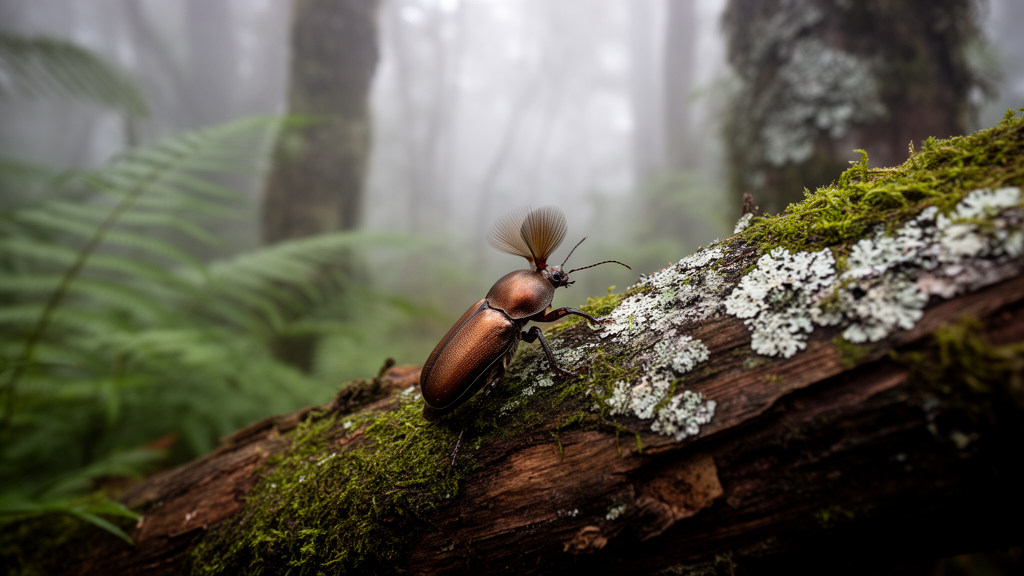
A taxonomic study of 52 museum specimens from nature reserves in South Africa’s Western Cape established the beetle genus Parvapila and designated Parvapila lyncispinnae as its type and only known species. The researchers placed the insects in the family Melandryidae and tribe Orchesiini.
The unidentified specimens originated from reserves at the foot of the Langeberg Range and from the Kogelberg. The authors determined that the beetle could not be accommodated in an existing Orchesiini genus and therefore described both a new genus and a new species.
The study examined specimens housed in the Muséum d’histoire naturelle in Geneva, the Ditsong Museum in Pretoria, the Ondřej Konvička collection in Zlín, and the Petr Bulirsch collection in Prague. The material included the holotype and numerous male and female paratypes collected between 2004 and 2020.
Photographs were taken with a Leica DFC425 camera attached to a Leica M205-C compound microscope. The images were stacked using Zerene Stacker version 1.04 and processed with GIMP version 2.10.30. Figures of the scutellar shield and metanepisternum have scale bars of 0.1 millimetres, while the habitus and reproductive anatomy figures have scale bars of 0.5 millimetres.
Parvapila has a distinct scutellar shield, unlike most Orchesiini genera. It can be distinguished from the three genera with a visible scutellar shield—Orchesia, Hylobia and Microscapha—by a combination of three characters: a small scutellar shield with a rounded posterior margin, a suture dividing the metanepisterna and metaventrite that becomes evanescent posteriorly, and metacoxae directed anterolaterally.
Parvapila lyncispinnae has a small, oval, convex body measuring 1.48–2.51 millimetres in length, 0.78–1.28 millimetres in width, and 0.57–0.91 millimetres in depth. Its body is yellowish to orange-reddish and covered with dense pubescence. Males have a deep oval medial depression in the metaventrite with long pubescence, whereas females have a shallow longitudinal groove surrounded by backward-directed hairs.
The male sternite IX consists of two tubular pieces joined anteriorly and linked by a thin membrane, with pubescent tips that inspired the species name. The genus name refers to the animal’s small size and convex, ball-like form. The beetle also lacks developed hind wings, although the formal genus diagnosis rests on the scutellar shield, metanepisternal–metaventrite suture, and orientation of the metacoxae.
Specimens were collected by sifting forest-floor litter and sampling around the bases of large trees in patches of Afromontane forest. Most records came from Grootvadersbosch and Marloth nature reserves, with one specimen collected at Platbos in Kogelberg Nature Reserve. These records show an apparently restricted distribution, and the authors suggest that the species may be endemic to South Africa and to Afromontane forests, although the evidence is limited to the available specimens and sampled localities.
The evolutionary position of Parvapila remains unresolved. Its restricted distribution may indicate a Gondwanian origin, and possible relationships with Lyperocharis, groups within Lederia, and Hylobia were discussed. The authors caution that the characters used to divide Orchesiini into genera may not necessarily reflect evolutionary relationships. They also note that knowledge of Afrotropical Melandryidae remains limited and that additional Parvapila species may exist.
Subject of Research: Taxonomic description of a new Orchesiini beetle genus and species from Western Cape forests
Article Title: Parvapila lyncispinnae new genus and new species ( Coleoptera , Melandryidae ) from South Africa
Article References: Cosandey, V. (2023). Parvapila lyncispinnae new genus and new species (Coleoptera, Melandryidae) from South Africa. Alpine Entomology, 7, 269-273. https://doi.org/10.3897/alpento.7.108448
Image Credits: AI Generated
Keywords: Parvapila, Parvapila lyncispinnae, Melandryidae, Orchesiini, taxonomy, new genus, new species, Western Cape, Afromontane forests, museum specimens, lyncispinnae, genus
Cite Scienmag News
Drew Townsend. (October 21, 2026). Taxonomic study establishes new beetle genus and species from South African forests. Scienmag. https://scienmag.com/taxonomic-study-establishes-new-beetle-genus-and-species-from-south-african-forests/
Drew Townsend. "Taxonomic study establishes new beetle genus and species from South African forests." Scienmag, 21 October 2026, https://scienmag.com/taxonomic-study-establishes-new-beetle-genus-and-species-from-south-african-forests/. Accessed 21 October 2026.
Drew Townsend. "Taxonomic study establishes new beetle genus and species from South African forests." Scienmag. October 21, 2026. https://scienmag.com/taxonomic-study-establishes-new-beetle-genus-and-species-from-south-african-forests/


