


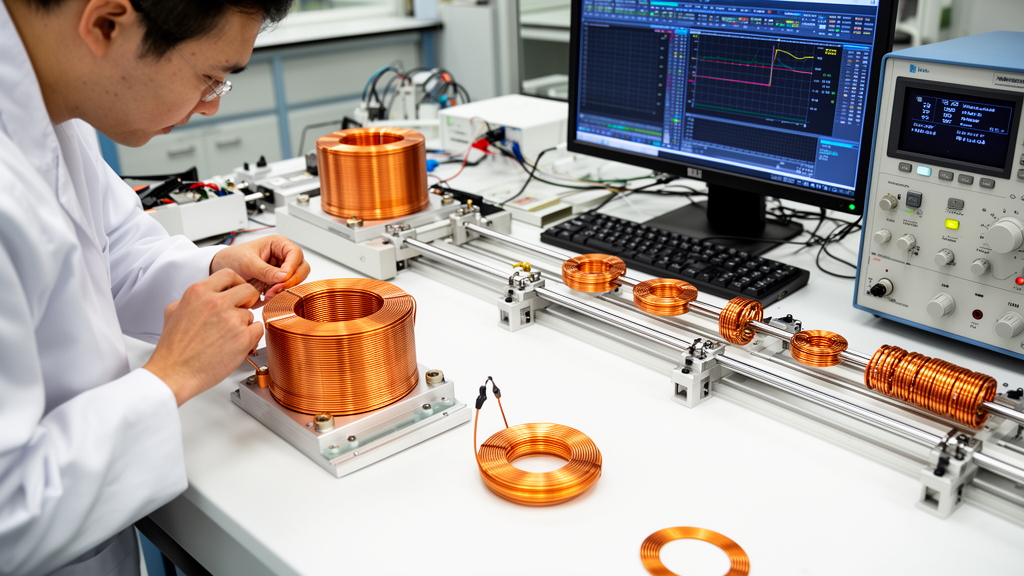
A modeling study of an S–P type inductive power transfer system identified parameter combinations that jointly maximize output power and transmission efficiency in the analyzed circuit model. The researchers optimized three interdependent variables: the coupling coefficient, resonant angular frequency and equivalent load resistance. The investigation began with an equivalent circuit model representing the mutual inductance of the contactless transformers.
This model was used to analyze how coupling coefficient, resonant angular frequency and equivalent load resistance influence the system’s output power and transmission efficiency. By examining these relationships together, the study addressed the difficulty of assigning specific values to resonant components during system design. The researchers converted the parameter-design problem into a nonlinear optimization problem.
They defined the product of efficiency and output power as the objective function, while treating coupling coefficient, resonant angular frequency and equivalent load resistance as decision variables. According to the study, this combined objective helps the fitness function escape local optima while seeking parameter settings that perform well in both power output and transmission efficiency. To adjust the equivalent load resistance, the design changes the duty cycle of a Buck–Boost circuit.
Joint optimization of this resistance, the coupling coefficient and the resonant angular frequency produced a globally optimal design for both output power and transmission efficiency within the study’s model. The result offers a design framework for selecting resonant compensation parameters in S–P inductive power transfer systems, although the supplied study description reports model-based optimization rather than numerical performance values or physical-system validation.
Subject of Research: Optimization of resonant parameters in S–P inductive power transfer systems
Article Title: Parameter optimization of IPT systems based on genetic algorithms
Article References: Guo, J., & Xing, L. (2026). Parameter optimization of IPT systems based on genetic algorithms. PLOS One, 21(10), e0360165. https://doi.org/10.1371/journal.pone.0360165
Image Credits: AI Generated
DOI: 10.1371/journal.pone.0360165
Keywords: inductive power transfer, parameter optimization, output power, transmission efficiency, coupling coefficient, resonant frequency, equivalent resistance, Buck–Boost circuit, nonlinear optimization, Parameter, optimization, systems
Cite Scienmag News
Juliet Wilcox. (October 21, 2026). Research report: Parameter optimization of IPT systems based on genetic algorithms. Scienmag. https://scienmag.com/research-report-parameter-optimization-of-ipt-systems-based-on-genetic-algorithms/
Juliet Wilcox. "Research report: Parameter optimization of IPT systems based on genetic algorithms." Scienmag, 21 October 2026, https://scienmag.com/research-report-parameter-optimization-of-ipt-systems-based-on-genetic-algorithms/. Accessed 21 October 2026.
Juliet Wilcox. "Research report: Parameter optimization of IPT systems based on genetic algorithms." Scienmag. October 21, 2026. https://scienmag.com/research-report-parameter-optimization-of-ipt-systems-based-on-genetic-algorithms/


