


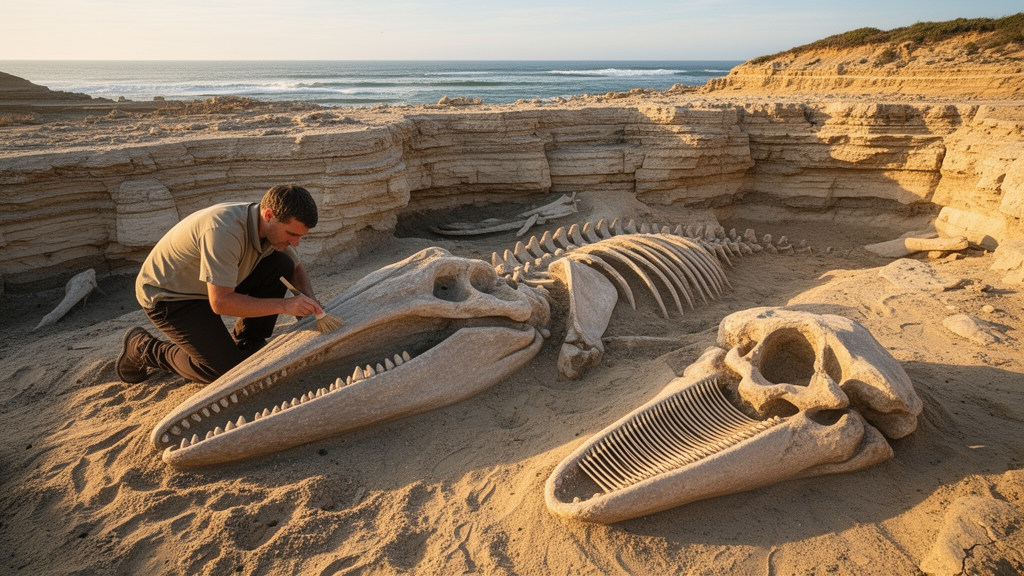
A descriptive paleontological study identifies a partial whale skull from Japan as the first formally recognized toothed mysticete from the Jinnobaru Formation. The specimen, catalogued as YM-G-100208, was provisionally assigned to Aetiocetidae gen. et sp. indet., establishing evidence for the coexistence of a toothed mysticete and the baleen-assisted eomysticetid Yamatocetus canaliculatus in the Oligocene northwestern Pacific.
YM-G-100208 was collected by Akito Makino on Umashima Island in Fukuoka Prefecture. It consists of the posterior part of the skull and was discovered as a floating nodule, leaving its geological horizon uncertain. No microfossils indicating its age were recovered from the surrounding matrix. The matrix is grayish, fine-grained sandstone resembling that of the Jinnobaru Formation, the only exposed formation on Umashima. Because the fossil is extensively eroded but retains some skull sutures, the researchers considered it unlikely to have been transported far from its original locality and assigned it to the Jinnobaru Formation.
The Ashiya Group, which includes the Yamaga, Norimatsu, Jinnobaru, Honjo and Waita formations, ranges from the latest Early Oligocene to the Late Oligocene on the basis of fission-track dating, calcareous nannofossils and planktonic foraminifera. The base of the Jinnobaru Formation has been dated to 28.91 ± 0.2 Ma using sensitive high-resolution ion microprobe zircon uranium-lead dating. Because the upper boundary of the formation remains uncertain, the authors consider YM-G-100208 to be slightly younger than 28 Ma, approximately early Late Oligocene and similar in age to Yamatocetus canaliculatus.
The preserved skull region includes the parietals, supraoccipital, basioccipital, vomer, pterygoid sinus region, damaged periotic and squamosal. Its combination of a broadly triangular supraoccipital, an anteriorly projecting supraoccipital with straight lateral margins, moderate exposure of the parietals on the skull roof, a well-developed basioccipital crest and an estimated body length below 3 m supports an aetiocetid identification. It differs from llanocetids in its small size, lack of a sagittal trough, bulbous basioccipital crest and posterior extension of the ventral vomer keel. It also differs from mammalodontids and eomysticetids in several skull-roof and vomer characters.
The researchers estimated the bizygomatic width at about 28 cm. Applying a published equation for stem mysticetes produced an estimated total length of 268 cm, a value described as typical for aetiocetids. This is a model-based estimate based on the reconstructed skull width rather than a directly measured body length. Skull sutures used to determine developmental stage are broadly eroded, but the fusion of the basioccipital-basisphenoid suture and the robustness of the preserved anatomy led the authors to identify the individual as at least a subadult.
The classification remains provisional because YM-G-100208 is incomplete. Another whale from the formation, “Metasqualodon” symmetricus, was originally named as an odontocete but was subsequently placed within the mysticete lineage by cladistic analyses. A formal revision and new generic identification were still in progress, while the lack of overlapping material between that holotype and YM-G-100208 prevented detailed assessment of their taxonomic similarities or the composition of the formation’s mysticete community. The authors nevertheless interpreted the co-occurrence as evidence of a complex Oligocene ecosystem containing eomysticetids and toothed mysticetes.
Regional comparisons reveal an apparent faunal discrepancy. The Jinnobaru Formation, dated to about 28 Ma, has yielded both toothed mysticetes and eomysticetids in Kyushu. By contrast, the younger Morawan Formation of Hokkaido, dated to approximately 26–24 Ma, has produced several toothed mysticete species but no eomysticetids. The authors offer one possible evolutionary scenario in which resource-dependent niche partitioning reduced competition between toothed and baleen-assisted mysticetes, after which toothed mysticetes dispersed north and differentiated among different niches, potentially contributing to the size disparity among Hokkaido’s toothed mysticetes. This remains a hypothesis rather than a demonstrated sequence of events.
An alternative explanation for the regional difference is insufficient sampling in the Ashoro area of Hokkaido, which has produced several aetiocetid species but no baleen-assisted mysticetes. Comparisons with other regions also show uneven records of Oligocene mysticetes. The eastern North Pacific, from Washington to Mexico, contains toothed and baleen-assisted mysticetes; New Zealand likewise has both types, whereas Australia’s established Oligocene record includes only toothed mysticetes. Supplementary information from a 2019 publication listed 12 earbone specimens assigned to eomysticetids or chaeomysticetes from Australia, but the authors state that additional finds are needed to substantiate those identifications.
The broader significance of the Umashima specimen lies in documenting coexistence among morphologically different early mysticetes while preserving uncertainty about the processes behind their distribution. Questions about whether toothed aetiocetids possessed proto-baleen and how the transition from toothed to baleen-based feeding structures occurred remain central to research on mysticete evolution. The authors argue that further discoveries and a better-sampled global dataset could help researchers examine Oligocene coexistence patterns and other paleoecological traits associated with the disappearance of archaic mysticetes and the emergence of modern-looking baleen whales.
Subject of Research: Coexistence of toothed and baleen-assisted mysticetes in the Oligocene Jinnobaru Formation
Article Title: Coexistence of Oligocene toothed and baleen-assisted mysticetes in the northwestern Pacific
Article References: Tsai, C.-H., Kimura, T., & Hasegawa, Y. (2024). Coexistence of Oligocene toothed and baleen-assisted mysticetes in the northwestern Pacific. Fossil Record, 27(1), 95-100. https://doi.org/10.3897/fr.27.111567
Image Credits: AI Generated
DOI: 10.3897/fr.27.111567
Keywords: Oligocene whales, toothed mysticetes, baleen-assisted mysticetes, Jinnobaru Formation, aetiocetids, Yamatocetus canaliculatus, Umashima Island, Japan, fossil skull, northwestern Pacific, paleoecology, Coexistence
Cite Scienmag News
Gavin Prescott. (October 21, 2026). Coexistence of Oligocene toothed and baleen-assisted mysticetes in the northwestern Pacific. Scienmag. https://scienmag.com/coexistence-of-oligocene-toothed-and-baleen-assisted-mysticetes-in-the-northwestern-pacific/
Gavin Prescott. "Coexistence of Oligocene toothed and baleen-assisted mysticetes in the northwestern Pacific." Scienmag, 21 October 2026, https://scienmag.com/coexistence-of-oligocene-toothed-and-baleen-assisted-mysticetes-in-the-northwestern-pacific/. Accessed 21 October 2026.
Gavin Prescott. "Coexistence of Oligocene toothed and baleen-assisted mysticetes in the northwestern Pacific." Scienmag. October 21, 2026. https://scienmag.com/coexistence-of-oligocene-toothed-and-baleen-assisted-mysticetes-in-the-northwestern-pacific/


