


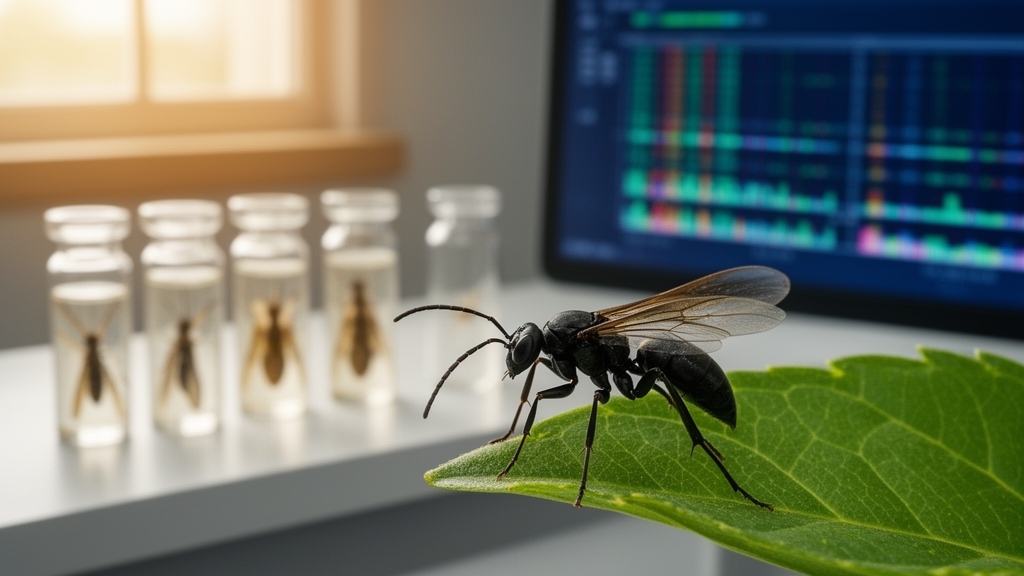
A perspective and review of taxonomic research argues that DNA and morphology should be combined rather than treated as competing approaches to documenting biodiversity, particularly in hyperdiverse parasitoid wasps. Drawing on long-term work with Chalcidoidea and Ceraphronoidea, the authors conclude that molecular methods can accelerate species discovery, but molecular-only descriptions may weaken the stability and meaning of species names when morphology, nomenclatural history and expert training are neglected.
The appeal of DNA-based taxonomy lies in its capacity to process many specimens rapidly, cluster sequences into operational units and standardize comparisons through apparently objective characters. These capabilities are especially attractive in extremely species-rich groups such as Chalcidoidea, Braconidae and Ichneumonidae, where the majority of species remain undescribed and the number of trained taxonomists is declining. The review says that increasingly accessible and inexpensive sequencing technologies have consequently encouraged taxonomic studies to incorporate molecular data, although it cautions against treating DNA-only taxonomy as a complete replacement for traditional examination of specimens.
Minimalist approaches have been influential but remain contested. Meierotto and colleagues proposed a 2019 protocol for initially describing species in hyperdiverse groups through DNA-barcode diagnoses with minimal morphological information, while a 2021 revision of Costa Rican Braconidae described 403 new species. The review notes the practical arguments supporting such strategies: tropical taxa may be too numerous for complete morphological treatments, examining historical types can require costly or impractical international travel, and molecular data may help associate life stages and host records. However, it describes a broad consensus that purely DNA-based descriptions are not a sufficient long-term solution when sound integrative methods are feasible.
One central limitation is the interpretation of mitochondrial COI barcodes. Citing a broad review by Emerson, the authors say that barcode and related delimitation approaches can generate putative species faster than they can be incorporated into coherent, evolutionarily meaningful taxonomy. COI-only delimitation may mistake population structure, introgression or sampling artefacts for species-level divergence, particularly in hyperdiverse arthropods. The review further identifies risks to nomenclatural stability: apparently distinct entities may later be synonymized after broader sampling, while names based only on sequence differences may lack morphological connections to historical taxa.
Museum constraints reinforce the problem. Primary type specimens in many Hymenoptera groups often cannot be sampled non-destructively, and numerous museum specimens are unsuitable for sequencing. For many parasitoid wasps, including Chalcidoidea and Ichneumonoidea, species are represented only by historical type material and brief original descriptions with limited illustrations. In these circumstances, morphological diagnoses and illustrations may be the only practical means of connecting newly collected material to established names. The review also notes that biodiversity-rich regions may lack affordable sequencing facilities, while many field workers and students receive primarily morphological training, making a system that universally requires COI data less accessible and harder to integrate with museum collections.
Reference databases provide another constraint. Coverage in public resources such as BOLD and GenBank is incomplete and sometimes unreliable for hyperdiverse or poorly studied insect groups: sequences may be scarce, lack reliably identified vouchers or carry incorrect species names. In a study of Canadian Mymaridae, Hébert and Favret reported less than 1% correct species-level identification using existing DNA reference libraries. The authors present this measured result as evidence of limited reference coverage for minute parasitoid wasps, rather than as a general estimate of DNA identification performance across all taxa.
Integrative taxonomy can address these limitations by combining morphological evidence with mitochondrial and nuclear markers, ecological information and well-documented voucher specimens. The review cites Encyrtidae studies in which Samra and colleagues used COI, ITS2, detailed morphology and cross-breeding experiments to delimit cryptic species, while Triapitsyn and colleagues combined morphology, COI, 28S, ITS2 and morphometrics in revisions that resolved synonymies and stabilized species limits. It also cites work on Ceraphronoidea in which life-history information complements integrative taxonomic analysis. These are case studies of particular wasp groups, not evidence that one workflow will apply equally to every lineage.
For hyperdiverse Hymenoptera, the review proposes that COI sorting may provide an initial division of operational units, followed by explicit morphological diagnoses, high-quality imaging and targeted nuclear-marker analyses for problematic complexes. Specimen-level identifiers and publicly accessible vouchers deposited in collections are described as essential throughout. The proposed workflow also allows iterative revision as taxonomic and geographic coverage improves, acknowledging that molecular clusters remain hypotheses to be tested rather than self-sufficient species diagnoses.
The review ultimately emphasizes that technology alone cannot make taxonomy stable. It reports a rapid worldwide decline in the number of expert taxonomists able to work on diverse insect groups and warns that this creates a risk of losing the expertise needed to interpret molecular results, revise historical taxa and maintain continuity with the existing literature. Its proposed response is stronger education, mentorship and long-term support for taxonomists trained in morphology, comparative anatomy, nomenclature, life history and evolution. Within these limits, the authors’ conclusion is that molecular and morphological evidence should complement one another: DNA can increase the efficiency of biodiversity documentation, while morphology and deep taxonomic knowledge help preserve the scientific meaning of species names.
Subject of Research: Integrative taxonomy of hyperdiverse parasitoid wasps using DNA, morphology and nomenclatural expertise
Article Title: Parasitoid wasps and beyond: The need for DNA, morphology and deep taxonomic knowledge in modern biodiversity discovery
Article References: Japoshvili, G., & Peters, R. S. (2026). Parasitoid wasps and beyond: The need for DNA, morphology and deep taxonomic knowledge in modern biodiversity discovery. Evolutionary Systematics, 10(2), 469-473. https://doi.org/10.3897/evolsyst.10.214588
Image Credits: AI Generated
DOI: 10.3897/evolsyst.10.214588
Keywords: integrative taxonomy, parasitoid wasps, DNA barcoding, COI, species delimitation, morphological taxonomy, Hymenoptera, nomenclatural stability, biodiversity discovery, Parasitoid, wasps, beyond
Cite Scienmag News
Drew Townsend. (October 21, 2026). Perspective and review finds DNA and morphology both needed for parasitoid wasp taxonomy. Scienmag. https://scienmag.com/perspective-and-review-finds-dna-and-morphology-both-needed-for-parasitoid-wasp-taxonomy/
Drew Townsend. "Perspective and review finds DNA and morphology both needed for parasitoid wasp taxonomy." Scienmag, 21 October 2026, https://scienmag.com/perspective-and-review-finds-dna-and-morphology-both-needed-for-parasitoid-wasp-taxonomy/. Accessed 21 October 2026.
Drew Townsend. "Perspective and review finds DNA and morphology both needed for parasitoid wasp taxonomy." Scienmag. October 21, 2026. https://scienmag.com/perspective-and-review-finds-dna-and-morphology-both-needed-for-parasitoid-wasp-taxonomy/


