

Wednesday, October 21, 2026
Science
No Result
View All Result
  • Login
  • HOME
  • SCIENCE NEWS
  • CONTACT US
  • HOME
  • SCIENCE NEWS
  • CONTACT US
No Result
View All Result
Scienmag
No Result
View All Result
Home Science News Social Science

Upward Moves Link Elite Chinese Academics to Stronger Research Outcomes

October 21, 2026
in Social Science
Courtney Benton
By Courtney Benton Scienmag Editorial Profile - Science and Technology Policy
Reading Time: 2 mins read
0
Upward Moves Link Elite Chinese Academics to Stronger Research Outcomes

Upward Moves Link Elite Chinese Academics to Stronger Research Outcomes

65
SHARES
587
VIEWS
Share on FacebookShare on Twitter
ADVERTISEMENT

A bibliometric study of 658 academics at China’s Double First-Class universities finds that the direction of an institutional move is closely associated with subsequent research performance. Researchers who moved upward in institutional prestige showed more favorable outcomes across most measured dimensions, especially citation impact and collaboration scope, whereas downward mobility was followed by an immediate “citation cliff effect,” or sharp reduction in citation performance.

The observational study used 11 years of event-time bibliometric data covering publication output, citation impact and collaboration scope from five years before to five years after each mobility event. Its population consisted entirely of mobile academics, and the analysis compared upward, lateral and downward movers rather than contrasting all movers with stationary researchers. Movements were classified by changes in institutional prestige, allowing the authors to test whether the effects of moving followed a smooth hierarchy or differed according to direction.

Upward mobility was associated with the clearest advantages. The strongest evidence concerned citation impact and the reach of collaborations, while downward mobility coincided with an immediate decline in citations. However, the results did not show a uniform prestige gradient. Lateral and downward movers had no statistically detectable difference in the relevant outcome distributions, and only upward movers were associated with an advantage. The findings therefore challenge the assumption that academic mobility produces broadly similar gains regardless of where a researcher moves.

To reduce selection bias, the authors applied inverse probability weighting based on research motivation and a broad set of individual, organizational and regional variables. They also used Kolmogorov–Smirnov tests for distributional analysis, examining performance across its full range rather than relying only on comparisons of average outcomes. These methods were intended to distinguish differences among mobility directions while accounting for the possibility that researchers’ circumstances and reasons for moving influenced both their decisions and their later performance.

Because the study was observational and limited to mobile academics at elite Chinese universities, the results show associations rather than establish that institutional moves caused changes in scholarly performance. Within that scope, however, the analysis identifies a threshold pattern: moving to a more prestigious institution was linked to stronger citation and collaboration outcomes, while lateral or downward moves did not show comparable advantages. The authors interpret the pattern as evidence that institutional prestige may shape research visibility through intertwined reputational and resource channels. Mean-only comparisons of mobility could obscure this structure, because averaging across different directions can make heterogeneous outcomes appear more uniform than they are.

Subject of Research: Effects of upward, lateral and downward academic mobility on research performance at elite Chinese universities

Article Title: Who gains from moving? mobility direction and research performance of academics at China’s elite universities

Article References: Chen, P., Ma, Y., & Jiang, F. (2026). Who gains from moving? mobility direction and research performance of academics at China’s elite universities. Higher Education. https://doi.org/10.1007/s10734-026-01796-x

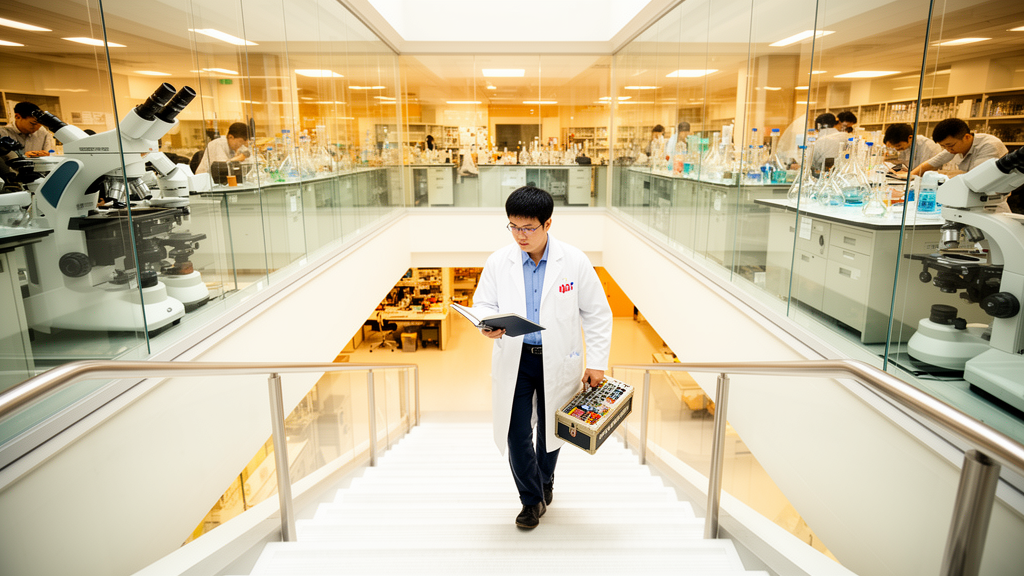
Image Credits: AI Generated

DOI: 10.1007/s10734-026-01796-x

Keywords: academic mobility, research performance, citation impact, collaboration scope, institutional prestige, Double First-Class universities, bibliometrics, career trajectories, selection bias, gains, moving, mobility

Cite Scienmag News

Courtney Benton. (October 21, 2026). Upward Moves Link Elite Chinese Academics to Stronger Research Outcomes. Scienmag. https://scienmag.com/upward-moves-link-elite-chinese-academics-to-stronger-research-outcomes/

Courtney Benton. "Upward Moves Link Elite Chinese Academics to Stronger Research Outcomes." Scienmag, 21 October 2026, https://scienmag.com/upward-moves-link-elite-chinese-academics-to-stronger-research-outcomes/. Accessed 21 October 2026.

Courtney Benton. "Upward Moves Link Elite Chinese Academics to Stronger Research Outcomes." Scienmag. October 21, 2026. https://scienmag.com/upward-moves-link-elite-chinese-academics-to-stronger-research-outcomes/


Tags: academic career mobility and research outcomesacademic mobilitybibliometric analysis of university rankingsbibliometricscareer trajectoriesChinese academic mobilityChinese Double First-Class universitiescitation cliff effect in academiacitation impactcitation impact and collaboration scopecollaboration scopeDouble First-Class universitieseffects of university ranking changesgainsinfluence of institutional hierarchy on research productivityinstitutional prestigeinstitutional prestige and publication outputlong-term bibliometric study of academic movesMobilitymovingresearch performanceresearch performance impactselection biasupward vs downward academic mobility
Share26Tweet16
Previous Post

Fungal parasite selects against larger yellow dung flies

Next Post

GLIS3 regulates astrocyte differentiation in human stem cells

Related Posts

Shared Boundaries Reduce Escalation in Territorial Conflict Game
Social Science

Shared Boundaries Reduce Escalation in Territorial Conflict Game

October 21, 2026
Panel study links cooperation to Pakistan’s regional positioning
Social Science

Panel study links cooperation to Pakistan’s regional positioning

October 21, 2026
Caribbean review finds coastal resilience requires integrated planning
Social Science

Caribbean review finds coastal resilience requires integrated planning

October 20, 2026
Classmates’ Parents Marrying Up Linked to Better Student Outcomes
Social Science

Classmates’ Parents Marrying Up Linked to Better Student Outcomes

October 20, 2026
Seismic evaluation of transmission tower structures under coupled ice-earthquake action
Social Science

Seismic evaluation of transmission tower structures under coupled ice-earthquake action

October 20, 2026
Income precarity links differently to India’s handloom sustainability outcomes
Social Science

Income precarity links differently to India’s handloom sustainability outcomes

October 20, 2026
Next Post
GLIS3 regulates astrocyte differentiation in human stem cells

GLIS3 regulates astrocyte differentiation in human stem cells

  • Mothers who receive childcare support from maternal grandparents show more optimized

    Mothers who receive childcare support from maternal grandparents show more parental warmth, finds NTU Singapore study

    27656 shares
    Share 11059 Tweet 6912
  • University of Seville Breaks 120-Year-Old Mystery, Revises a Key Einstein Concept

    1061 shares
    Share 424 Tweet 265
  • Bee body mass, pathogens and local climate influence heat tolerance

    682 shares
    Share 273 Tweet 171
  • Researchers record first-ever images and data of a shark experiencing a boat strike

    546 shares
    Share 218 Tweet 137
  • Groundbreaking Clinical Trial Reveals Lubiprostone Enhances Kidney Function

    531 shares
    Share 212 Tweet 133
Science

Embark on a thrilling journey of discovery with Scienmag.com—your ultimate source for cutting-edge breakthroughs. Immerse yourself in a world where curiosity knows no limits and tomorrow’s possibilities become today’s reality!

RECENT NEWS

  • Hypothesis proposes auxiliary brain for severe stroke restoration
  • GLIS3 regulates astrocyte differentiation in human stem cells
  • Upward Moves Link Elite Chinese Academics to Stronger Research Outcomes
  • Fungal parasite selects against larger yellow dung flies

Categories

  • Agriculture
  • Anthropology
  • Archaeology
  • Athmospheric
  • Biology
  • Biotechnology
  • Blog
  • Bussines
  • Cancer
  • Chemistry
  • Climate
  • Earth Science
  • Editorial Policy
  • Marine
  • Mathematics
  • Medicine
  • Pediatry
  • Policy
  • Psychology & Psychiatry
  • Science Education
  • Science News
  • Social Science
  • Space
  • Technology and Engineering

Subscribe to Blog via Email

Enter your email address to subscribe to this blog and receive notifications of new posts by email.

Join 5,150 other subscribers

© 2025 Scienmag - Science Magazine

Welcome Back!

Login to your account below

Forgotten Password?

Retrieve your password

Please enter your username or email address to reset your password.

Log In
No Result
View All Result
  • HOME
  • SCIENCE NEWS
  • CONTACT US

© 2025 Scienmag - Science Magazine

Discover more from Science

Subscribe now to keep reading and get access to the full archive.

Continue reading