


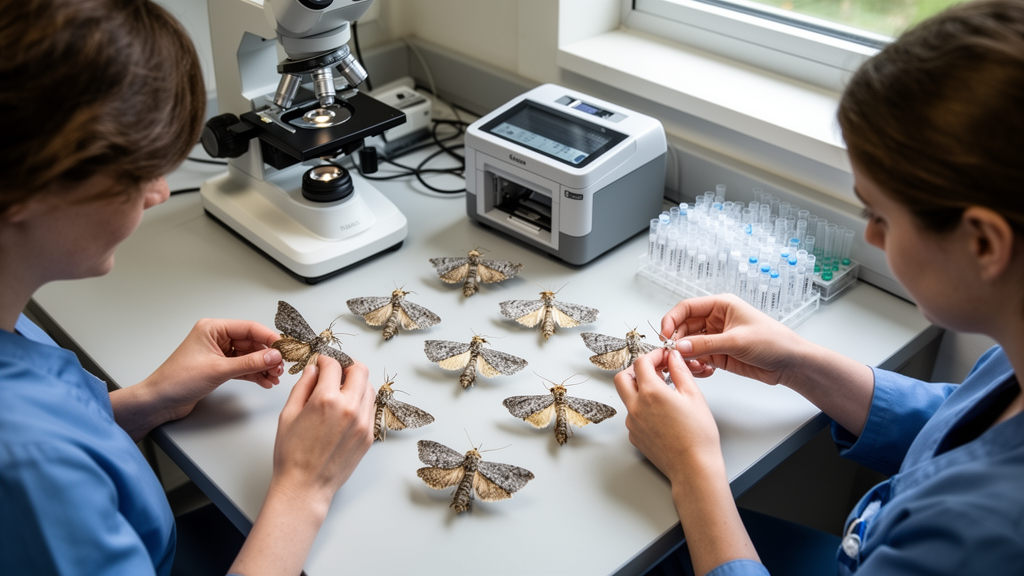
A taxonomic study of alpine Dichrorampha tortricid moths has resolved a long-standing species complex into two distinct species, one of them described for the first time as Dichrorampha velata. Researchers combined differences in wing pattern and male genital anatomy with mitochondrial DNA barcodes, examination of historical museum specimens and analysis of zoological nomenclature. The study concluded that D. velata had been confused with D. alpestrana, and that an anonymous description attributed to an earlier author also caused a long-standing error over which name should take priority.
The investigation originated with two superficially similar male moths collected in 2006 at the same site near La Punt in Switzerland’s Engadine valley. One specimen had a distinct whitish triangular mark arising from the dorsal edge of its forewing, while the mark was hardly visible on the other. Their genital structures were distinct: the conspicuous-marked moth had a broad phallus ending in a large curved, tooth-like structure and a triangular projection on the inner border of its valva, whereas the other had a narrower phallus with several peaks and a straight inner valval border. Similar differences had been observed in Austrian and German material by the 1960s, but Danilevski and Kuznetsov had treated them as intraspecific variation within D. montanana while explicitly calling for further research.
For the study, the authors examined 104 male and 12 female specimens identified as D. montanana sensu auct., mainly from the Alps and the Jura Mountains. They photographed the wings and examined the male and female genitalia, with standard preparations completed for 64 specimens. They also obtained full 658-base-pair fragments of the mitochondrial cytochrome c oxidase 1 gene, or COI, from 35 moths. These sequences formed two well-delimited clusters containing 18 and 17 specimens, respectively, and corresponded to the two male genital phenotypes. Serial dissection revealed no intermediate genital forms. The molecular and anatomical groupings therefore provided mutually consistent evidence that the specimens previously treated as one taxon represented two separate species.
DNA barcoding supported the division but also demonstrated its limitations across the wider genus. The researchers combined their new sequences with 317 supplementary records from the Barcode of Life Data System, covering 37 additional European Dichrorampha species and two subspecies. Among European species in the analysis, mean within-species Kimura 2-parameter barcode divergence was 0.54%, compared with a mean distance to the nearest species of 3.45%. For D. velata, the mean intraspecific distance was only 0.05% and the maximum was 0.31%, while its minimum distance from its nearest neighbour, D. alpestrana, was 3.96%. The marker did not separate some closely related members of the D. plumbana species group, nor did it distinguish D. infuscata from D. inconspiqua.
Resolving the names required the authors to reconstruct a complicated sequence of descriptions, illustrations, specimen labels and later synonymies. The name alpestrana appeared in an anonymously published account based on material supplied by Austrian entomologist Josef Emanuel Fischer von Röslerstamm. Bibliographical and stylistic analysis showed that the description was attributable to Philipp Christoph Zeller, making the valid authorship Dichrorampha alpestrana ([Zeller], 1843). Philogène Auguste Joseph Duponchel separately described Ephippiphora montanana in the same year. Zeller’s description was published in May, while Duponchel’s work was registered with the French legal deposit on August 18, and the later names were also treated inconsistently in nineteenth- and twentieth-century works.
Museum specimens helped anchor those names to the two biological entities. A dissected male syntype of D. montanana in the Muséum national d’histoire naturelle in Paris was designated as the lectotype, fixing the identity of the name. Its large-toothed phallus and projecting inner valval border correspond to the first anatomical group. Historical names including D. tanaceti, D. herbosana, Hemimene blasiana and Hemimene modestana were likewise found to represent that same species through their descriptions, illustrations or surviving type material. In contrast, names published as an aberration or form—D. alpestrana ab. schatzmanni and D. alpestrana f. olivana—were infrasubspecific and unavailable under the International Code of Zoological Nomenclature. No available name could be found for the second species, leading to the description of D. velata.
The new species is most clearly distinguished from D. alpestrana by its male genitalia. In D. velata, the phallus is broad and half-pipe-like, with slightly twisted walls that each terminate in a prominent thorn; smaller additional teeth may also be present. The inner lobal line of the cucullus is broadly rounded and lacks the projection characteristic of the other species. The name velata, meaning “veiled” in Latin, refers to the taxon’s confused taxonomic history. Female D. velata have a broad, heavily sclerotized and proximally asymmetrically bulbous colliculum, a very short ductus bursae, and two signa, one larger and curved and the other small and straight. The authors could not identify corresponding female genital features that reliably separate D. velata from D. alpestrana, so more material remains necessary for that part of the diagnosis.
Forewing appearance offers a useful but imperfect identification clue. Fresh D. velata generally have a more olive ground colour, a weaker dorsal blotch and a slightly larger wingspan than D. alpestrana, whose dorsal triangular mark is generally more conspicuous. A few moths do not fit either wing-pattern category cleanly, and wear can make the distinction less reliable. For confident determination of individual specimens, the study therefore supports genital preparation or DNA barcoding, especially where external characters are ambiguous. The measured male wingspan of D. velata was 12.8–16.5 millimetres, with a mean of 14.6 millimetres; the four measured females had wingspans of 10.9–13 millimetres, averaging 12 millimetres.
Confirmed records place D. velata in Germany, Austria, Italy, Switzerland and France, mainly in the western Alps, with its eastern confirmed limit reaching Salzburg in Austria. In Switzerland it also occurs in the Jura Mountains, and extra-alpine records are documented in southern Germany’s Swabian Alps. D. alpestrana occurs south of the Rhine-Rhône line in Switzerland, is widely distributed in Austria and has confirmed records in the Italian Alps, Northern Macedonia and the United Kingdom, indicating a disjunct Arctic-Alpine distribution. The two species have been observed in sympatry at some Swiss and Italian localities, including the area where D. velata was first collected, but no intermediate forms were found there.
Direct biological information about the new species remains limited. D. velata has been recorded in dry lowland pastures and in alpine grassland above the treeline, with an apparent preference for montane to subalpine margins of fertile meadows near woodland. Adults have been observed flying during the daytime near Leucanthemum and Achillea plants. The researchers were unable to locate its caterpillars, so the early life history of the species was not established. D. alpestrana, by contrast, has been recorded from the rootstocks of Achillea ptarmica, Achillea millefolium and Chrysanthemum vulgare. Adults of D. velata were observed from June 10 to August 8 between elevations of 590 and 2,400 metres. The authors proposed that the species’ present ranges may reflect postglacial expansion from different glacial refugial areas, but presented that history as a hypothesis rather than a demonstrated conclusion.
Subject of Research: Taxonomic separation of two European alpine Dichrorampha moth species using morphology, DNA barcodes and type material
Article Title: Unraveling a complex problem: Dichrorampha velata sp. nov., a new species from the Alps hitherto confounded with D. alpestrana ([Zeller], 1843) sp. rev. = D. montanana (Duponchel, 1843) syn. nov. ( Lepidoptera , Tortricidae )
Article References: Schmid, J., & Huemer, P. (2021). Unraveling a complex problem: Dichrorampha velata sp. nov., a new species from the Alps hitherto confounded with D. alpestrana ([Zeller], 1843) sp. rev. = D. montanana (Duponchel, 1843) syn. nov. (Lepidoptera, Tortricidae). Alpine Entomology, 5, 37-53. https://doi.org/10.3897/alpento.5.67498
Image Credits: AI Generated
Keywords: Dichrorampha velata, Dichrorampha alpestrana, Tortricidae, alpine moths, species delimitation, DNA barcoding, male genitalia, taxonomy, zoological nomenclature, museum specimens, Unraveling, complex
Cite Scienmag News
Drew Townsend. (October 21, 2026). Alpine moth study separates two species using anatomy and DNA barcodes. Scienmag. https://scienmag.com/alpine-moth-study-separates-two-species-using-anatomy-and-dna-barcodes/
Drew Townsend. "Alpine moth study separates two species using anatomy and DNA barcodes." Scienmag, 21 October 2026, https://scienmag.com/alpine-moth-study-separates-two-species-using-anatomy-and-dna-barcodes/. Accessed 21 October 2026.
Drew Townsend. "Alpine moth study separates two species using anatomy and DNA barcodes." Scienmag. October 21, 2026. https://scienmag.com/alpine-moth-study-separates-two-species-using-anatomy-and-dna-barcodes/


