


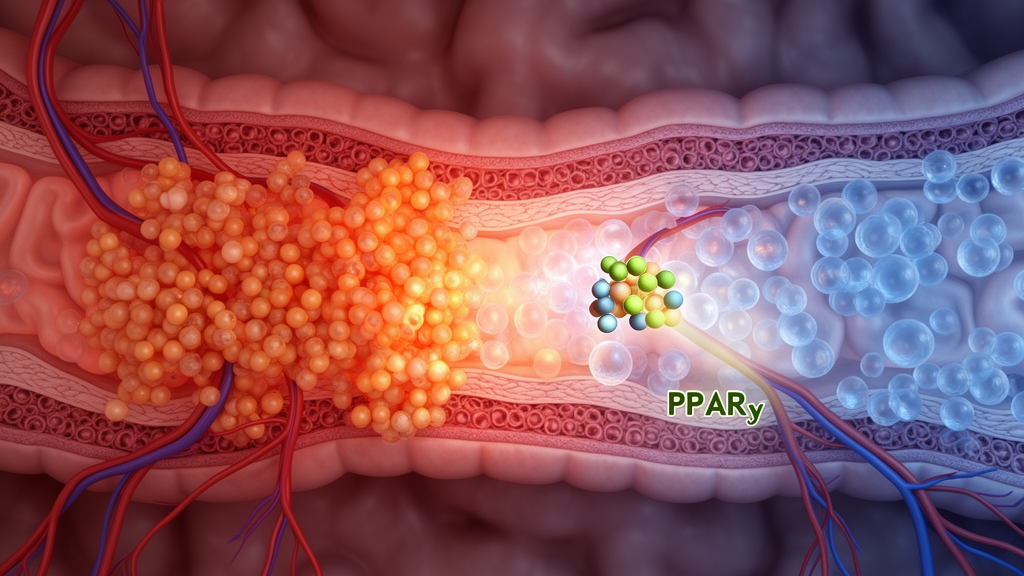
A 2026 review found that several natural compounds influence PPARγ-related signaling in cell and mouse models of ulcerative colitis, reducing inflammatory markers and improving measures of intestinal injury in some experiments. The authors screened 352 records from PubMed, Web of Science, and the China National Knowledge Infrastructure, covering literature published from 2016 to 2026, and included 25 preclinical studies in their mechanism analysis. None involved human participants or clinical trials, so the results support biological plausibility and candidate mechanisms rather than clinical efficacy for ulcerative colitis.
The compounds with reported activity included flavonoids, phenolic compounds, triterpenoids, alkaloids, polysaccharides, and plant extracts, but the strength and specificity of the evidence varied substantially among them. PPARγ is a ligand-dependent nuclear receptor encoded by the PPARG gene. It is expressed in colonic epithelial cells and in macrophages, dendritic cells, T lymphocytes, and other cell types.
Ligand binding changes the receptor’s conformation, allowing it to form a complex with retinoid X receptor, bind PPAR response elements, and recruit transcriptional co-regulators. PPARγ can also restrain inflammatory transcriptional programs involving NF-κB, AP-1, and STAT. The review presents reduced expression or impaired activity of PPARγ as a possible link among persistent inflammation, altered immune-cell behavior, disturbed microbial ecology, and damaged mucosal barriers.
In that framework, PPARγ is a regulatory hub linking several interdependent processes rather than a target isolated to one inflammatory pathway. One proposed function of PPARγ is to limit inflammatory amplification. Experimental activation in colitis models reduced sustained NF-κB signaling and expression of mediators including TNF-α, IL-1β, IL-6, and inducible nitric oxide synthase.
The receptor is also associated with adaptive immune balance: experimental findings indicate that PPARγ can suppress the RORγt-associated Th17 program while supporting Foxp3, TGF-β, IL-10, and the regulatory T-cell phenotype. In macrophage models, PPARγ-related signaling was linked to reduced M1-like activation and increased markers associated with the M2-like phenotype, including CD206 and arginase-1. These observations describe relationships in experimental systems; they do not show that restoring PPARγ alone would reverse established human disease.
The proposed effects of PPARγ extend into metabolism and the intestinal ecosystem. Reduced receptor activity may alter epithelial oxidative metabolism, oxygen availability, and nitrate levels, creating conditions that favor facultative anaerobic bacteria such as Enterobacteriaceae. The relationship also runs in the opposite direction.
Short-chain fatty acids, including butyrate, propionate, and acetate, are associated with epithelial metabolism, barrier function, and PPARγ-related signaling, whereas the microbiota-derived metabolite imidazole propionate was reported to inhibit PPARγ. These findings suggest a reciprocal microbiota-metabolite-receptor network, but they remain preclinical. Many studies measured selected microbes, metabolites, or pathway markers rather than the full microbial ecology associated with human ulcerative colitis.
The mucosal barrier is another major focus of the evidence. PPARγ signaling has been linked with MUC2-producing goblet cells, mucin secretion, and the expression and membrane localization of tight-junction proteins such as ZO-1, occludin, and claudins. In the reviewed experiments, compounds including paeonol, ginsenoside Rb1, geniposide, magnolol, and several plant extracts were associated with improvements in some barrier markers, inflammatory measures, or histological injury.
The pattern was not uniform: individual studies used different models, doses, endpoints, and combinations of assays. A compound that increased PPARγ expression or reduced downstream inflammatory markers was therefore not necessarily shown to bind the receptor directly, and improvement in one experimental system did not establish efficacy in people with ulcerative colitis. The strength of the proposed mechanism depends on how PPARγ was tested.
The review grouped evidence into altered receptor expression, molecular docking predictions, pharmacological blockade or rescue, direct binding and transcriptional assays, and genetic evaluation. These categories are not interchangeable. Increased PPARγ abundance may be a downstream consequence of reduced inflammation, while sensitivity to a PPARγ antagonist indicates that the receptor contributes to a measured effect but does not by itself demonstrate that a compound binds it.
That evidence nevertheless remained preclinical and was based mainly on an acute chemically induced model. Several studies used GW9662 or T0070907 as PPARγ antagonists to assess functional involvement. Loss of protection after receptor blockade can strengthen causal inference, but it has limits.
Pharmacological antagonism may have different effects from genetic deletion, and a compound may influence several pathways that converge on PPARγ without binding the receptor. Accordingly, results from emodin, paeonol, honokiol, naringin, and several extracts support PPARγ-dependent components of their effects but do not establish direct molecular targeting. Molecular docking also requires caution.
Predicted contacts with residues in the PPARγ ligand-binding domain constitute a computational hypothesis, not evidence of physical binding. Polyphenols, flavonoids, and quinones may also aggregate, chelate metals, participate in redox reactions, or interfere nonspecifically with assay components. The review cautions that structural alerts associated with PAINS compounds do not automatically make their pharmacology false, but they increase the need for rigorous follow-up.
Orthogonal experiments using different detection principles, reverse screens for aggregation and redox interference, direct binding assays, receptor transcriptional-activity tests, and genetic interventions could build a stronger evidence chain. For complex plant extracts, chemical characterization, activity-guided isolation, and back-filling experiments would also be needed to identify which constituents or combinations account for the observed activity. The relevant biological context is also unresolved because whole-colon measurements combine epithelial cells, macrophages, dendritic cells, and T lymphocytes, which can have different transcriptional programs.
Cell-specific knockouts and spatially resolved analyses could clarify which cell populations account for a compound’s effects. Disease-model design and exposure are additional limits on interpretation. Many experiments used acute dextran sulfate sodium exposure, which induces epithelial injury and inflammation but does not fully reproduce the chronic, relapsing, immunologically heterogeneous course of human ulcerative colitis.
The review recommends adding chronic or recurrent designs, trinitrobenzene sulfonate and T-cell adoptive-transfer models, and patient-derived colonic organoids. Microbiome results also require tests of direction: changes in community composition or metabolites accompanying improvement do not show that microbial remodeling caused the response. Germ-free animals, antibiotics, metabolite supplementation, and targeted pathway manipulation could help distinguish direct receptor effects from changes in epithelial metabolism or microbial composition.
Translation also requires measuring parent compounds and active metabolites in plasma, colonic tissue, and intestinal contents, because a concentration active in cultured cells may not be attainable after oral dosing. Repeated-dose toxicology and assessments of systemic metabolic effects are needed because PPARγ participates in adipocyte function, lipid storage, insulin sensitivity, and glucose homeostasis. The review’s central conclusion is consequently a research framework, not a clinical recommendation: PPARγ-linked natural compounds may offer multi-target candidates, but target specificity, cell-resolved mechanisms, reproducible exposure, and safety must be established before their therapeutic value in ulcerative colitis can be assessed in humans.
Subject of Research: Preclinical evidence on natural compounds modulating PPARγ-related signaling in ulcerative colitis models
Article Title: PPARγ signaling pathway: strategies and limitations of natural compounds in the treatment of ulcerative colitis
Article References: Liang, L., & Deng, H. (2026). PPARγ signaling pathway: strategies and limitations of natural compounds in the treatment of ulcerative colitis. Frontiers in Pharmacology, 17, Article 1977683. https://doi.org/10.3389/fphar.2026.1977683
Image Credits: AI Generated
DOI: 10.3389/fphar.2026.1977683
Keywords: ulcerative colitis, PPARγ, natural compounds, preclinical research, animal models, cellular models, gut microbiota, mucosal barrier, inflammation, clinical translation, PPAR, signaling
Cite Scienmag News
Ophelia Keating. (October 21, 2026). Preclinical Review Links Natural Compounds to PPARγ in Colitis Models. Scienmag. https://scienmag.com/preclinical-review-links-natural-compounds-to-ppar%ce%b3-in-colitis-models/
Ophelia Keating. "Preclinical Review Links Natural Compounds to PPARγ in Colitis Models." Scienmag, 21 October 2026, https://scienmag.com/preclinical-review-links-natural-compounds-to-ppar%ce%b3-in-colitis-models/. Accessed 21 October 2026.
Ophelia Keating. "Preclinical Review Links Natural Compounds to PPARγ in Colitis Models." Scienmag. October 21, 2026. https://scienmag.com/preclinical-review-links-natural-compounds-to-ppar%ce%b3-in-colitis-models/


