


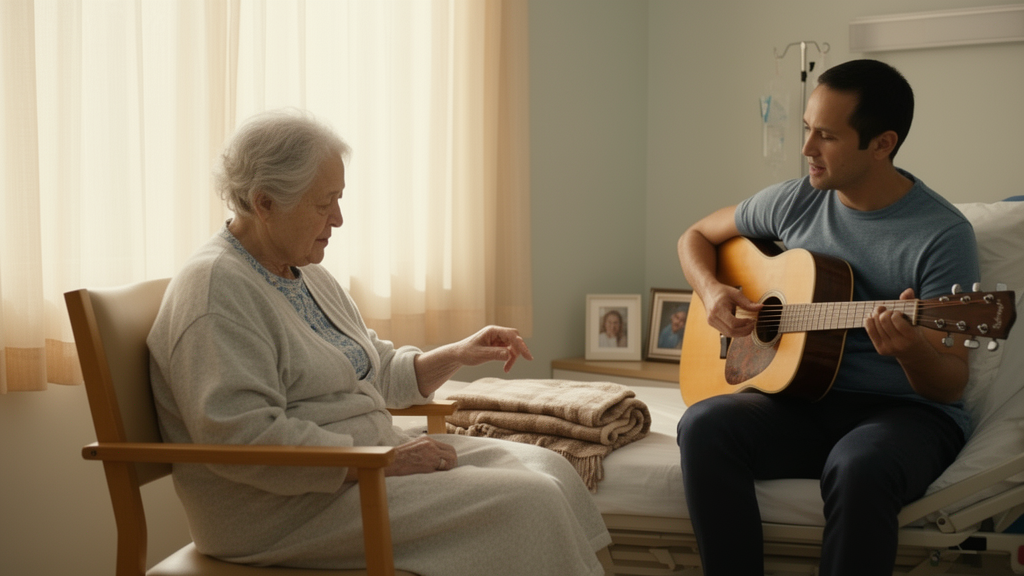
A three-session biographical music therapy program improved selected short-term measures of spiritual wellbeing and ego-integrity among palliative-care patients, but it did not significantly improve the trial’s primary psychological quality-of-life outcome or global quality of life. The finding comes from a narrative review of legacy work, meaning-making and biographical music therapy in palliative, hospice, oncology and end-of-life care. The review synthesizes randomized trials, qualitative and mixed-methods studies, evidence reviews and clinical accounts, concluding that the intervention’s benefits must be described by specific outcome rather than generalized into a universal effect on quality of life, bereavement or symptom control.
The most directly relevant evidence comes from the multicentre Song of Life trial, conducted in two German palliative-care units. The trial randomized 104 patients equally to Song of Life or relaxation exercises. Each Song of Life session involved selecting a personally meaningful song, reflecting on its autobiographical significance, hearing a live rendition and receiving a recorded version.
Participants in the music group had higher ratings for spiritual wellbeing and ego-integrity and also rated the treatment as more meaningful and important than the control group. No significant difference was detected in either the primary psychological quality-of-life measure or global quality of life. The findings therefore support a focused psycho-spiritual interpretation of the protocol, rather than improvement across every dimension of wellbeing.
A linked analysis from the same Song of Life trial is not an independent replication. Of 104 randomized patients, 89 completed a second session. The analysis found a greater reduction in subjective distress in the biographical music therapy group than in the mindfulness-based control group, but no differential psychobiological treatment effects.
Cortisol concentrations declined over time in both groups, so the analysis neither established a cortisol-specific advantage nor demonstrated a biological mechanism for legacy work. These limitations matter because a patient-reported change in distress is an observed result, while claims that a hormone mediates the effect would require additional experimental evidence. The review separated this direct legacy-focused evidence from randomized studies of other forms of music therapy.
A German trial assigned 84 palliative-care inpatients to two sessions of live relaxation using monochord and voice or to recorded verbal relaxation. Both groups improved in relaxation and wellbeing, but the between-group difference in acute pain was not significant. A separate trial involving 200 palliative-care inpatients found a greater immediate reduction in numerical pain scores after one therapist-guided session with live music than after standard care that included analgesics.
The contrasts are not interchangeable: an improvement against usual care does not establish added benefit over an active relaxation intervention, and immediate pain reduction is distinct from sustained pain relief, lower analgesic consumption or longer-term quality of life. Other randomized evidence extends beyond end-of-life care and therefore cannot automatically confirm legacy-specific effects. A small four-arm study involving 32 hospice family caregivers compared music, progressive muscle relaxation, their combination and a control group.
It found no significant main effect of group, meaning that changes over time could not be attributed specifically to music. In Colombia, 129 chemotherapy patients were randomized to a single group music-therapy session plus standard care or to standard care alone, with 110 included in the complete-data analysis. The music group had lower post-session anxiety and higher psychological and general wellbeing.
Because the setting involved chemotherapy rather than specifically terminal or legacy-focused care, those results do not establish effects on legacy creation, bereavement or end-of-life outcomes. Qualitative and observational studies provide a different kind of insight into the experience of music therapy. An analysis of 64 patient-written lyrics from 39 palliative-care patients identified personally significant concerns, while clinical accounts describe songwriting as a way to express relationships, memories, gratitude, grief, love or ambivalence.
Interviews with bereaved caregivers described remembrance, connection and hope associated with pre-loss music therapy. A grounded-theory study involving 14 bereaved hospice caregivers proposed that shared music experiences may support caregiving relationships and pre-illness identities. These accounts are clinically informative, but retrospective perceptions and models developed from interviews cannot establish that music caused a bereavement outcome or predict how every patient will respond.
Legacy-oriented music therapy can include songs, spoken messages and recordings intended for patients or families, with songwriting and musical life review forming its central approaches. The process of creating something meaningful may itself be valuable even when no polished song or recording results. Research with four music therapists has examined how unfinished musical legacies are understood and handled, cautioning against valuing the finished artifact above the encounter.
Not every patient wants to create a tangible record, and declining or discontinuing an activity should not automatically be interpreted as failure. The value experienced during creation and the later use of a recording by relatives are separate outcomes and require separate evaluation rather than being combined into a single measure of legacy success. Several related practices should not be conflated with biography-based therapy.
Music thanatology is a bedside tradition of accompaniment, commonly using live harp and voice, whose immediate aims include comfort rather than explicit reflection or artifact creation. An uncontrolled review of 65 music-vigil records reported changes in observed agitation, wakefulness and breathing, while a survey of 55 family members suggested particular benefit for comfort and relaxation but less positive effects on pain. Without a comparison group, observed changes may reflect concurrent care or the natural dying process.
A separate qualitative study of music therapy surrounding medical assistance in dying involved 10 patients and seven caregiver completers. It identified life reflection, control, communication and aesthetic experience, but the small selected sample and the therapist-researcher’s dual role limit generalization, and some participants ultimately died without receiving medical assistance in dying. Neonatal work and broader caregiver studies likewise have distinct populations and evidence bases.
Caregiver perspectives on combining an infant’s heartbeat with a family-selected song included themes of connection, memory-making and support for the parental role, but neonatal intensive care is not synonymous with neonatal palliative care, and preliminary accounts do not show that recordings prevent prolonged grief. A mixed-methods synthesis of 34 caregiver studies found encouraging qualitative accounts alongside equivocal quantitative findings, with much of the literature concerning dementia or phases other than bereavement after end-of-life care. These findings show that family experiences merit attention, but they do not establish sustained improvement in grief trajectories or direct confirmation that a legacy recording produces such an effect.
The review found no evidence that one musical genre is superior for existential or legacy outcomes. Song of Life uses personally meaningful repertoire, whereas other interventions have used live monochord and voice, improvisation, participant-selected inspirational songs, boleros, gospel, vallenatos, salsa, Hispanic ballads, classical pieces, national songs and hymns. These examples demonstrate diversity rather than controlled genre comparisons.
Familiarity, lyrical meaning, language, religious significance, autobiographical association, delivery method and the therapeutic relationship may influence responses and often occur together. A qualitative Singapore study involving 16 women receiving gynecologic-oncology palliative care documented varied preferences, but one setting cannot represent Asia or determine an individual’s musical identity. Country labels also do not establish ethnicity, language, religion or preference.
Evidence about pain and analgesic medication remains mixed and setting-specific. In a randomized peri-transplant study of 82 patients, the music-therapy group used fewer morphine-equivalent analgesics than controls despite similar pain scores, with median use of 24 versus 73 milligrams and p = 0.038. That study occurred during transplantation rather than end-of-life care, and medication use was a secondary outcome.
A retrospective cohort of 283 hospital admissions involving hematologic or oncologic conditions found no significant exposure-by-time effect for pain intensity, p = 0.131, or daily opioid use, p = 0.118, among patients receiving one, two or at least three music-therapy interventions. With no untreated comparison group and potential residual confounding, it does not support reduced opioid use in dying patients. As a single-author narrative synthesis with English-language retrieval, selective coverage, no formal study-level risk-of-bias grading and no pooled effect estimate, the review concludes that biographical music therapy may complement multidisciplinary palliative care, while universal mechanisms, genre superiority, durable analgesic effects and established long-term bereavement benefits remain unproven.
Subject of Research: Evidence on biographical and legacy-focused music therapy in palliative and end-of-life care
Article Title: Legacy, meaning-making, and biographical music therapy in palliative and end-of-life care: a narrative review
Article References: Sieusahai, J. K. (2026). Legacy, meaning-making, and biographical music therapy in palliative and end-of-life care: a narrative review. Frontiers in Psychology, 17, Article 1913381. https://doi.org/10.3389/fpsyg.2026.1913381
Image Credits: AI Generated
DOI: 10.3389/fpsyg.2026.1913381
Keywords: biographical music therapy, palliative care, end-of-life care, Song of Life trial, legacy creation, meaning-making, songwriting, spiritual wellbeing, bereavement, narrative review, Legacy, biographical
Cite Scienmag News
Glenn Wilkins. (October 21, 2026). Narrative review finds outcome-specific benefits of biographical music therapy in palliative care. Scienmag. https://scienmag.com/narrative-review-finds-outcome-specific-benefits-of-biographical-music-therapy-in-palliative-care/
Glenn Wilkins. "Narrative review finds outcome-specific benefits of biographical music therapy in palliative care." Scienmag, 21 October 2026, https://scienmag.com/narrative-review-finds-outcome-specific-benefits-of-biographical-music-therapy-in-palliative-care/. Accessed 21 October 2026.
Glenn Wilkins. "Narrative review finds outcome-specific benefits of biographical music therapy in palliative care." Scienmag. October 21, 2026. https://scienmag.com/narrative-review-finds-outcome-specific-benefits-of-biographical-music-therapy-in-palliative-care/


