

Wednesday, October 21, 2026
Science
No Result
View All Result
  • Login
  • HOME
  • SCIENCE NEWS
  • CONTACT US
  • HOME
  • SCIENCE NEWS
  • CONTACT US
No Result
View All Result
Scienmag
No Result
View All Result
Home Science News Cancer

Mouse study identifies PLD1 target in non-small cell lung cancer

October 21, 2026
in Cancer
Nathaniel Bowman
By Nathaniel Bowman Scienmag Editorial Profile - Precision Oncology
Reading Time: 3 mins read
0
Mouse study identifies PLD1 target in non-small cell lung cancer

Mouse study identifies PLD1 target in non-small cell lung cancer

65
SHARES
587
VIEWS
Share on FacebookShare on Twitter
ADVERTISEMENT

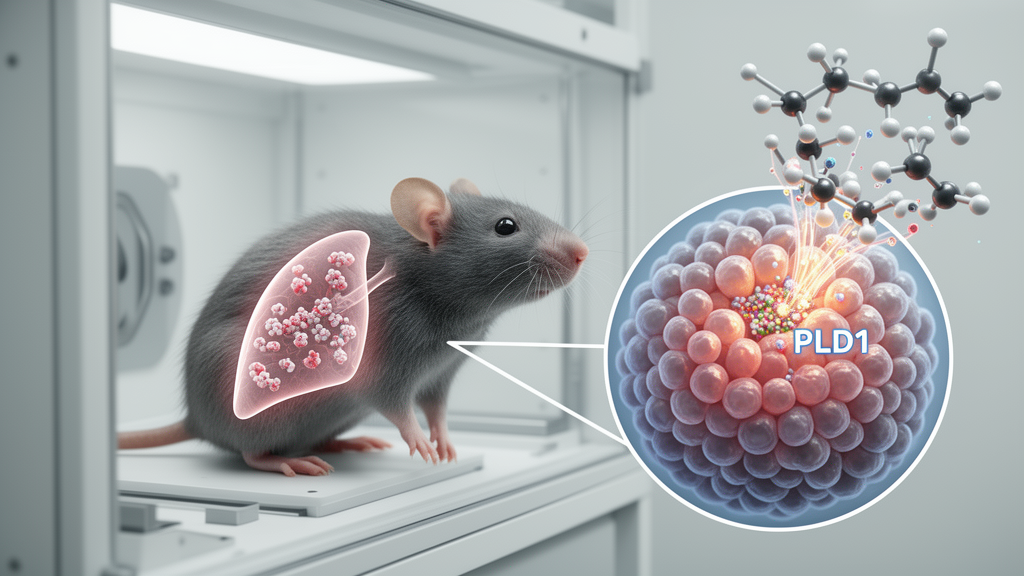
A UTHealth Houston-led team identified a molecular dependency in a subtype of non-small cell lung cancer and showed in mouse models that a drug delivered directly to cancer cells could reduce their reliance on phospholipase D1, significantly slowing tumor growth without other reported negative health effects. The peer-reviewed study, led by Xiaochao Tan, PhD, of the Department of Integrative Biology and Pharmacology at McGovern Medical School, was published in the Proceedings of the National Academy of Sciences. The findings describe a preclinical treatment strategy and do not establish clinical benefit in people with lung or other cancers.

The research centers on lung cancer cells with extra copies of an abnormal segment of chromosome 3q. Tan’s previous work found that these extra DNA copies encode several proteins associated with the Golgi apparatus, which modifies, sorts and packages proteins for delivery within cells or secretion outside them. In the current study, the team identified a chromosome 3q region containing the gene encoding phospholipase D1, or PLD1. The researchers found that lung cancer cells produced unusually high levels of PLD1 and used the Golgi apparatus to send cancer-promoting materials out of the cells, allowing tumors to grow and survive.

The team tested the approach in mouse models using a drug delivered directly to cancer cells that curbs their reliance on PLD1. This intervention significantly slowed tumor growth in the mice, and the investigators reported that it caused no other negative health effects in the experimental animals. The university’s news release did not identify the drug or provide the number of animals, effect size, dose, treatment schedule or measurements used to assess health effects, so the result cannot establish the magnitude, durability or general applicability of the benefit. It remains an experimental observation from mouse tumor models rather than evidence that an available therapy works in patients.

Extra copies of chromosome 3q are common in head and neck cancer and esophageal cancer, leading the researchers to propose that patients with those cancers may also benefit from targeting the same pathway. That application remains untested in the reported research: the experiments described involved lung cancer models, and the release did not present treatment results for head and neck or esophageal tumors. The study also does not establish how many patients with non-small cell lung cancer carry the relevant chromosome 3q changes, or whether elevated PLD1 and Golgi activity are sufficiently distinctive to identify candidates for this strategy. Direct delivery is also part of the experimental finding; the release does not show how the method might work after systemic administration in people or whether it can reach and selectively affect tumor cells in a clinical setting.

Non-small cell lung cancer is the most common type of lung cancer and is often diagnosed after it has spread to other parts of the body, while therapeutic options for the subtype examined in the research remain limited. The study identifies a specific weakness in this setting: cancer cells with extra copies of chromosome 3q appear to depend on PLD1 and Golgi-mediated secretion to promote tumor growth and survival. By delivering a drug directly to the affected cells, the team interrupted that dependency and reduced tumor growth in mice, with no additional negative health effects reported. The work provides a technically defined target for further testing, but its scope is limited to cellular findings and mouse models; it does not demonstrate safety, efficacy or patient selection in humans.

Subject of Research: Preclinical targeting of PLD1-dependent Golgi secretion in non-small cell lung cancer

Article Title: Researchers unlock promising lung cancer treatment option

Article References: Researchers unlock promising lung cancer treatment option. Original publication (Bibliographic details unavailable.)

Image Credits: AI Generated

DOI: Not provided

Keywords: lung cancer, non-small cell lung cancer, phospholipase D1, PLD1, Golgi apparatus, chromosome 3q, tumor growth, drug delivery, mouse models, cancer secretion, Researchers, unlock

Cite Scienmag News

Nathaniel Bowman. (October 21, 2026). Mouse study identifies PLD1 target in non-small cell lung cancer. Scienmag. https://scienmag.com/mouse-study-identifies-pld1-target-in-non-small-cell-lung-cancer/

Nathaniel Bowman. "Mouse study identifies PLD1 target in non-small cell lung cancer." Scienmag, 21 October 2026, https://scienmag.com/mouse-study-identifies-pld1-target-in-non-small-cell-lung-cancer/. Accessed 21 October 2026.

Nathaniel Bowman. "Mouse study identifies PLD1 target in non-small cell lung cancer." Scienmag. October 21, 2026. https://scienmag.com/mouse-study-identifies-pld1-target-in-non-small-cell-lung-cancer/


Tags: cancer cell metabolismcancer secretionchromosome 3qchromosome 3q amplificationDrug deliveryGolgi apparatusGolgi apparatus in cancerlung cancerlung cancer genetic markersmolecular dependency in cancer cellsmouse modelsmouse models of lung cancernon-small cell lung cancerphospholipase D1phospholipase D1 role in tumor growthPLD1PLD1 inhibitionpreclinical cancer treatment strategiesResearcherstargeted drug delivery in lung cancertumor growthtumor growth reductionunlock
Share26Tweet16
Previous Post

Non-invasive adjunctive diagnostic models incorporating high-frequency ultrasound and shear wave elastography for pediatric Duchenne muscular dystrophy

Next Post

Panamanian Megalopta bees nested in 11 woody plant species

Related Posts

Network and cell study links carboplatin to four melanoma targets
Cancer

Network and cell study links carboplatin to four melanoma targets

October 21, 2026
Longer Scalp Cooling Sessions Emerge as Strongest Shield Against Chemotherapy Hair Loss
Cancer

Network meta-analysis finds prolonged scalp hypothermia may preserve hair during chemotherapy

October 21, 2026
Huntsman Cancer Institute to Host 2027 Frontiers Symposium
Cancer

Huntsman Cancer Institute to Host 2027 Frontiers Symposium

October 20, 2026
Machine Learning Uncovers Shikonin as a Hypoxia-Selective Weapon Against Triple-Negative Breast Cancer
Cancer

Machine learning and cell study link shikonin to Parkin-dependent activity in hypoxic triple-negative breast cancer

October 20, 2026
Clinical score separates idiopathic granulomatous mastitis from breast cancer mimics
Cancer

Clinical score separates idiopathic granulomatous mastitis from breast cancer mimics

October 20, 2026
Review maps mechanisms, diagnosis and treatment of primary cardiac angiosarcoma
Cancer

Review maps mechanisms, diagnosis and treatment of primary cardiac angiosarcoma

October 20, 2026
Next Post
Panamanian Megalopta bees nested in 11 woody plant species

Panamanian Megalopta bees nested in 11 woody plant species

  • Mothers who receive childcare support from maternal grandparents show more optimized

    Mothers who receive childcare support from maternal grandparents show more parental warmth, finds NTU Singapore study

    27656 shares
    Share 11059 Tweet 6912
  • University of Seville Breaks 120-Year-Old Mystery, Revises a Key Einstein Concept

    1061 shares
    Share 424 Tweet 265
  • Bee body mass, pathogens and local climate influence heat tolerance

    682 shares
    Share 273 Tweet 171
  • Researchers record first-ever images and data of a shark experiencing a boat strike

    546 shares
    Share 218 Tweet 137
  • Groundbreaking Clinical Trial Reveals Lubiprostone Enhances Kidney Function

    531 shares
    Share 212 Tweet 133
Science

Embark on a thrilling journey of discovery with Scienmag.com—your ultimate source for cutting-edge breakthroughs. Immerse yourself in a world where curiosity knows no limits and tomorrow’s possibilities become today’s reality!

RECENT NEWS

  • Panamanian Megalopta bees nested in 11 woody plant species
  • Mouse study identifies PLD1 target in non-small cell lung cancer
  • Non-invasive adjunctive diagnostic models incorporating high-frequency ultrasound and shear wave elastography for pediatric Duchenne muscular dystrophy
  • Laboratory HPT study links kinks and dislocations to alloy strengthening

Categories

  • Agriculture
  • Anthropology
  • Archaeology
  • Athmospheric
  • Biology
  • Biotechnology
  • Blog
  • Bussines
  • Cancer
  • Chemistry
  • Climate
  • Earth Science
  • Editorial Policy
  • Marine
  • Mathematics
  • Medicine
  • Pediatry
  • Policy
  • Psychology & Psychiatry
  • Science Education
  • Science News
  • Social Science
  • Space
  • Technology and Engineering

Subscribe to Blog via Email

Enter your email address to subscribe to this blog and receive notifications of new posts by email.

Join 5,150 other subscribers

© 2025 Scienmag - Science Magazine

Welcome Back!

Login to your account below

Forgotten Password?

Retrieve your password

Please enter your username or email address to reset your password.

Log In
No Result
View All Result
  • HOME
  • SCIENCE NEWS
  • CONTACT US

© 2025 Scienmag - Science Magazine

Discover more from Science

Subscribe now to keep reading and get access to the full archive.

Continue reading