


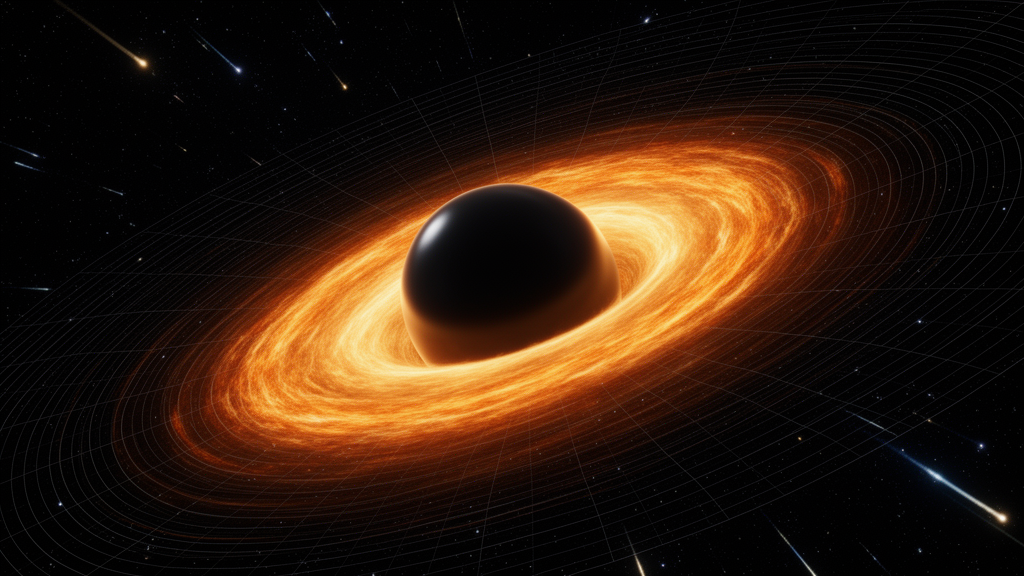
A team of theoretical physicists has constructed an exact spherically symmetric vacuum solution within Freund–Nambu scalar–tensor gravity, extending the well-known Janis–Newman–Winicour (JNW) naked-singularity spacetime into a richer theoretical arena. The work, published in The European Physical Journal C by Akbar Davlataliev, Bobur Turimov, Bobomurat Ahmedov, Yuri Vyblyi, Chengxun Yuan, and Chen Zhou, does more than solve a set of coupled field equations. It connects a half-century-old alternative to general relativity directly to X-ray observations of stellar-mass black holes, deriving orbital frequencies, accretion efficiencies, and the first observational constraints on the theory's new parameters using real quasi-periodic oscillation data from two famous microquasars.
Scalar–tensor theories have long been considered promising alternatives to the standard cosmological model because they introduce scalar degrees of freedom in addition to the metric tensor of general relativity. The Freund–Nambu formulation, introduced by Emil Freund and Yutaka Nambu in the late 1960s, augments the gravitational action with a real scalar field φ of mass μ that couples nonminimally to the Ricci scalar and, crucially, to matter itself. In the action written in geometrized units, the kinetic term of the scalar field is divided by the factor 1 + 2qφ, where the constant q governs the strength of the coupling between the scalar field and geometry.
Matter is coupled to the conformally rescaled metric (1 + 2qφ)g_αβ, so the scalar field does not merely ride along with gravity but actively reshapes how matter and spacetime talk to each other. Varying the total action with respect to the metric and the scalar field yields a set of coupled nonlinear differential equations: the Einstein tensor equals the sum of the scalar-field and matter energy-momentum tensors, while the scalar field obeys a wave equation with a source proportional to q times the total trace of the energy-momentum. To make analytic progress, the authors focused on the vacuum configuration, setting the scalar mass μ to zero and switching off the matter sector entirely.
This reduction isolates the purely geometric effects of a self-interacting massless scalar field on a curved background. Working with a static, spherically symmetric ansatz in which the product of the time and radial metric components equals minus one, the team reduced the field equations to a pair of simple differential equations for the metric functions. The radial function λ satisfies λ'' − 2 = 0, giving λ = r² + 2C₃r + C₄, while the second metric function follows from an integrable first-order relation.
After a coordinate transformation and careful identification of the integration constants with the mass M of the central object and a scalar parameter n, the final metric takes a strikingly compact form: ds² = −(1 − 2M/nr)ⁿ dt² + (1 − 2M/nr)⁻ⁿ dr² + r²(1 − 2M/nr)^(1−n)(dθ² + sin²θ dφ²). The associated scalar field profile is where the new physics lives. In Freund–Nambu theory the scalar field acquires a nonlinear self-interaction term proportional to q, so the solution reads φ = (√(1−n²)/2) ln(1 − 2M/nr) multiplied by a bracket containing an additional q-dependent logarithmic correction.
When q vanishes, the solution reduces exactly to the classic Janis–Newman–Winicour metric with its massless scalar field, confirming that the new spacetime is a natural parametrized extension of that important class. The metric itself retains the JNW form governed by n, while the new parameter q deforms only the scalar field's radial profile. This separation is elegant: the geometry is unchanged, but the scalar field that test particles can feel directly is modified, opening a clean observational window onto the coupling.
Naked singularities are the provocative backdrop for this entire program. In general relativity, a naked singularity is a region where curvature invariants such as the Kretschmann scalar diverge without being hidden behind an event horizon, meaning null and timelike geodesics originating arbitrarily close to the singularity can reach distant observers. Because the Freund–Nambu extension preserves the JNW metric while deforming the scalar profile, it offers a controlled laboratory for asking how scalar self-interaction changes strong-field phenomena without altering the underlying geometry.
The team then turned to test-particle dynamics, introducing a direct linear coupling g_s between a massive particle and the scalar field through an effective mass m* = m(1 + g_sφ). The authors are careful to note that this coupling is phenomenological: in minimally coupled models ordinary particles need not feel the scalar at all, while in scalar–tensor theories an effective coupling can arise through scalar-dependent masses or conformal-frame transformations. The parameters q and g_s therefore carry different physical meanings—q characterizes the background scalar configuration, while g_s characterizes the particle's scalar charge—and a specific relation between them would require a microscopic matter model beyond the scope of the analysis.
The innermost stable circular orbit, or ISCO, emerges as the key diagnostic. For g_s = 0 the team recovers the known analytic JNW result, r_ISCO = (3 + 1/n + √(5 − 1/n²))M. With nonzero coupling, the ISCO conditions become highly nontrivial because the nonlinear scalar contributions enter the effective potential multiplicatively, and numerical methods are required.
The results show a clear asymmetry with the sign of the coupling: for positive g_s the ISCO radius decreases, indicating that attractive scalar interactions enhance orbital stability at smaller radii, while for negative g_s the ISCO shifts outward, signaling a destabilizing effect. Radiative efficiency, defined as η = 1 − E_ISCO, follows suit. At n = 1 all curves converge to roughly 6 percent regardless of parameters, but for n ≠ 1 positive g_s enhances efficiency while negative g_s reduces it, and q mainly splits the curves apart.
In Kerr spacetime the ISCO radius depends on the black hole spin parameter a, shrinking from 6M for a Schwarzschild black hole toward M for a maximally rotating one. The authors demonstrate that certain combinations of q, n, and g_s can reproduce ISCO shifts typically attributed to spin, even when the intrinsic angular momentum is absent. Small values of the spacetime parameter n produce ISCO changes comparable to those of rapidly rotating Kerr black holes.
For certain parameter combinations, the effective ISCO radius corresponds to spin values comparable to those inferred for Sgr A* (a/M ≈ 0.65–0.9) and M87* (a/M ≈ 0.75–1). This means that interpreting X-ray observations in terms of spin alone could be misleading, and that multi-frequency quasi-periodic oscillation modeling is essential to break the degeneracy. That modeling is exactly what the team delivered.
By expanding the effective potential around circular orbits, they derived the radial and vertical epicyclic frequencies; by spherical symmetry the vertical frequency coincides with the orbital frequency. Within the epicyclic resonance model, the upper twin-peak QPO frequency is identified with the orbital frequency and the lower with the radial epicyclic frequency. The parameter n exerts the most pronounced influence, decreasing both frequencies across the radial range, while q modestly increases both and g_s raises the radial frequency while suppressing the orbital one.
The consistency of the fits with real data suggests that Freund–Nambu scalar–tensor gravity remains a viable and testable framework for strong-field physics beyond general relativity. The distinctive imprints of the parameters q, n, and g_s on orbital frequencies, ISCO locations, and accretion efficiency mean that current and future X-ray observations can discriminate between this class of theories and the Kerr paradigm.
Subject of Research: An exact spherically symmetric vacuum solution in Freund–Nambu scalar–tensor gravity and its astrophysical constraints from black hole X-ray observations
Article Title: Spherically symmetric vacuum solution in Freund–Nambu scalar–tensor gravity
Article References: Davlataliev, A., Turimov, B., Ahmedov, B., Vyblyi, Y., Yuan, C., & Zhou, C. (2026). Spherically symmetric vacuum solution in Freund–Nambu scalar–tensor gravity. The European Physical Journal C, 86(10), Article 1177. https://doi.org/10.1140/epjc/s10052-026-16324-5
Image Credits: AI Generated
DOI: 10.1140/epjc/s10052-026-16324-5
Keywords: scalar-tensor gravity, Freund-Nambu theory, naked singularity, Janis-Newman-Winicour spacetime, black holes, ISCO, quasi-periodic oscillations, epicyclic resonance, Markov Chain Monte Carlo, microquasars, X-ray binaries, modified gravity
Cite Scienmag News
Grant Pearson. (October 21, 2026). Physicists Derive Exact Naked-Singularity Solution in Freund–Nambu Gravity and Constrain It with X-Ray Data. Scienmag. https://scienmag.com/physicists-derive-exact-naked-singularity-solution-in-freund-nambu-gravity-and-constrain-it-with-x-ray-data/
Grant Pearson. "Physicists Derive Exact Naked-Singularity Solution in Freund–Nambu Gravity and Constrain It with X-Ray Data." Scienmag, 21 October 2026, https://scienmag.com/physicists-derive-exact-naked-singularity-solution-in-freund-nambu-gravity-and-constrain-it-with-x-ray-data/. Accessed 21 October 2026.
Grant Pearson. "Physicists Derive Exact Naked-Singularity Solution in Freund–Nambu Gravity and Constrain It with X-Ray Data." Scienmag. October 21, 2026. https://scienmag.com/physicists-derive-exact-naked-singularity-solution-in-freund-nambu-gravity-and-constrain-it-with-x-ray-data/


