


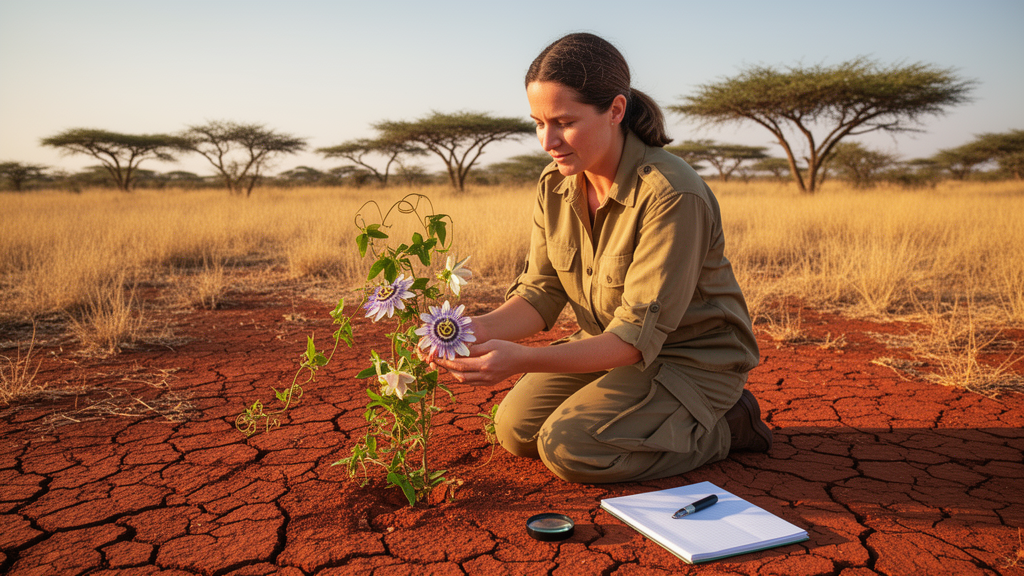
A morphological and molecular study supports the recognition of Adenia sajoreciae as a new species in the passionflower family, Passifloraceae. The plant was documented in Kenya’s Lake Baringo region, and an analysis of 82 nuclear ribosomal internal transcribed spacer sequences placed the new species within Adenia section Blepharanthes, as the sister taxon of A. ellenbeckii. The authors provisionally assessed the species as Endangered based on its restricted distribution and projected decline in occupied area and habitat.
The discovery followed botanical exploration in the Lake Baringo region conducted from 2023 to 2025 as part of the Flora of Kenya project. Researchers initially regarded an unusual plant as potentially resembling A. ellenbeckii, but its entirely glabrous vegetative habit and entire, spinose-dentate leaves without laminar glands distinguished it from that species. Consultation of specimens, regional flora treatments and monographs did not produce a match among the accepted Kenyan species. Herbarium examination showed that the plant had first been collected in Baringo County in February 1990 and was later documented in Samburu County, although it had not previously been identified to species level.
For the molecular analysis, the researchers collected leaf tissue in the field, dried it in silica gel, extracted genomic DNA with a modified cetyltrimethylammonium bromide method, and amplified and bidirectionally sequenced the nuclear ribosomal ITS region using Sanger sequencing. Three new ITS sequences from A. sajoreciae were combined with published Adenia sequences downloaded from GenBank, producing 82 accessions in total. Sequences were aligned and trimmed before phylogenetic inference by maximum likelihood in IQ-TREE and Bayesian analysis in MrBayes. Maximum-likelihood support was evaluated with 1,000 bootstrap replicates, while the Bayesian analyses used two independent runs of four chains and were continued until convergence. Representatives of section Ophiocaulon were used as an internal outgroup.
The maximum-likelihood tree recovered five principal clades. The three accessions of A. sajoreciae formed a monophyletic group nested within section Blepharanthes, with 100% bootstrap support and a posterior probability of 1.00. This group was sister to A. ellenbeckii, with 99% bootstrap support and a posterior probability of 1.00. The study notes that support for some deeper relationships within the genus was variable and that the sectional circumscriptions were only partly congruent with the recovered topology. Thus, the molecular result provides strong support for the species-level placement and close relationship of the new taxon, while some internal relationships among Adenia sections remain less certain.
Direct comparison of A. sajoreciae and A. ellenbeckii used a 495-base-pair overlapping ITS alignment. The taxa differed by two fixed C-to-G substitutions at alignment positions 14 and 57 and a fixed indel at position 462. One accession of A. sajoreciae had an additional substitution at position 146, interpreted as intraspecific polymorphism. Pairwise p-distances ranged from 0.0020 to 0.0061, corresponding to approximately one to three nucleotide differences across the alignment. The study characterized this fixed ITS divergence as typical of closely related species within Adenia and treated it, together with the morphological discontinuities, as corroborative evidence for recognizing the new taxon.
Morphological comparisons were based on living plants, photographs and 16 herbarium specimens, with additional observations made in the field and through collections at several herbaria. Adenia sajoreciae is a perennial herb or scandent subshrub reaching 1.7–2.0 metres and arising from a tuberous rootstock, with succulent basal stems. Its simple leaves measure 6–12 by 2–9 cm, have spinose-dentate margins and lack laminar glands. The species has minute, subulate, caducous stipules. Male flowers are 2–3 mm wide and female flowers 3–5 mm wide. Mature fruit is globose and 2–3 cm in diameter. These characters distinguish it from A. ellenbeckii, which is subglabrous to pubescent, has persistent triangular stipules, may have deeply palmately three-to-seven-lobed or pinnatifid leaves with laminar glands, bears larger flowers and produces larger subglobose to ellipsoid fruit.
All documented records of A. sajoreciae come from Baringo and Samburu counties in Kenya. The species has been recorded at Kapkoror, Ruko Community Conservancy and Lonjorin, where it occupies well-drained rocky soils in open dry bushland with minimal anthropogenic disturbance. Associated vegetation includes Vachellia, Boscia, Grewia, Commiphora and Adenium obesum, together with other xerophytic shrubs and succulents. Recorded sites range from approximately 900 to 1,200 metres in elevation. Field observations placed flowering between January and March and fruiting between February and March. The leaves are cooked as vegetables in Baringo County.
Under the IUCN Red List categories and criteria, the authors assessed A. sajoreciae as Endangered, with the criterion EN B2ab(ii, iii). Using a 2-by-2-kilometre grid, they estimated an area of occupancy of 12 km² and an extent of occurrence of 943.1 km². The assessment is based on no more than five threat-defined locations and a projected continuing decline in area of occupancy and habitat area, extent and quality. The species is known from five herbarium specimens, while one surveyed population contained approximately 15 individuals. Livestock grazing and possible airstrip expansion were identified as ongoing or plausible threats to its dry-bushland habitat.
The epithet sajoreciae recognizes the Sino-Africa Joint Research Center, established in Kenya and headquartered in Nairobi in 2013 by the Chinese Academy of Sciences for its contributions to documenting plant diversity and conservation in Africa. The study also provides a modified key identifying the Adenia species recorded in Kenya, including A. sajoreciae. Its principal limitation is the small number of known populations and individuals, together with the limited geographic and population sampling available for the conservation assessment; the authors consequently regarded further floristic surveys in northern Kenya as particularly important.
Subject of Research: Description, phylogenetic placement and conservation assessment of the newly recognized Kenyan plant Adenia sajoreciae
Article Title: Adenia sajoreciae ( Passifloraceae ), a new species from Kenya and its phylogenetic placement
Article References: Kipkemoi, E., Munyao Mutie, F., Qiu, X.-D., Kirika, P. M., Muchuku, J. K., Nyakudya, E., Yan, X., Wang, S.-W., Wei, N., & Wang, Q.-F. (2026). Adenia sajoreciae (Passifloraceae), a new species from Kenya and its phylogenetic placement. PhytoKeys, 276, 197-216. https://doi.org/10.3897/phytokeys.276.190059
Image Credits: AI Generated
DOI: 10.3897/phytokeys.276.190059
Keywords: Adenia sajoreciae, new species, Passifloraceae, Kenya, plant taxonomy, ITS phylogeny, morphology, Endangered, Baringo County, Samburu County, Adenia, sajoreciae
Cite Scienmag News
Margaret Porter. (October 20, 2026). Morphological and ITS analysis supports Adenia sajoreciae as a new Kenyan species assessed as Endangered. Scienmag. https://scienmag.com/morphological-and-its-analysis-supports-adenia-sajoreciae-as-a-new-kenyan-species-assessed-as-endangered/
Margaret Porter. "Morphological and ITS analysis supports Adenia sajoreciae as a new Kenyan species assessed as Endangered." Scienmag, 20 October 2026, https://scienmag.com/morphological-and-its-analysis-supports-adenia-sajoreciae-as-a-new-kenyan-species-assessed-as-endangered/. Accessed 20 October 2026.
Margaret Porter. "Morphological and ITS analysis supports Adenia sajoreciae as a new Kenyan species assessed as Endangered." Scienmag. October 20, 2026. https://scienmag.com/morphological-and-its-analysis-supports-adenia-sajoreciae-as-a-new-kenyan-species-assessed-as-endangered/


