


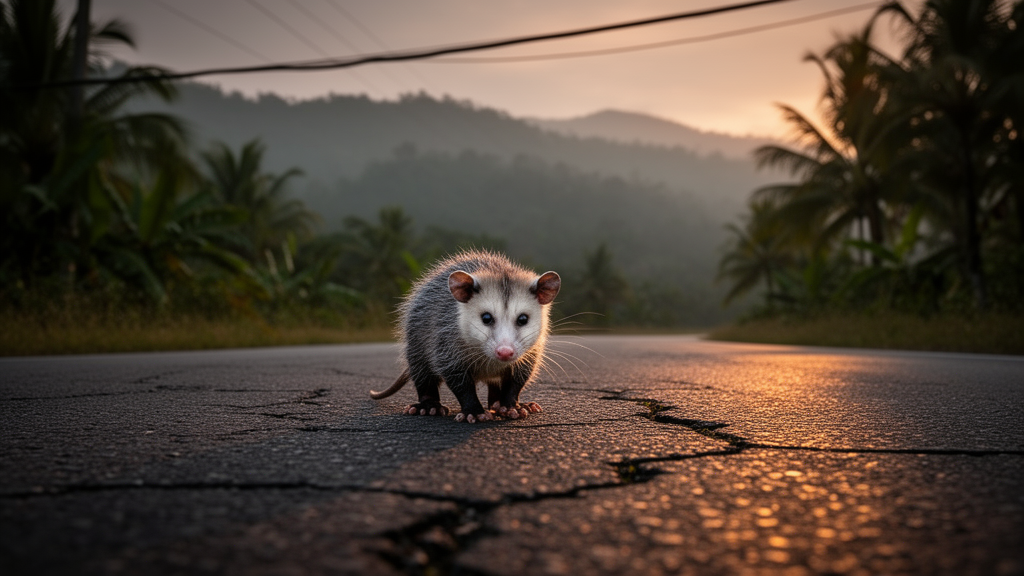
A field study documented six observations of two opossum species in southern Mexico between 2016 and 2023, adding municipal or locality records for Derby’s woolly opossum, Caluromys derbianus, and the gray four-eyed opossum, Philander opossum. The observational records were based on photographs and direct sightings rather than a population survey, and the study did not estimate abundance, trends or the effects of the hazards it documented.
Researchers gathered the observations with photographic cameras and smartphones and recorded coordinates using a Garmin GPSMAP 65 in the WGS84 datum. They identified the animals with taxonomic references and compared the new observations with vouchered records retrieved from GBIF and published records of both species in Mexico. In R version 4.2.3, they used the Species Occurrence Data Sources-spooc and CoordinateCleaner packages to remove duplicate occurrences and records lacking coordinates. SimpleMappr was used to map the resulting distribution data.
Three C. derbianus observations were recorded in Veracruz. In May 2016, a female was found dead at the edge of a road in Cuichapa at 415 metres elevation, accompanied by two young that were recovered by a villager. One young animal did not survive, while the second was assisted in captivity. The Cuichapa site was a patch of high evergreen forest surrounded by sugarcane crops and near human settlements. This was the first municipal record for the species there; the closest earlier record was 8.28 kilometres away in Tezonapa municipality and dated from 1943.
At Tlilapan, Veracruz, an adult male with difficulty moving was found near a rural road in December 2017 and taken into captivity by local villagers. The observation site, at 1,200 metres elevation, was surrounded by high evergreen forest, human settlements and irrigated agricultural land. It constituted the first municipal record for C. derbianus; the nearest previous occurrence was approximately 14.46 kilometres away in Fortín de las Flores and dated from 1962. In December 2023, the researchers photographed an individual electrocuted on high-tension power lines at a height of around five metres in Las Lajas, Tezonapa, at 435 metres elevation. High evergreen forest there was associated with coffee and banana plantations. The observation represented a new locality within Tezonapa municipality, where the closest earlier record was 10.84 kilometres away and dated from 1943.
Three P. opossum records were also documented. An adult was observed at 00:30 on July 10, 2017, in a tree approximately 3.5 metres high in Cuichapa, Veracruz, at 420 metres elevation. The site was surrounded by a sugarcane field and irrigated agricultural land. It was the first recorded individual for the municipality; the closest previous record was 9.57 kilometres away in Tezonapa municipality and dated from 1943.
On March 17, 2022, at 22:13, an individual was photographed walking among trees approximately three metres high on a riverbank in La Esperanza, Santiago Comaltepec, Oaxaca. The location, at 500 metres elevation, lay between mountain cloud forest and high evergreen forest. It was the first record for Santiago Comaltepec municipality and was about 50.28 kilometres northeast of the nearest vouchered occurrence, in San Juan Bautista Tuxtepec, Oaxaca, from 1947. A third P. opossum was observed at 23:00 on March 23, 2022, among Guazuma ulmifolia trees in the canopy at Rancho El Cacao, Mapastepec, Chiapas. The site was intended for intensive cattle farming and grassland cultivation and stood at 29 metres elevation. The closest earlier record for Mapastepec was 7.14 kilometres east and dated from 1943.
Both species are classified as Least Concern globally by the International Union for Conservation of Nature, but their national treatment differs. Mexico’s official legislation, NOM-ECOL-059-SEMARNAT-2010, lists C. derbianus as Threatened, while P. opossum is not included. The new woolly opossum records came from anthropized settings that included sugarcane fields, rural roads and high-tension cables, and two involved deaths. Other evidence cited in the study associates Caluromys in anthropized areas with vehicle strikes, electrocution and attacks by domestic animals. For P. opossum, the study identifies habitat loss related to land-use change and agriculture as a principal concern, citing documented roadkill in Costa Rica and predation by domestic cats in Mexico.
The conservation notes also describe ecological roles for the two species. Derby’s woolly opossum has a varied diet that includes fleshy fruits, insects, small vertebrates, plant material, nectar, pollen and possibly carrion. The gray four-eyed opossum acts as a predator and contributes to seed dispersal. The authors note that occurrence records can inform distribution maps, estimated potential distributions, conservation priorities and assessments of population status, while helping identify landscape threats such as habitat loss, fragmentation and interactions with natural predators or introduced species.
Although the records provide precise spatial and temporal documentation, the study is limited by its small number of opportunistic observations. Two records consisted of animals found dead, and the researchers did not use systematic sampling to infer the species’ distribution across all suitable habitat. The findings therefore establish additional documented localities and provide conservation context, but they do not demonstrate population changes, quantify mortality rates or establish causal effects of roads, power lines, agriculture, predators or human activity on either opossum population.
Subject of Research: Field records and conservation notes for two opossum species in southern Mexico
Article Title: New records of two marsupials ( Didelphimorphia , Didelphidae ) and conservation notes from southern Mexico
Article References: Contreras-Calvario, A. I., Julián-Caballero, C. C., Mora-Reyes, A., & Arreortúa, M. (2024). New records of two marsupials (Didelphimorphia, Didelphidae) and conservation notes from southern Mexico. Neotropical Biology and Conservation, 19(2), 79-86. https://doi.org/10.3897/neotropical.19.e119836
Image Credits: AI Generated
DOI: 10.3897/neotropical.19.e119836
Keywords: opossums, Caluromys derbianus, Philander opossum, southern Mexico, field observations, species records, conservation, habitat fragmentation, roadkill, electrocution, records, marsupials
Cite Scienmag News
Margaret Porter. (October 20, 2026). Field records add localities for two opossum species in southern Mexico. Scienmag. https://scienmag.com/field-records-add-localities-for-two-opossum-species-in-southern-mexico/
Margaret Porter. "Field records add localities for two opossum species in southern Mexico." Scienmag, 20 October 2026, https://scienmag.com/field-records-add-localities-for-two-opossum-species-in-southern-mexico/. Accessed 20 October 2026.
Margaret Porter. "Field records add localities for two opossum species in southern Mexico." Scienmag. October 20, 2026. https://scienmag.com/field-records-add-localities-for-two-opossum-species-in-southern-mexico/


