


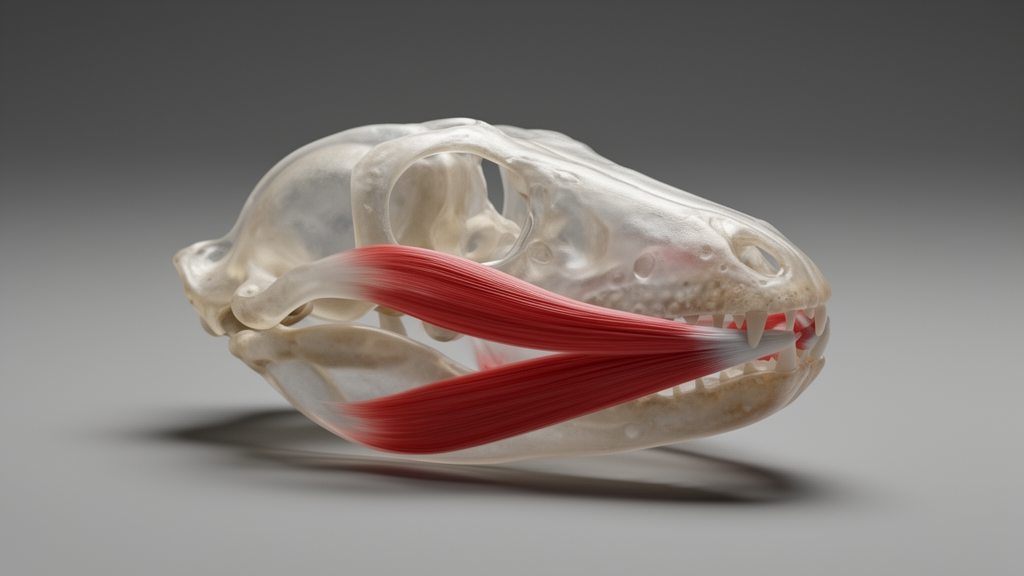
A qualitative comparative and biomechanical analysis argues that the cranial architecture of tetrapods reflects interacting developmental processes, feeding forces, neck musculature, body posture and external forces applied to the head. The study reconstructs proposed stress flows in four fossil tetrapods: the temnospondyl Parotosuchus helgolandicus, the reptiliomorph Anthracosaurus russelli, the early archosauriform Euparkeria capensis and the ceratopsid dinosaur Protoceratops andrewsi. The resulting scenarios are qualitative interpretations rather than measured causal relationships.
The central proposal is that regions experiencing mechanical stress tend to become ossified, whereas areas subjected to relatively little stress may remain open or become excavated. The author develops graphical stress-flow diagrams to illustrate this principle and expands a recent biomechanical approach to skull construction. Jaw musculature, neck musculature, the scruff of the neck, the lower jaw and the postcranial skeleton are considered together as possible routes through which forces are transmitted, forming a proposed “circle of forces.”
Developmental evidence from lungfishes provides a model for an ancestral condition among early tetrapods. Free-living lungfish larvae lack a fully formed dermal skeleton, their temporal bones are loosely positioned on the head, and their jaw muscles originate from the braincase. As dermal bones develop and connect in adults, the jaw musculature expands laterally onto the temporal bones, adding fibres and increasing potential bite force. The author suggests that comparable reorganization occurred in early tetrapods, while metamorphosis in dissorophoid temnospondyls and direct development in many reptiliomorphs produced distinct cranial developmental pathways. The emergence of the amniotic egg eliminated the free-living larval stage and is associated with late development of jaw-muscle attachments and a hatchling that more closely resembles the adult.
Parotosuchus helgolandicus illustrates the proposed effects of anterior biting on a relatively ancestral tetrapodomorph skull. The reconstruction places compressive stress along the dorsal snout and tensile stress along its underside. Because the eye and other sensory organs develop early and constrain the later arrangement of cranial bones, the stress paths pass above and below the orbit. The region immediately behind the eye is comparatively unstressed, providing a possible mechanical explanation for the otic notch found in early semiaquatic tetrapods. The notch is associated with the ancestral vertebrate spiracle, which acquired a hearing-related function in tetrapods.
Anthracosaurus russelli represents a different combination of loading conditions. This unusually tall-skulled Carboniferous reptiliomorph had large teeth, extensive palatal dentition and temporal fenestration resembling that of synapsid amniotes and several parareptiles. The analysis relates this architecture to strong anterior biting, comparatively weak posterior biting and the action of lateral neck muscles. Increased head mobility in reptiliomorphs is associated with stronger musculature inserting near the posterolateral skull and stiffening the retrotemporal region. The similarity between Anthracosaurus and amniotes illustrates a proposed convergence in temporal openings under similar mechanical demands, limiting their value as direct indicators of evolutionary relationships.
Euparkeria capensis is used to examine powerful posterior biting, transversal loading and the formation of several archosauriform openings. The proposed stress pattern links a strong posterior bite to separation of the upper temporal arcade and formation of an upper temporal fenestra, while similar mechanical conditions are associated with the antorbital fenestra and a mandibular opening in the lower jaw. Forces generated when prey or food moves the head transversely produce different paths through the temporal bars and occipital region. The analysis consequently presents an anterior-bite-dominated skull with an infratemporal opening as a possible amniote ancestral condition, while associating the upper temporal opening of diapsids with posterior biting.
Protoceratops andrewsi extends the model beyond feeding. The reconstruction includes the beak, frill, brow protuberances and exposed cheek region, as well as hypothetical forces associated with structures that could have functioned as weapons. A force concentrated on the posterolateral frill is modelled as producing stress paths toward different neck muscles and leaving part of the supratemporal fenestra comparatively unstressed. Another pathway leaves a parietal fenestra within a single bone, unlike the other openings discussed, which are bounded by at least two bones. Forces directed at a nasal horn, cheek weapon or exposed lateral horn could redirect compressive and tensile stresses through the braincase, skull roof, cheek and neck musculature.
The proposed effects of cranial armour are conditional rather than universal. In ceratopsians with numerous spines or osteoderms, multiple external forces could create overlapping stress flows that hinder formation of a parietal foramen, whereas concentrated forces from a single frill edge or conspicuous osteoderm could leave a more clearly bounded opening. The same reasoning is applied to the Late Triassic turtle Proganochelys: newly reported cranial horn cores and other osteoderms are considered alongside neck retraction as possible influences on closure of temporal regions. These are hypotheses about interacting mechanical influences, not quantitative demonstrations of how the openings formed.
The analysis also connects cranial loading to the postcranial skeleton. Jaw muscles can redirect bite stresses through the lower jaw, while neck muscles transfer transversal and external loads into the vertebral column, shoulders, forelimbs and ultimately the ground. Within this model, upright hind limbs, sprawled forelimbs, transverse vertebral processes and shoulder anatomy may reflect not only locomotion but also stabilization of the head during feeding or combat. The paper concludes that tetrapod skull architecture should be interpreted holistically through development, behaviour and biomechanics, while acknowledging that its graphical reconstructions are qualitative and that finite-element analyses and other quantitative tests were outside the study’s scope.
Subject of Research: Biomechanical and developmental analysis of cranial architecture in four fossil tetrapods.
Article Title: Terrestrialisation and the cranial architecture of tetrapods
Article References: Werneburg, I. (2024). Terrestrialisation and the cranial architecture of tetrapods. Fossil Record, 27(3), 473-497. https://doi.org/10.3897/fr.27.137860
Image Credits: AI Generated
DOI: 10.3897/fr.27.137860
Keywords: tetrapod skull evolution, tetrapod terrestrialisation, cranial biomechanics, stress-flow reconstruction, skull fenestration, jaw biomechanics, neck musculature, cranial armour, fossil vertebrates, Terrestrialisation, cranial, architecture
Cite Scienmag News
Gavin Prescott. (October 20, 2026). Qualitative stress-flow analysis links tetrapod skull architecture to development, feeding and combat. Scienmag. https://scienmag.com/qualitative-stress-flow-analysis-links-tetrapod-skull-architecture-to-development-feeding-and-combat/
Gavin Prescott. "Qualitative stress-flow analysis links tetrapod skull architecture to development, feeding and combat." Scienmag, 20 October 2026, https://scienmag.com/qualitative-stress-flow-analysis-links-tetrapod-skull-architecture-to-development-feeding-and-combat/. Accessed 20 October 2026.
Gavin Prescott. "Qualitative stress-flow analysis links tetrapod skull architecture to development, feeding and combat." Scienmag. October 20, 2026. https://scienmag.com/qualitative-stress-flow-analysis-links-tetrapod-skull-architecture-to-development-feeding-and-combat/


