


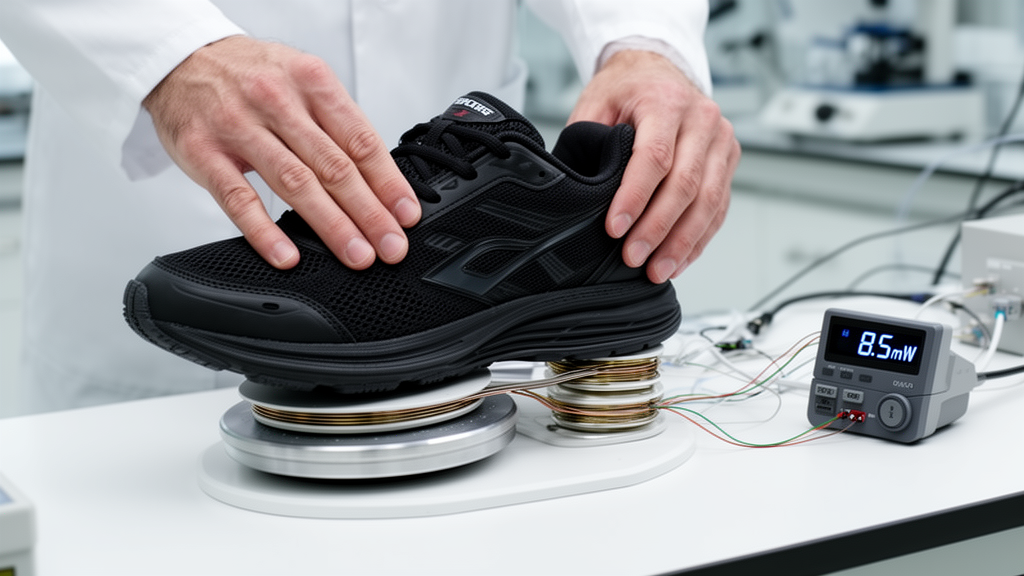
A hybrid electromagnetic and piezoelectric energy harvester designed to capture human heel-strike movement produced a maximum average output of 8.5 milliwatts from its electromagnetic branch in laboratory tests at an excitation frequency of 1.5 hertz. The prototype also reached an electromagnetic output power density of 23.3 microwatts per cubic centimetre under the same test condition. The device, described by its developers as an electromagnetic-piezoelectric hybrid energy harvester with frequency up-conversion performance, combines bearings, a gear transmission and ratchet mechanisms.
Its mechanical transmission converts the up-and-down stroke of heel movement into rotation of a rotor. As the rotor turns, its magnets move within the electromagnetic generating system, producing voltage through electromagnetic induction. A second conversion mechanism operates alongside the electromagnetic branch.
A driven magnet and a tip magnet couple the device’s motion into vibration of a piezoelectric cantilever beam, allowing the piezoelectric component to generate electrical voltage. The design therefore uses two energy-conversion approaches within a single heel-strike harvester rather than relying on only one physical effect. Researchers built the EPHEH prototype and performed detailed performance tests.
The reported maximum average output power of 8.5 milliwatts applied specifically to the electromagnetic branch at a pressing frequency of 1.5 hertz. At that same excitation frequency, the measured electromagnetic output power density was 23.3 microwatts per cubic centimetre. The supplied study abstract does not report a combined output value for the electromagnetic and piezoelectric branches.
The investigators also evaluated how the electrical output could be stored and used. Under excitation at 1.5 hertz, a 0.22-farad capacitor charged from 0 to 3.3 volts in four minutes. They then incorporated the harvester into an energy-harvesting shoe and carried out application experiments in which a microcontroller controlled the lighting state of an LED, while another configuration powered a thermohygrometer.
These demonstrations show that the prototype’s electrical output can operate low-power electronic components. They do not establish how much power the shoe would recover from unrestricted human walking, because the reported maximum output and power density came from tests conducted at a specified pressing frequency. The frequency-up-conversion design is central to the prototype’s operation.
Mechanical movement associated with heel strike is transferred into rotor rotation for electromagnetic generation, while magnet coupling excites the piezoelectric cantilever. These two branches are intended to make use of the same movement through distinct conversion pathways, although the reported headline performance figure concerns only the electromagnetic component. The capacitor-charging measurement and the operation of the LED and thermohygrometer move beyond instrument-only output tests, while the reported laboratory values quantify the prototype’s performance under controlled excitation.
The study’s scope remains centered on a constructed prototype and shoe-based demonstrations, and the available evidence does not quantify longer-term operation or harvesting from continuous, unconstrained walking.
Subject of Research: Electromagnetic and piezoelectric energy harvesting from human heel-strike movement
Article Title: Design and analysis of a frequency up-conversion electromagnetic-piezoelectric hybrid energy harvester for human heel strike movement energy harvesting
Article References: Xie, Z., Zhang, S., Zhu, Y., Fu, B., & Huang, W. (2026). Design and analysis of a frequency up-conversion electromagnetic-piezoelectric hybrid energy harvester for human heel strike movement energy harvesting. Journal of Materials Science. https://doi.org/10.1007/s10853-026-13926-y
Image Credits: AI Generated
DOI: 10.1007/s10853-026-13926-y
Keywords: energy harvesting, heel strike, piezoelectricity, electromagnetic induction, frequency up-conversion, wearable electronics, prototype testing, energy storage, Design, analysis, frequency, up-conversion
Cite Scienmag News
Denise Maddox. (October 20, 2026). Hybrid heel-strike harvester reaches 8.5 milliwatts in laboratory testing. Scienmag. https://scienmag.com/hybrid-heel-strike-harvester-reaches-8-5-milliwatts-in-laboratory-testing/
Denise Maddox. "Hybrid heel-strike harvester reaches 8.5 milliwatts in laboratory testing." Scienmag, 20 October 2026, https://scienmag.com/hybrid-heel-strike-harvester-reaches-8-5-milliwatts-in-laboratory-testing/. Accessed 20 October 2026.
Denise Maddox. "Hybrid heel-strike harvester reaches 8.5 milliwatts in laboratory testing." Scienmag. October 20, 2026. https://scienmag.com/hybrid-heel-strike-harvester-reaches-8-5-milliwatts-in-laboratory-testing/


