


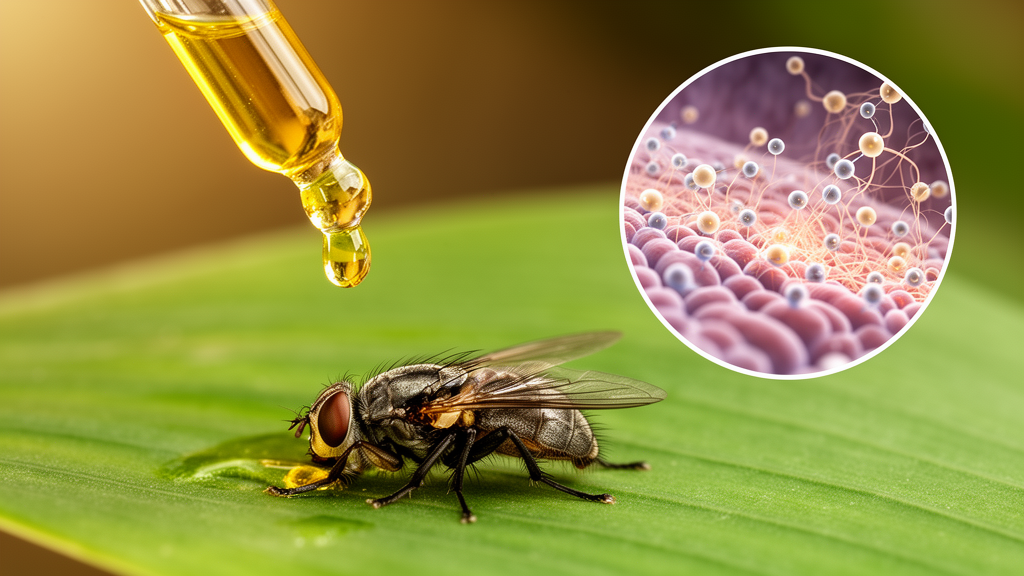
An in vitro screening study found that four essential oils and one methanolic extract had the strongest acetylcholinesterase inhibitory activity among 18 plant products tested. The results were based on an enzyme assay rather than tests of insect killing, repellence, crop protection or field performance.
The strongest activity was measured in essential oils of Monarda fistulosa, Satureja pilosa, Origanum vulgare subsp. hirtum and Thymus longidentatus, together with a methanolic extract of Leucojum aestivum. The study examined methanolic extracts and essential oils from 17 plant species in the Amaryllidaceae, Asteraceae, Brassicaceae and Lamiaceae families.
Plant material was collected from natural localities or obtained from the Institute of Biodiversity and Ecosystem Research and the Institute of Roses and Aromatic Plants. For methanolic extraction, 1 g of air-dried, powdered plant material was extracted with methanol for 24 hours at room temperature. After filtration, the solution was evaporated and the dry extract was stored at 4 °C until analysis. Essential oils were extracted by water distillation on a Clevenger apparatus using 50 g of dry plant material and 500 ml of water over two hours.
Acetylcholinesterase inhibition was measured using a modified version of Ellman’s colorimetric method in 96-well microplates. The assay used acetylcholinesterase from the electric eel Electrophorus electricus, acetylthiocholine iodide as the substrate, and 5,5′-dithiobis(2-nitrobenzoic acid). Samples were tested at concentrations between 0.001 and 1,000 µg/ml and incubated for 30 minutes at room temperature before substrate was added. Absorbance was measured at 405 nanometres after three minutes, and inhibition was calculated relative to a buffer control. Galanthamine served as the positive control.
Among the essential oils, M. fistulosa had the lowest reported half-maximal inhibitory concentration, or IC50, at 0.0042 mg/ml. The oil of S. pilosa followed at 0.0069 mg/ml. The O. vulgare subsp. hirtum and T. longidentatus oils had IC50 values of 0.30 and 0.72 mg/ml, respectively, while the L. aestivum methanolic extract had a value of 0.20 mg/ml. The galanthamine positive control had an IC50 of 0.0011 mg/ml, equivalent to 4.03 µM. IC50 values were measured in triplicate and reported as means.
A second group of seven methanolic extracts showed moderate activity, with IC50 values from 0.73 to 1.23 mg/ml. These extracts came from O. vulgare subsp. hirtum, Artemisia lerchiana, Artemisia santhonicum, Eupatorium cannabinum, Nepeta caria, Micromeria dalmatica and Salvia aethiopis. Several other samples had IC50 values above 1 mg/ml. For O. vulgare subsp. hirtum, the measured inhibition was stronger for the essential oil than for its methanolic extract.
The researchers used gas chromatography coupled with mass spectrometry to characterize compounds in the most active samples. Components were identified by comparing mass spectra and retention indices with authentic standards and a National Institute of Standards and Technology library. Carvacrol and thymol were major constituents of the essential oils of S. pilosa, O. vulgare subsp. hirtum and M. fistulosa. Carvacrol accounted for 51.18% of the oregano oil and 50.54% of the S. pilosa oil. Thymol represented 30.58% of the S. pilosa oil and 19.75% of the M. fistulosa oil. The M. fistulosa oil also contained thymoquinone at 25.41% and p-cymene at 21.82%.
In the T. longidentatus essential oil, the citral isomers neral and geranial accounted for 24.9% and 27.96% of the identified area. Galanthamine was the main alkaloid detected in the L. aestivum extract. The oregano methanolic extract contained carvacrol at 15.67%, compared with 51.18% in its essential oil, along with rosmarinic acid, flavonoid glycosides, malic acid and catechin. The authors noted that the difference in carvacrol content may be related to the difference in acetylcholinesterase inhibition, but the assay did not establish that individual compounds caused the measured effects.
The evidence in this study comprises in vitro enzyme measurements and GC/MS chemical characterization of selected samples. It does not demonstrate that the plant products kill or repel insects, protect crops under field conditions, or avoid effects on non-target organisms. The authors described the strong acetylcholinesterase activity as a prerequisite for potential insecticidal activity and recommended testing the plant products for insecticidal effects.
Subject of Research: In vitro acetylcholinesterase inhibition and chemical characterization of plant extracts and essential oils
Article Title: Plant products with acetylcholinesterase inhibitory activity for insect control
Article References: Georgiev, B., Nikolova, M., Aneva, I., Dzhurmanski, A., Sidjimova, B., & Berkov, S. (2022). Plant products with acetylcholinesterase inhibitory activity for insect control. BioRisk, 17, 309-315. https://doi.org/10.3897/biorisk.17.77052
Image Credits: AI Generated
Keywords: acetylcholinesterase inhibition, plant extracts, essential oils, in vitro assay, gas chromatography-mass spectrometry, insect control, carvacrol, thymol, galanthamine, Plant, products, acetylcholinesterase
Cite Scienmag News
Diana Fleming. (October 20, 2026). In vitro screening identifies plant products with strongest acetylcholinesterase inhibition. Scienmag. https://scienmag.com/in-vitro-screening-identifies-plant-products-with-strongest-acetylcholinesterase-inhibition/
Diana Fleming. "In vitro screening identifies plant products with strongest acetylcholinesterase inhibition." Scienmag, 20 October 2026, https://scienmag.com/in-vitro-screening-identifies-plant-products-with-strongest-acetylcholinesterase-inhibition/. Accessed 20 October 2026.
Diana Fleming. "In vitro screening identifies plant products with strongest acetylcholinesterase inhibition." Scienmag. October 20, 2026. https://scienmag.com/in-vitro-screening-identifies-plant-products-with-strongest-acetylcholinesterase-inhibition/


