


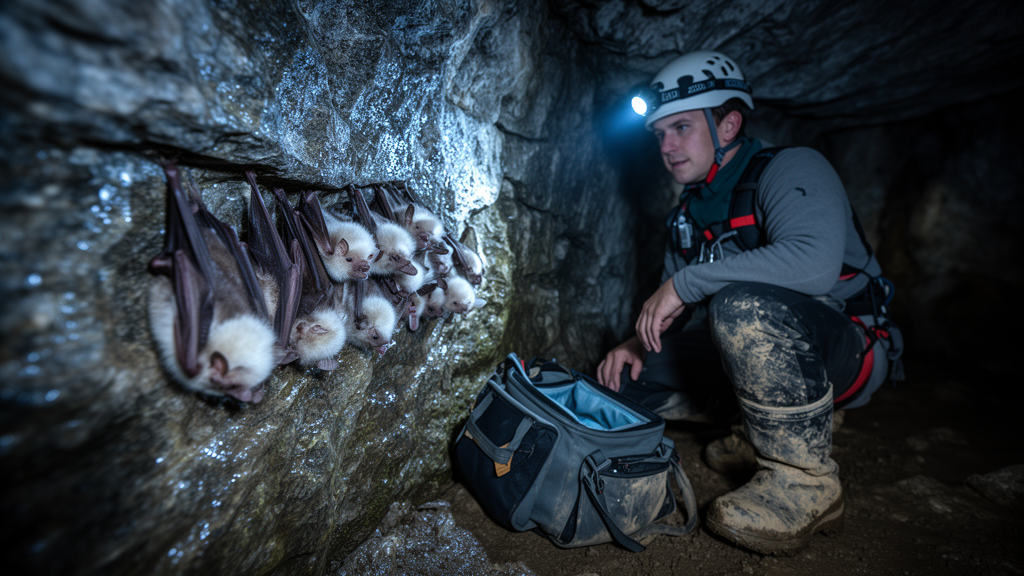
A cross-sectional online survey of 654 cavers from 43 countries found large geographic differences in knowledge of white-nose disease and equipment-cleaning practices, with respondents’ continent of origin explaining more variation in biosecurity scores than knowledge of the disease. The study, conducted from May to August 2021, reported that awareness was strongest in North America, where the disease is associated with substantial bat mortality, and weakest in Europe and Asia, where its fungal cause is native but is not associated with mass bat mortality.
White-nose disease is caused by the cold-adapted fungus Pseudogymnoascus destructans, which infects bats during hibernation and can survive for several years in cave substrates. Its spores can attach to caving equipment and remain viable at room temperature for at least 25 days, allowing contaminated clothing and gear to transport the pathogen even after a pause between trips. The introduction of the fungus from Europe to North America and its movement from the East Coast to the West Coast of the United States are considered human-mediated, making cavers’ travel and hygiene practices relevant to long-distance pathogen spread.
The researchers designed a 23-question questionnaire covering caving and hygiene habits, knowledge of white-nose disease, willingness to change behaviour for conservation, and demographics. It was available in English, Spanish, French, Russian, Slovenian and Bulgarian; no responses were received in Chinese. Recruitment used mailing lists from national and international speleological federations, international bat research groups, social media and the authors’ personal networks. Only respondents who completed every question were analysed, and two respondents from Africa were excluded because the sample was too small for analysis.
Participants were divided geographically into North America, where the fungus had been introduced and continued to cause significant bat mortality; Australia and South and Central America, where it had not been reported but was considered capable of causing mortality if introduced; and Europe and Asia, where it was native without an associated pattern of bat mortality. The primary analysis examined biosecurity scores for trips of 101–1,000 kilometres, the most frequently reported travel distance beyond that considered to present a low natural-spread risk. The researchers used hierarchical linear regression and automatic model selection based on the Akaike information criterion.
North American respondents knew the most about white-nose disease and most often followed specific mitigation or decontamination instructions. Respondents from Australia and South and Central America also showed relatively good awareness, and approximately half reported adhering preventively to disease-related instructions. In contrast, European and Asian respondents were less informed and rarely took steps intended to prevent further spread. Water-only cleaning was most common among respondents from Europe and Asia, water and soap or another detergent was more common in Australia and South and Central America, and adherence to white-nose disease decontamination procedures was most frequent in North America.
Among all respondents, the model selected continent of origin, white-nose disease knowledge and age, with age adding little explanatory power. Continent alone accounted for an R-squared of 0.13; adding knowledge increased it to 0.15, an incremental value of 0.02, and adding age raised it to 0.16. Among 350 respondents who had heard of the disease, the selected model included continent, adherence to disease-related instructions and participation in disease-related studies, producing an R-squared of 0.22. The researchers therefore found only weak support for their hypothesis that knowledge alone would strongly influence hygiene habits; the study’s cross-sectional design did not establish a causal effect.
Knowledge was not absent from reported behaviour, but other factors were associated with it. Personal responsibility was the most common reason for following disease-related instructions, while lack of awareness was the most common reason for not following them. Most respondents who had received information about human impacts on cave ecosystems reported changing their behaviour, and most of those already familiar with white-nose disease agreed that limiting anthropogenic spread of the fungus was necessary and possible. The authors interpreted these results through the Theory of Planned Behaviour, under which attitudes, perceived social norms and perceived practical control can shape behaviour beyond knowledge alone.
Travel history highlighted the remaining prevention problem. Respondents reported 387 trips between continents during the preceding 10 years, although the questionnaire allowed each person to select no more than 10 locations, so the list was not exhaustive. Of those trips, 137 were made by cavers whose biosecurity scores indicated that they cleaned equipment only with water or did not clean it. Some of these respondents were unaware that the fungus could be carried on used equipment or believed it was absent from their country of residence. Thirty-five percent of the low-biosecurity transcontinental travellers reported involvement in scientific activities. Although scientific cavers had higher disease knowledge, hygiene did not differ significantly by respondents’ stated purpose for caving.
The authors proposed distance-based hygiene guidance: washing equipment with water when changing sites within 100 kilometres, using water and soap for distances up to 1,000 kilometres, and using local equipment or established decontamination protocols for longer journeys, particularly between continents. They also called for updated, standardised guidance in Europe and Asia, translation into national languages and more time for researchers to clean equipment between sites. These are the study authors’ recommendations, not interventions tested by the survey. Limitations included unequal continental sample sizes, possible recruitment bias toward the authors’ contacts and countries with research networks, reliance on self-reported knowledge and behaviour, unmeasured factors such as participant sex and formal training, and the sensitivity of knowledge–behaviour relationships to question wording.
Subject of Research: A global online survey of cavers’ white-nose disease knowledge, travel and equipment-hygiene practices
Article Title: Cavers’ knowledge of biosecurity and its influence on the prevention of white-nose disease
Article References: Zhelyazkova, V., Tičar, J., Deleva, S., Ivanov, A., Toshkova, N., & Puechmaille, S. (2025). Cavers’ knowledge of biosecurity and its influence on the prevention of white-nose disease. Subterranean Biology, 52, 45-68. https://doi.org/10.3897/subtbiol.52.140425
Image Credits: AI Generated
DOI: 10.3897/subtbiol.52.140425
Keywords: white-nose disease, cavers, biosecurity, bat conservation, pathogen pollution, Pseudogymnoascus destructans, equipment decontamination, caving hygiene, global survey, knowledge, influence, prevention
Cite Scienmag News
Drew Townsend. (October 20, 2026). Global survey finds white-nose disease knowledge alone weakly predicts cavers’ biosecurity practices. Scienmag. https://scienmag.com/global-survey-finds-white-nose-disease-knowledge-alone-weakly-predicts-cavers-biosecurity-practices/
Drew Townsend. "Global survey finds white-nose disease knowledge alone weakly predicts cavers’ biosecurity practices." Scienmag, 20 October 2026, https://scienmag.com/global-survey-finds-white-nose-disease-knowledge-alone-weakly-predicts-cavers-biosecurity-practices/. Accessed 20 October 2026.
Drew Townsend. "Global survey finds white-nose disease knowledge alone weakly predicts cavers’ biosecurity practices." Scienmag. October 20, 2026. https://scienmag.com/global-survey-finds-white-nose-disease-knowledge-alone-weakly-predicts-cavers-biosecurity-practices/


