


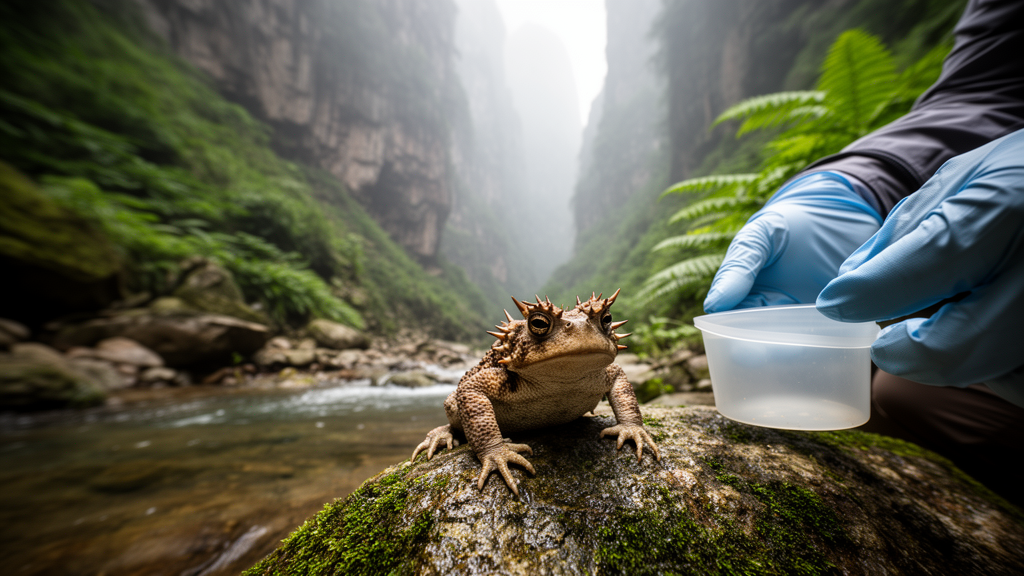
An amphibian survey in Guizhou Province, China, led researchers to identify and describe a new species of Asian horned toad in the genus Boulenophrys. The species, named Boulenophrys yezhongensis, was based on five adult males and three adult females collected in Yezhong Nature Reserve, Shuicheng County, at approximately 2,022 metres above sea level. The description combined mitochondrial DNA analyses, comparisons with related species and measurements of 21 adult morphometric characters.
The specimens were collected on 31 May 2024. Following collection, the toads were euthanized with isoflurane, fixed in 10% buffered formalin and transferred to 75% ethanol for preservation. Muscle samples for molecular analysis were stored in 95% alcohol at −20 °C. The voucher specimens were deposited at the Chengdu Institute of Biology, Chinese Academy of Sciences. The adult male holotype, CIB SC20240531005, is an animal with a snout-vent length of 44.4 mm.
For the phylogenetic analysis, the researchers sequenced fragments of the mitochondrial 16S ribosomal RNA and cytochrome c oxidase subunit I genes from the eight new specimens. They also sequenced three specimens of B. fanjingmontis and assembled a dataset containing 96 available congeneric sequences downloaded from GenBank. Xenophrys glandulosa and X. mangshanensis served as outgroups. The concatenated alignment contained 537 base pairs of 16S and 558 base pairs of COI, for a total of 1,095 base pairs.
Maximum-likelihood and Bayesian analyses produced nearly identical mitochondrial trees. All sampled Boulenophrys sequences formed one strongly supported lineage, with a Bayesian posterior probability of 1.00 and a maximum-likelihood ultrafast bootstrap value of 100%. The lineage containing the Yezhong specimens was sister to a clade comprising B. fanjingmontis, B. qianbeiensis, B. sangzhiensis and B. spinata. The new species had less than 0.1% divergence among its own COI sequences.
Genetic distances from the undescribed species varied among its close relatives. COI distance was 2.5% from B. qianbeiensis, 5.3% from B. sangzhiensis, 5.8% from B. fanjingmontis and 5.9% from B. spinata. For 16S, the smallest reported distance was 0.6% from B. binlingensis, followed by 0.9% from both B. qianbeiensis and B. fanjingmontis, 1.1% from B. sangzhiensis and 1.4% from B. spinata. These distances were estimated with the uncorrected p-distance model.
Morphological analyses were based on 29 specimens, including five males of the new taxon and males of four closely related species. Measurements were taken with dial calipers to the nearest 0.1 mm. To reduce the influence of body size, each character was divided by snout-vent length and log-transformed. One-way analysis of variance found significant differences at p < 0.05 between males of the new species and males of B. qianbeiensis, B. fanjingmontis, B. sangzhiensis and B. spinata for several characters. In a principal component analysis of males, the first two components accounted for 61.9% of the total variance, with the new specimens differentiated from the four comparison species along the first axis.
The species was distinguished by a combination of size and anatomical characters. Adult males measured 41.2–46.2 mm in snout-vent length, compared with 51.8–58.6 mm in adult females. Diagnostic features included a small horn-like tubercle at the edge of each upper eyelid, absent vomerine teeth, a tongue that was not notched posteriorly, a distinct round tympanum, two metacarpal tubercles, rudimentary toe webbing with narrow lateral fringes, overlapping heels when the thighs were positioned at right angles to the body, and a single internal subgular vocal sac in adult males. Breeding males had dark nuptial pads with fine, dense black spines at the bases of the first and second fingers.
Boulenophrys yezhongensis was known only from the type locality in Yezhong Nature Reserve, where individuals were found on stones in streams or gorges surrounded by evergreen broadleaved forest. The study recorded the sympatric amphibians Rana chaochiaoensis and Quasipaa boulengeri. The authors proposed the common name “Yezhong Horned Toad” and the Chinese name “Yě Zhōng Jiǎo Chán (野钟角蟾).” The description is based on a small series collected from one locality, so the species’ geographic range and population distribution remain limited by the available survey data.
Animal protocols for the study were approved by the Management Office of Yezhong Nature Reserve under project number P52230020243100013. The Animal Care and Use Committee of Guizhou University approved the research protocol under approval number EAE-GZU-20244-T1228. The study concerns the taxonomic description of a wild amphibian species, and its principal evidence comprises mitochondrial sequence comparisons, morphometric analysis and direct examination of the eight type series specimens.
Subject of Research: Taxonomic description of a new Boulenophrys horned toad from Guizhou, China
Article Title: A new species of the genus Boulenophrys ( Anura , Megophryidae ) from Guizhou, China
Article References: Liu, J., Feng, C.-B., Shen, T., Li, S.-Z., Cheng, Y., Wei, G., Wang, B., & Su, H. (2025). A new species of the genus Boulenophrys (Anura, Megophryidae) from Guizhou, China. Herpetozoa, 38, 117-136. https://doi.org/10.3897/herpetozoa.38.e155430
Image Credits: AI Generated
DOI: 10.3897/herpetozoa.38.e155430
Keywords: Boulenophrys yezhongensis, new species, Asian horned toads, Megophryidae, Guizhou, Yezhong Nature Reserve, molecular phylogeny, morphometrics, amphibian taxonomy, species, genus, Boulenophrys
Cite Scienmag News
Margaret Porter. (October 20, 2026). Study describes Boulenophrys yezhongensis, a new horned toad species from Guizhou, China. Scienmag. https://scienmag.com/study-describes-boulenophrys-yezhongensis-a-new-horned-toad-species-from-guizhou-china/
Margaret Porter. "Study describes Boulenophrys yezhongensis, a new horned toad species from Guizhou, China." Scienmag, 20 October 2026, https://scienmag.com/study-describes-boulenophrys-yezhongensis-a-new-horned-toad-species-from-guizhou-china/. Accessed 20 October 2026.
Margaret Porter. "Study describes Boulenophrys yezhongensis, a new horned toad species from Guizhou, China." Scienmag. October 20, 2026. https://scienmag.com/study-describes-boulenophrys-yezhongensis-a-new-horned-toad-species-from-guizhou-china/


