


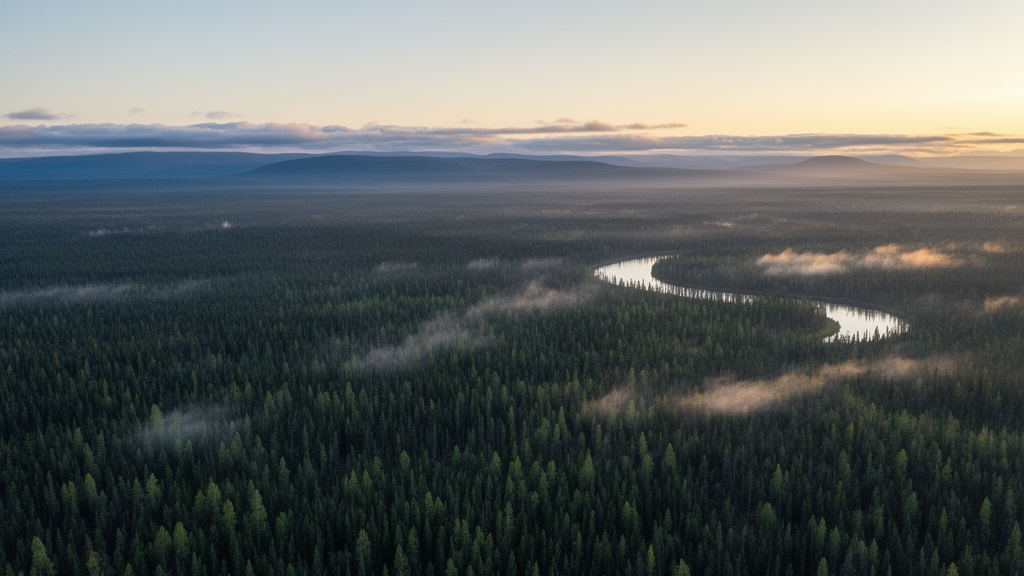
Deep in the mountains of southern Siberia, the taiga forests of cedar pine and Siberian larch have become the unlikely subject of a botanical naming dispute that has simmered for more than four decades. Among his descriptions were taiga forest communities that he assigned to new units: the association Rhododendro-Pinetum sibiricae and a suballiance he called Pino-Laricenion sibiricae, placed within the broader alliance Vaccinio-Piceion. There was a problem, however.
Under the International Code of Phytosociological Nomenclature, the rulebook that governs how plant community names are established, Guinochet's descriptions fell short. His two associations were based on diagnoses containing only two vegetation plots, known as relevés, and he never designated a type plot to anchor each name. That made the associations invalid under Article 5a of the code, and because the suballiance contained no validly named association, the suballiance itself was invalid as well under Article 2b.
The rescue came in 1988, when Dostálek and colleagues validated the association Rhododendro-Pinetum sibiricae by designating a type relevé with an unambiguous reference back to Guinochet's 1982 table. They also proposed raising Guinochet's suballiance to the rank of alliance, giving it the name Pino sibiricae-Laricion sibiricae and designating Rhododendro-Pinetum sibiricae as its nomenclatural type. Because Guinochet's original diagnosis already fulfilled the requirement of indicating character or differential species for the alliance, this act validated the alliance name.
Under the code's recommendations, the correct author citations are Rhododendro daurici-Pinetum sibiricae Guinochet ex Dostálek et al. 1988 and Pino sibiricae-Laricion sibiricae Guinochet ex Dostálek et al. 1988. Decades later, in 2004, Ermakov and Alsynbaev described an alliance from southwestern Siberia that they also named Pino sibiricae-Laricion sibiricae. Although the authors did not use the Latin word typus, the alliance is considered valid under Article 5 because it contains a single association, Carici iljinii-Laricetum sibiricae, described with a single relevé.
This second name was accepted in the prodromus of vegetation syntaxa of Russia published in 2012 and in a 2019 overview of the taiga larch forests of continental northern Asia, giving it considerable currency in the Russian literature. The trouble is that two different plant communities cannot legitimately carry the same name at the same rank. In his later publications, Ermakov attempted to clear the way for his 2004 name by rejecting Guinochet's association as a nomen dubium, or dubious name, under Article 37 of the code, and by treating the names validated by Dostálek and colleagues as nomina nuda, or naked names lacking proper description.
In a 2023 publication he argued that the type relevé of the association was so incomplete that it could not be used in syntaxonomic analysis, and that Article 37 determines the invalidity of an association name. The new analysis shows that this reasoning conflates two distinct concepts in the nomenclatural code. Applying Articles 37, which concerns associations, and 38, which concerns higher-rank syntaxa, determines the illegitimacy of a name, not its invalidity.
Crucially, illegitimate names also generate homonymy, meaning that a later name identical to an earlier illegitimate one must itself be rejected. So even if the 1988 alliance name were rejected under Article 38, it would still be a valid name and thereby a prior heterotypic homonym of the 2004 name, which would then have to be rejected under Article 31. Moreover, the current edition of the code sets a high bar for rejecting an association name as dubious.
It requires a reasoned proposal addressed to the Council for the Nomenclature of Phytosociological Syntaxa, and the council's recommendation must be ratified by the Assembly of the Working Group for Phytosociological Nomenclature. Because the 1988 name has never been formally proposed for rejection through this procedure, it remains a legitimate name, and no unilateral declaration in the literature can change that status. The paper also takes on the argument that the type relevé is too species-poor to be useful.
In fact, the type plot contains twelve species of vascular plants, ten of which were considered by Ermakov himself in his 2012 and 2019 works as character species of the class Vaccinio-Piceetea or its subordinate units. Ermakov's own publications treat Larix sibirica, Pinus sibirica, and Calamagrostis obtusata as diagnostic species of his alliance, and Bergenia crassifolia and Rhododendron dauricum as diagnostic species of a related association. There is therefore little doubt about the syntaxonomic position of the type relevé at the class, order, and alliance levels, even if its floristic composition differs in detail from other associations in the alliance.
Applying Article 37 to the type relevé without a corresponding comparative analysis, the paper argues, is not advisable. Floristic poverty, the paper notes, is not unusual in these forests at all. Reduced numbers of vascular plant species are common in such communities, sometimes falling below ten to fifteen species per 400 square meters, a pattern documented as early as 1980 and echoed in an unpublished 1987 manuscript in which many relevés of several associations contain fewer than thirteen vascular plant species.
The forests in question are typical of southern Siberia, known locally as Siberian cedar-pine green moss forests, with a well-developed moss layer of widespread boreal species such as Pleurozium schreberi and Hylocomium splendens. Because mosses are largely indifferent to the composition of the tree layer and have rarely been used in diagnostic combinations for these forests, the absence of moss data in Guinochet's type relevé is no reason to reject the name. The conclusion is firm: the association Rhododendro daurici-Pinetum sibiricae Guinochet ex Dostálek et al. 1988 and the alliance Pino sibiricae-Laricion sibiricae Guinochet ex Dostálek et al. 1988 are valid and legitimate names, and the 2004 name of Ermakov must be rejected as a later homonym.
Subject of Research: Nomenclatural status of the Siberian taiga forest alliance Pino sibiricae-Laricion sibiricae under the International Code of Phytosociological Nomenclature
Article Title: Nomenclatural comments on the alliance Pino sibiricae-Laricion sibiricae
Article References: Anenkhonov, O. A. (2023). Nomenclatural comments on the alliance Pino sibiricae-Laricion sibiricae. Vegetation Classification and Survey, 4, 319-321. https://doi.org/10.3897/vcs.104301
Image Credits: AI Generated
DOI: 10.3897/VCS.104301
Keywords: phytosociological nomenclature, Siberian taiga, plant communities, Braun-Blanquet classification, homonymy, syntaxonomy, Vaccinio-Piceetea, Pinus sibirica, Larix sibirica, nomenclatural code, forest classification, South Siberia
Cite Scienmag News
Gavin Prescott. (October 20, 2026). Research report: Nomenclatural comments on the alliance Pino sibiricae-Laricion sibiricae. Scienmag. https://scienmag.com/research-report-nomenclatural-comments-on-the-alliance-pino-sibiricae-laricion-sibiricae/
Gavin Prescott. "Research report: Nomenclatural comments on the alliance Pino sibiricae-Laricion sibiricae." Scienmag, 20 October 2026, https://scienmag.com/research-report-nomenclatural-comments-on-the-alliance-pino-sibiricae-laricion-sibiricae/. Accessed 20 October 2026.
Gavin Prescott. "Research report: Nomenclatural comments on the alliance Pino sibiricae-Laricion sibiricae." Scienmag. October 20, 2026. https://scienmag.com/research-report-nomenclatural-comments-on-the-alliance-pino-sibiricae-laricion-sibiricae/


