

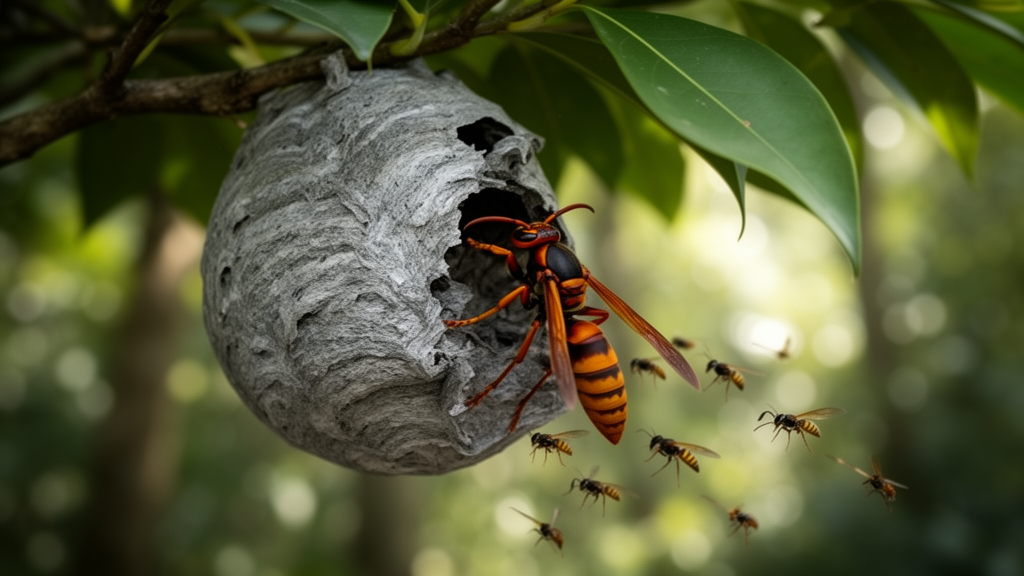
A Taiwanese field study provides evidence that queens of the hornet Vespa basalis can take over founding nests established by Vespa velutina. The researchers combined nest collections, photographic observations and molecular identification of brood, supporting the interpretation that V. basalis can behave as a facultative social parasite during the early nest-founding stage. The study examined 47 early-stage nests collected in Taiwan from 2007 onward through direct field collection, bird nest boxes and cooperation with hornet hunters.
Sampling in 2024–2025 focused on nests collected between April and June. Fifteen nests were classified as being in the colony-establishment stage and 32 in the colony-growth stage; no propagation- or collapse-stage nests were observed. Seventeen nests contained only V. velutina, one contained a V. basalis queen and undeveloped brood, and 29 contained both species.
In at least 16 of the mixed-species nests, the observations indicated that a V. basalis queen had replaced a V. velutina queen. Earlier records had suggested that V. basalis and V. velutina queens might interact during nest establishment, but the process had not been confirmed. The present study focused on the less-understood founding stage of the two species.
Observations at bird nest boxes in the Guanwu area of Shei-Pa National Park documented V. velutina queens constructing small embryo nests. Most of these colonies were later abandoned, while one retained four V. velutina workers until August. The reasons for abandonment were not established, although human disturbance or competition from other species were considered possible explanations.
Photographic records provided additional evidence of interspecific interactions. At a founding nest discovered beneath a building at the Fushan Research Center in late April 2007, a V. velutina queen guarded the nest, while dead queens of both species were found nearby, suggesting a conflict during establishment. Later footage showed a V. basalis queen approaching and entering the nest and interacting with the resident V. velutina, although the footage did not establish whether a confrontation occurred.
Three other founding nests contained queens of both species, and the first adults recorded in those nests were V. velutina workers. Mixed-species colonies also occurred at the growth stage. One nest collected in 2012 contained five apparent V. basalis workers and 30 apparent V. velutina workers, with more than 30 adult V. basalis subsequently emerging.
A second apparently abandoned nest contained eight V. basalis and four V. velutina workers, together with larvae, pupae and mold-covered empty cells. To identify immature wasps, the researchers developed a multiplex PCR assay using species-specific primers targeting the mitochondrial COI region. The assay produced an approximately 657-base-pair fragment for V. basalis and a 375-base-pair fragment for V. velutina.
Blind analysis of the growth-stage nest N_46 identified all 70 tested broods—20 eggs, 20 larvae and 30 pupae—as V. basalis, consistent with a complete reproductive takeover by that species. Brood mapping in a second growth-stage nest, N_47, provided a temporal sequence of reproduction. Of 70 samples examined, 43 yielded reliable species assignments after ambiguous results were excluded.
All 18 newly laid eggs identified were V. basalis, whereas the more developed larvae and pupae were predominantly V. velutina. The arrangement of eggs, capped cells and brood indicated that V. basalis had laid eggs in cells reused or newly constructed after the original colony developed. This pattern supports a takeover in which the V. basalis queen subsequently dominated reproductive output.
Across the sampled nests, the number of V. velutina decreased after usurpation while the number of V. basalis increased over time. The authors therefore interpret the combined field and molecular evidence as showing that a V. basalis queen can take over a developing V. velutina nest and produce offspring that become dominant. They suggest that this behavior may increase V. basalis reproductive success, but also note risks to both species because injury or death of a queen can lead to failure of the entire colony.
The evidence is nevertheless strengthened by repeated observations of interspecific coexistence, changes in queen and worker composition, and brood-level molecular results that distinguish the reproductive contributions of the two species. The findings support classifying V. basalis as a facultative social parasite of V. velutina during the founding stage, while the frequency and consequences of the behavior across the full colony cycle remain unresolved.
Subject of Research: Nest usurpation and facultative social parasitism in Vespa hornets
Article Title: Evidence of nest usurpation of Vespa velutina in the founding stage by V. basalis reveals it as a facultative social parasite ( Hymenoptera , Vespidae )
Article References: Lu, S.-S., Hu, Y.-H., Shiao, M.-T., & Sung, I.-H. (2025). Evidence of nest usurpation of Vespa velutina in the founding stage by V. basalis reveals it as a facultative social parasite (Hymenoptera, Vespidae). Journal of Hymenoptera Research, 98, 779-794. https://doi.org/10.3897/jhr.98.162472
Image Credits: AI Generated
Keywords: Vespa basalis, Vespa velutina, nest usurpation, social parasitism, Taiwan, hornet nests, multiplex PCR, brood identification, colony founding, Evidence, nest, usurpation
Cite Scienmag News
Scienmag. (October 20, 2026). Taiwan field study finds Vespa basalis can usurp founding nests of V. velutina. https://scienmag.com/taiwan-field-study-finds-vespa-basalis-can-usurp-founding-nests-of-v-velutina/
Scienmag. "Taiwan field study finds Vespa basalis can usurp founding nests of V. velutina." Scienmag, 20 October 2026, https://scienmag.com/taiwan-field-study-finds-vespa-basalis-can-usurp-founding-nests-of-v-velutina/. Accessed 20 October 2026.
Scienmag. "Taiwan field study finds Vespa basalis can usurp founding nests of V. velutina." Scienmag. October 20, 2026. https://scienmag.com/taiwan-field-study-finds-vespa-basalis-can-usurp-founding-nests-of-v-velutina/


