


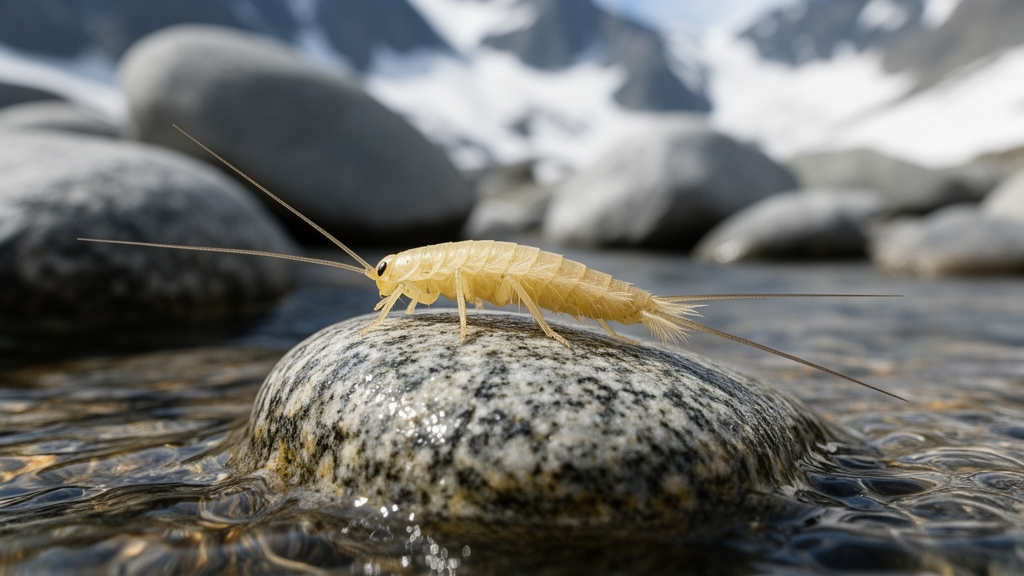
A specimen-based study has described the previously undocumented mature larva of Isoperla orobica Ravizza, 1975, a stonefly in the family Perlodidae. Researchers combined detailed morphology with mitochondrial DNA barcoding to associate larvae with known adults and documented the species’ habitat, elevation range and distribution in Switzerland.
The work addresses a gap in Swiss aquatic-insect knowledge. Isoperla is the most species-rich genus in Perlodidae, with at least 190 valid species recognized from the Holarctic and Oriental realms. Sixty-three species have been reported in Europe, mainly in the Mediterranean region, while eight occur in Switzerland. I. orobica and I. lugens are endemic to the Alps.
Larvae were collected by kicknet sampling or by picking individuals directly from the substrate, while adults were collected with sweep nets or a beating sheet. Specimens were stored in 80% ethanol and deposited in the collection of the Muséum cantonal des sciences naturelles in Lausanne. The investigators examined mouthparts, abdominal tergites and cerci mounted on slides and compared them with material of the sympatric species I. carbonaria and I. rivulorum.
To provide genetic evidence for the larval–adult association, the researchers sequenced a 658-base-pair fragment of the mitochondrial cytochrome oxidase subunit 1 gene, the standard animal barcode region. The analysis included two larvae and one adult male. DNA was extracted with a non-destructive procedure, while polymerase chain reaction, purification and sequencing followed established methods. Reads were assembled, edited and aligned. Searches of GenBank and the Barcode of Life Data System on 21 September 2023 found no additional I. orobica sequences.
The three sequences produced a 100% complete alignment with no missing data. They were identical except for one ambiguous site in one larval sequence, which the authors said strongly supported the conspecificity of the larvae and adult. The closest sequence returned by a BLAST search had 94.1% similarity and came from a specimen collected in Croatia and identified as I. rivulorum; all other matches were below 94% similarity. The three new sequences were the first publicly deposited barcodes for I. orobica.
The described mature larvae measured 8.9–11.3 mm. They were generally light brown, with an abdomen darker than the head and thorax and pale ventral coloration. The head lacked a defined pale interocellar area. The lacinia was bidentate and sub-quadrate, with 6–10 stout marginal setae and 9–12 thin marginal setae along the proximal half of its inner margin. The galea had sparse setae along both inner and outer margins and reached the base of the apical tooth, while the mandible had one incisor, three molars and a dense, long molar brush.
Other diagnostic structures included a pronotum half as long as wide, with marginal spines whose maximum length was one fifth of the pronotal width. Long blunt spines occurred along the posterior margins of abdominal tergites 1–10, in some cases exceeding half the corresponding tergal length. The pale yellow cercus had a thin brown ring on the proximal quarter of the cercomeres and lacked a dorsal setal fringe. Each claw possessed one basal tooth.
Several traits separated I. orobica from the two sympatric comparison species. Its body coloration was uniform rather than contrasting, and its interocellar area was indistinct rather than distinct. It had fewer thin marginal lacinial setae than I. rivulorum, which has 25–35 compared with 9–12 in I. orobica. Galeal setae occurred on both margins in I. orobica but only on the outer margin in I. carbonaria. The study also reported that I. orobica lacks the dense tibial setal fringes present in the other two species.
Larvae were found in springs, spring brooklets and brooks in the epirhithral zone, mainly between 900 and 1,500 metres above sea level and rarely above 2,000 metres. Their substrates ranged from organic to coarse stony bottoms on moderate to steep slopes. Adults were recorded from late June through October at altitudes ranging from 900 to 2,030 metres. The described Swiss distribution is concentrated around the Simplon Pass and mountainous parts of Ticino and Grisons, with one additional central-Alpine locality in the Rhône catchment in Valais; apart from that Valais site, the mapped Swiss localities were in the Po drainage basin.
This was a descriptive study based on examined specimens, DNA barcoding and existing distribution records, rather than a controlled ecological experiment. It provides a larval diagnosis, genetic links to adults, and habitat observations for I. orobica, but the reported distribution and environmental associations are limited by the material and monitoring records available to the investigators.
Subject of Research: Morphological and genetic description of the larva of the Alpine stonefly Isoperla orobica
Article Title: Description of the larva of Isoperla orobica Ravizza, 1975 ( Plecoptera , Perlodidae ), with notes on ecology and distribution in Switzerland
Article References: Lubini-Ferlin, V., Teufl, P., Novotny, C., & Vuataz, L. (2023). Description of the larva of Isoperla orobica Ravizza, 1975 (Plecoptera, Perlodidae), with notes on ecology and distribution in Switzerland. Alpine Entomology, 7, 205-212. https://doi.org/10.3897/alpento.7.109021
Image Credits: AI Generated
Keywords: Isoperla orobica, stonefly larva, Plecoptera, Perlodidae, morphological description, DNA barcoding, mitochondrial COI, Alpine ecology, Swiss distribution, aquatic insects, Description, larva
Cite Scienmag News
Gavin Prescott. (October 20, 2026). Morphological and genetic identification of the larva of the Alpine stonefly Isoperla orobica. Scienmag. https://scienmag.com/morphological-and-genetic-identification-of-the-larva-of-the-alpine-stonefly-isoperla-orobica/
Gavin Prescott. "Morphological and genetic identification of the larva of the Alpine stonefly Isoperla orobica." Scienmag, 20 October 2026, https://scienmag.com/morphological-and-genetic-identification-of-the-larva-of-the-alpine-stonefly-isoperla-orobica/. Accessed 20 October 2026.
Gavin Prescott. "Morphological and genetic identification of the larva of the Alpine stonefly Isoperla orobica." Scienmag. October 20, 2026. https://scienmag.com/morphological-and-genetic-identification-of-the-larva-of-the-alpine-stonefly-isoperla-orobica/


