


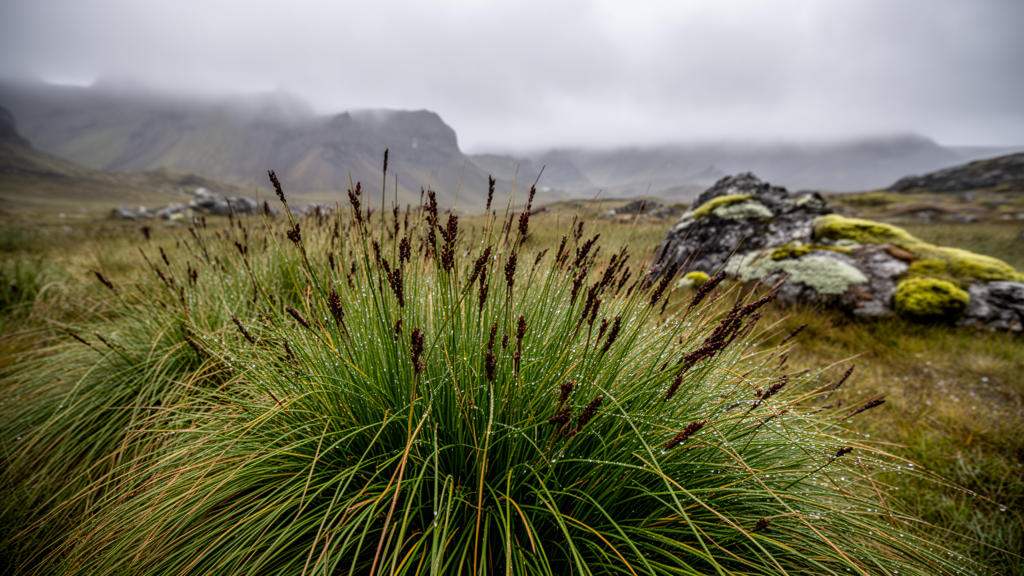
A morphometric study of two Carex section Uncinia species complexes supported the recognition of six previously unrecognized species distributed across oceanic and subantarctic archipelagos. Researchers analyzed 112 preserved herbarium specimens, finding distinct and diagnosable morphological groups among populations historically treated under the names Carex brevicaulis and the subantarctic Carex austrocompacta complex.
The study focused on island populations in the carex complexes, with the aim of revising their taxonomic identity and determining whether geographically separated populations warranted recognition as independent species. The C. brevicaulis analysis included 57 specimens: six from Hawaii, 10 from Amsterdam-Saint Paul, 15 from Tristan da Cunha, and 28 from South America and the Falkland Islands. The second analysis included 55 specimens from the subantarctic C. austrocompacta complex: 24 from Tristan da Cunha, four from Marion-Prince Edward, 12 from Crozet, five from Kerguelen, seven from Amsterdam-Saint Paul, and three from Macquarie and Campbell islands.
Researchers measured 20 vegetative and reproductive characters in the C. brevicaulis complex and 25 in the subantarctic C. austrocompacta complex. Measurements covered stems, leaves, spikes, pistillate glumes, utricles, achenes and rachillae. Exploratory and nested principal component analyses examined patterns of morphological variation. Linear discriminant analyses then tested group separation, using random partitions of 70% of samples for training and 30% for testing. Univariate boxplots were used to compare ranges, dispersion and overlap among geographic groups.
In the initial principal component analysis of the C. brevicaulis complex, the first two components accounted for 35.8% and 15.3% of the variation. Specimens from each island system formed geographically structured clusters, while the continental C. delacosta group occupied a more central position and partly overlapped with island groups in the reduced ordination. Pairwise nested analyses separated the South American and Falkland specimens from each of the three island groups without overlap along the principal components.
Linear discriminant analysis classified 94.4% of the C. brevicaulis specimens correctly in both the training and independent test data, with one misclassification overall. The four recognized taxa were C. delacosta in South America and the Falklands, C. brevicaulis in Tristan da Cunha, the newly named C. donjuanii in Amsterdam-Saint Paul, and the newly described C. haleakalensis in Hawaii. The study also proposed the name C. nao-victoriae for the Amsterdam-Saint Paul population formerly included within the subantarctic C. austrocompacta complex.
For the subantarctic C. austrocompacta complex, the first two principal components accounted for 39.1% and 11.9% of the variation. Amsterdam-Saint Paul and Kerguelen formed distinct clusters. In the initial ordination, samples from Campbell-Macquarie overlapped with those from Tristan da Cunha, while samples from Marion-Prince Edward overlapped with those from Crozet. Nested analysis substantially separated Campbell-Macquarie from Tristan da Cunha, apart from partial overlap by one Macquarie specimen, but did not separate Crozet from Marion-Prince Edward, so those populations were treated as one morphogroup.
Linear discriminant analysis achieved 82.4% classification accuracy in the independent test data for the subantarctic complex. The model distinguished Campbell-Macquarie from Tristan da Cunha despite their overlap in the exploratory principal component analysis, while one Campbell-Macquarie specimen was assigned to the Amsterdam-Saint Paul group. The five recognized taxa were C. moro-ortegae in Tristan da Cunha, C. nao-victoriae in Amsterdam-Saint Paul, C. moseleyana in Kerguelen, C. erebus in the southwestern Pacific, and C. dikei in Crozet and Marion-Prince Edward. The authors also concluded that applying C. austrocompacta to the subantarctic populations misrepresented the name of a temperate taxon restricted to Australia and Tasmania.
The authors attributed the historical concealment of this diversity to limited comparisons among archipelagos, scattered herbarium collections, difficult access to remote islands and the intricacy of Carex taxonomy. Their species-level conclusions were based on quantitative differences, multivariate discrimination and agreement with unpublished phylogenomic reconstructions in which the detected groups appeared as independent lineages. However, the study relied on 112 preserved specimens and had uneven representation among island systems; Campbell-Macquarie, for example, was represented by only three specimens. Within Tristan da Cunha, the authors observed substantial morphological variation but could not determine whether it was associated with habitat or potentially reflected more than one taxon because the herbarium records lacked sufficient habitat information.
Overall, the study supports recognition of four species in the C. brevicaulis complex and five in the subantarctic C. austrocompacta complex. The morphometric results establish a morphological and geographic framework for distinguishing island populations that had previously been combined under broadly circumscribed names, while uneven museum sampling and unresolved variation within Tristan da Cunha limit broader population-level conclusions.
Subject of Research: Morphometric delimitation of island species in the Carex section Uncinia complexes
Article Title: Hidden diversity at the edges of maps: morphometrics of Carex sect. Uncinia ( Cyperaceae ) helps unravel taxonomic diversity in subantarctic and remote archipelagos
Article References: García-Moro, P., Lois, R., Ford, K. A., Larridon, I., Rouhan, G., Roalson, E. H., & Jiménez-Mejías, P. (2026). Hidden diversity at the edges of maps: morphometrics of Carex sect. Uncinia (Cyperaceae) helps unravel taxonomic diversity in subantarctic and remote archipelagos. PhytoKeys, 277, 241-267. https://doi.org/10.3897/phytokeys.277.189029
Image Credits: AI Generated
DOI: 10.3897/phytokeys.277.189029
Keywords: Carex, Cyperaceae, plant taxonomy, morphometrics, subantarctic islands, oceanic archipelagos, species delimitation, principal component analysis, linear discriminant analysis, Carex sect. Uncinia, Hidden, diversity
Cite Scienmag News
Margaret Porter. (October 20, 2026). Morphometric study supports six new species in island Carex complexes. Scienmag. https://scienmag.com/morphometric-study-supports-six-new-species-in-island-carex-complexes/
Margaret Porter. "Morphometric study supports six new species in island Carex complexes." Scienmag, 20 October 2026, https://scienmag.com/morphometric-study-supports-six-new-species-in-island-carex-complexes/. Accessed 20 October 2026.
Margaret Porter. "Morphometric study supports six new species in island Carex complexes." Scienmag. October 20, 2026. https://scienmag.com/morphometric-study-supports-six-new-species-in-island-carex-complexes/


