


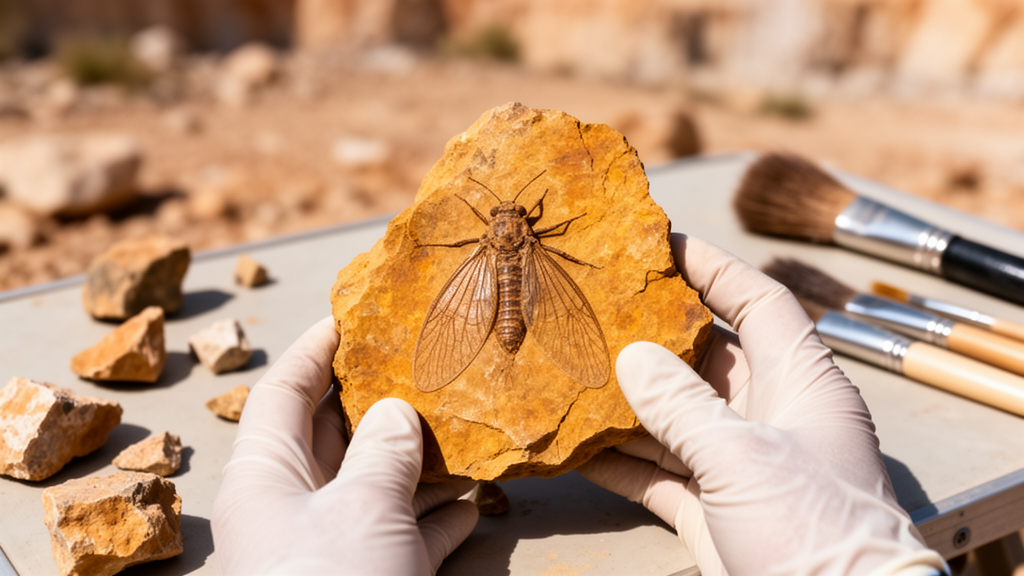
A descriptive paleontology study has documented the first insect fossils known from the Permian of Catalonia, Spain. The two specimens, recovered from the Sauvanyà red-bed outcrop in the Catalan Pyrenees, include a new species of the small winged insect family Probnidae and an incomplete roachoid tegmen that the authors tentatively assign to Spiloblattinidae. Together, they extend the geographic and temporal record of insects associated with the broadly defined Grylloblattodea and the stem group of living cockroaches and mantises.
The principal fossil is the holotype of Probnis sauvanyaensis, a new species named after the type locality. It consists of the part and counterpart of a nearly complete forewing measuring 5.7 mm long and 1.1 mm wide. The fossil is held as specimen IPS125664 at the Institut Català de Paleontologia Miquel Crusafont in Sabadell, Catalonia. Its age is assigned to the Guadalupian, or middle Permian, although a Lopingian age cannot be completely excluded.
Probnidae is a poorly understood family within the broadly defined assemblage “Grylloblattodea,” whose monophyly and internal classification remain uncertain. Before this study, the family contained three species: Probnis speciosa and Probnis fossor from the Permian of the United States and Triassoprobnis humilis from the Late Triassic of Ukraine. The Catalan specimen is therefore the first recognized member of Probnidae from Spain, while its occurrence alongside the Ukrainian Triassic species shows that the family was represented on both sides of central Pangaea during the late Paleozoic and early Mesozoic.
The authors assigned the fossil to Probnis through comparisons of forewing shape and venation. Shared features include a small, narrow wing, a long and simple subcostal posterior vein, a narrow costal area, a simple radius posterior vein closely parallel to the radius anterior, and a narrow median area. The cubitus anterior separates from the median vein near the wing base and runs parallel to the posterior margin, where it forms a series of parallel branches. Venation details distinguish the new species from the two North American Probnis species and from Triassoprobnis humilis.
Several alternative placements were considered during the analysis. A common stem for the cubitus anterior and cubitus posterior was considered inconsistent with Acercaria and Archaeorthoptera. Affinities with Holometabola were described as unlikely because the fossil lacks crossveins in the costal area and specialized cells in the cubito-anal region. It was excluded from Dictyoptera because the cubitus posterior is nearly straight and weakly concave, while Paoliida was rejected because the area between the cubitus anterior and cubitus posterior is narrow and lacks particular anterior branches. The authors placed it in Grylloblattodea and Probnidae while acknowledging the limited resolving power of the current classification.
The second fossil, specimen IPS125659, preserves the distal two-thirds of a roachoid forewing or tegmen. The preserved portion is 12.5 mm long and 4.2 mm wide and retains faint traces of coloration. Its regularly pectinate radius posterior and median veins, multiple-forked median branches, long sigmoidal cubitus anterior, regularly bent cubitus posterior and regularly spaced curved anal veins largely conform to the emended diagnosis of Spiloblattinidae proposed by Schneider and colleagues in 2021. The authors favored that family over the similarly defined Compsoblattidae because the region covered by the radius posterior appears less extended distally and the area between that vein and the median vein is broader than in Compsoblatta. Incomplete preservation and the absence of a usable coloration pattern prevent a more precise genus or species identification.
Both fossils came from the upper portion of the Upper Red Unit at Sauvanyà. The succession contains thick reddish mudstones alternating with layers, generally 2–5 cm thick, of greyish-bluish, very fine-grained carbonate sandstone. The sandstone layers are finely laminated and display prominent desiccation cracks on their upper surfaces. The cyclical sedimentology, localized fossil occurrences and mud cracks were interpreted as evidence of strong seasonality under generally semi-arid to arid conditions in an ephemeral lacustrine setting. All fossils identified so far occur in the sandstone layers, while the mudstones appear barren.
The fossils were collected during fieldwork in 2019 under permits from the Catalan government’s Department of Culture and Serra del Cadí-Moixeró Natural Park. Photographic images were acquired with a Nikon Z7II camera attached to a Nikon SMZ25 stereomicroscope, exported in NEF format and processed with Nikon NX Studio and DXO Lab 8 at the ISYEB institute’s Biophotonics 2D/3D Laboratory. The authors followed a wing-venation terminology based on basivenale bullae and used visible veins and vein-bounded areas in their systematic comparisons. Other remains at the site include sparse indeterminate tetrapod footprints, plant debris, vertical cylindrical invertebrate burrows and casts of possible bivalves.
The study identifies these fossils as the first insects reported from the Permian of the Iberian Peninsula and adds them to the faunal record of the Catalan Pyrenees, where Permian vertebrates are represented by scarce bones and trace fossils are more abundant. Probnidae occurrences in the United States and Spain were associated with warm, arid paleoclimates, and the Ukrainian Triassic occurrence likewise came from a dry and warm climate. However, the biology of these insects is unknown, so the suggestion that their small size and climatic adaptation helped them survive the Permian–Triassic mass extinction remains an interpretation rather than a directly tested result.
Subject of Research: Permian occurrence of Probnidae and a roachoid insect lineage in Catalonia
Article Title: New insects from the Permian of Catalonia (Spain) predate the early diversification of Triassic clades adapted to arid environments ( Grylloblattodea , Probnidae , Dictyoptera )
Article References: Garrouste, R., Fortuny, J., Mujal, E., Bolet, A., Steyer, J.-S., & Nel, A. (2025). New insects from the Permian of Catalonia (Spain) predate the early diversification of Triassic clades adapted to arid environments (Grylloblattodea, Probnidae, Dictyoptera). Fossil Record, 28(1), 179-186. https://doi.org/10.3897/fr.28.153912
Image Credits: AI Generated
DOI: 10.3897/fr.28.153912
Keywords: fossil insects, Permian, Catalonia, Probnidae, Grylloblattodea, roachoids, Spiloblattinidae, paleontology, Sauvanyà, insects, Spain, predate
Cite Scienmag News
Gavin Prescott. (October 20, 2026). Permian insect fossils from Catalonia extend the record of Probnidae and a roachoid lineage. Scienmag. https://scienmag.com/permian-insect-fossils-from-catalonia-extend-the-record-of-probnidae-and-a-roachoid-lineage/
Gavin Prescott. "Permian insect fossils from Catalonia extend the record of Probnidae and a roachoid lineage." Scienmag, 20 October 2026, https://scienmag.com/permian-insect-fossils-from-catalonia-extend-the-record-of-probnidae-and-a-roachoid-lineage/. Accessed 20 October 2026.
Gavin Prescott. "Permian insect fossils from Catalonia extend the record of Probnidae and a roachoid lineage." Scienmag. October 20, 2026. https://scienmag.com/permian-insect-fossils-from-catalonia-extend-the-record-of-probnidae-and-a-roachoid-lineage/


