


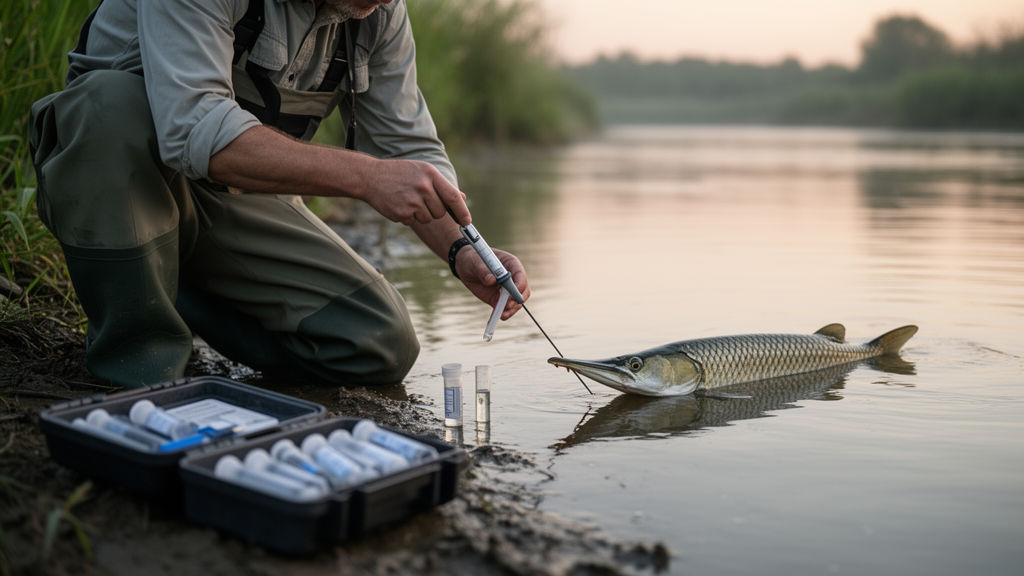
A laboratory validation and field study in China found that a recombinase polymerase amplification assay combined with lateral flow dipstick detection, or RPA-LFD, can identify environmental DNA from the invasive alligator gar, Atractosteus spatula, in about 15 minutes. The best-performing RPA-LFD primer-probe set detected 10 of 10 replicates at 15.88 copies/µL and had a 95% limit of detection of 4.21 copies/µL, with a 95% confidence interval of 3.49–5.08 copies/µL.
The study developed two RPA-LFD assays and four quantitative real-time PCR assays for alligator gar, then compared their analytical performance and tested them against environmental DNA from aquaria and a wild breeding pond in Guangdong Province. The assays were designed for surveillance of an invasive fish that has established populations outside its native North American range and has been associated in China with local extirpations of native fish and restructuring of trophic networks.
Researchers screened mitochondrial genome sequences from alligator gar and 11 comparison species, identifying candidate regions in the D-loop, ND5, ND4L and COXIII genes. They developed two RPA primer-probe sets, designated RPAS1 and RPAS2, and four qPCR sets. The RPA primers were 30–35 base pairs long, had 40–60% GC content, avoided homopolymers longer than four consecutive bases and incorporated terminal 3′ GC clamps of at least two bases. The probes included a tetrahydrofuran site spacer, a 5′ FAM label and a 3′ C3 spacer.
Specificity testing used genomic DNA from alligator gar and 11 closely related or cohabiting fish species. Both assay platforms amplified only the target species, with no cross-reactivity observed in the non-target samples. The qPCR protocol also included an exogenous internal control added at the PCR stage to identify possible false-negative results caused by an unsuccessful reaction. Optimization selected an internal template concentration of 0.005 ng/µL, primers at 0.2 µM and a probe at 0.16 µM.
For RPA-LFD, positive signals occurred from 32–44°C with RPAS1 and from 32–41°C with RPAS2, leading the researchers to select 38°C for consistent performance. A faint signal first appeared after nine minutes and became stable after 12 minutes in the time-course experiment. The researchers chose a 15-minute reaction to accommodate low template concentrations while retaining a short turnaround, rather than as a guarantee of detection at every concentration.
Analytical sensitivity was assessed with tenfold dilutions of alligator gar genomic DNA whose absolute copy numbers had been verified by digital PCR. Ten technical replicates were tested at each concentration, and probit regression was used to estimate 95% limits of detection. RPAS1 detected 10 of 10 replicates at 15.88 copies/µL and five of 10 at 2.83 copies/µL. RPAS2 performed less consistently, detecting nine of 10 replicates at 80.85 copies/µL and six of 10 at 15.88 copies/µL; its 95% limit was 84.17 copies/µL, with a 95% confidence interval of 46.50–152.38 copies/µL.
Most qPCR sets were more sensitive than RPAS2. qPCRS1 had a 95% limit of detection of 4.12 copies/µL, with a wide 95% confidence interval of 0.67–25.27 copies/µL. The corresponding limits were 10.6 copies/µL for qPCRS4, 11.39 copies/µL for qPCRS2 and 20.18 copies/µL for qPCRS3. Receiver operating characteristic analysis using 2,000 stratified bootstrap replicates gave qPCRS1 the largest area under the curve at 0.936, followed by RPAS1 at 0.894. qPCRS2 and RPAS2 each scored 0.864, while qPCRS4 scored 0.784 and qPCRS3 scored 0.600.
For field validation, the researchers collected environmental DNA from a positive-control aquarium containing alligator gar in natural freshwater, a natural lake confirmed to be free of the species, a wild outdoor breeding pond and a DNase/RNase-free blank. They filtered two water samples through 0.45-µm mixed cellulose ester membranes and used the rapid Chelex 100 extraction method, obtaining a measured DNA concentration of 4.5 ng/µL. Both RPA-LFD sets produced positive signals from the positive aquarium and breeding-pond samples and no signal from the negative control. All four qPCR sets detected the positive-control environmental DNA, but qPCRS3 did not pass the field test.
The findings support RPA-LFD as a rapid, specific option for alligator gar surveillance without thermal-cycling equipment, although the study was limited to laboratory validation, aquarium work and one natural breeding pond. The assay is qualitative or semi-quantitative and cannot provide precise DNA copy-number estimates. Its performance in other environmental matrices, including waters with high humic acid content, elevated turbidity or eutrophic conditions, was not evaluated. The authors propose that the rapid method and Chelex 100 extraction workflow could support citizen-science monitoring of artificial water bodies such as urban ponds, reservoirs and ornamental lakes.
Subject of Research: Validation of a rapid molecular assay for detecting invasive alligator gar DNA in laboratory and field samples
Article Title: qPCR validation and field application of a rapid RPA-LFD assay for monitoring the invasive alligator gar ( Atractosteus spatula )
Article References: Wang, H., Li, S., Mu, X., Lin, X., & Li, C. (2026). qPCR validation and field application of a rapid RPA-LFD assay for monitoring the invasive alligator gar (Atractosteus spatula). NeoBiota, 107, 1-20. https://doi.org/10.3897/neobiota.107.182542
Image Credits: AI Generated
DOI: 10.3897/neobiota.107.182542
Keywords: alligator gar, invasive species, RPA-LFD, environmental DNA, qPCR, species detection, field validation, biosurveillance, validation, field, application, rapid
Cite Scienmag News
Patricia Pace. (October 20, 2026). Laboratory and pond validation finds 15-minute DNA assay detects invasive alligator gar. Scienmag. https://scienmag.com/laboratory-and-pond-validation-finds-15-minute-dna-assay-detects-invasive-alligator-gar/
Patricia Pace. "Laboratory and pond validation finds 15-minute DNA assay detects invasive alligator gar." Scienmag, 20 October 2026, https://scienmag.com/laboratory-and-pond-validation-finds-15-minute-dna-assay-detects-invasive-alligator-gar/. Accessed 20 October 2026.
Patricia Pace. "Laboratory and pond validation finds 15-minute DNA assay detects invasive alligator gar." Scienmag. October 20, 2026. https://scienmag.com/laboratory-and-pond-validation-finds-15-minute-dna-assay-detects-invasive-alligator-gar/


