


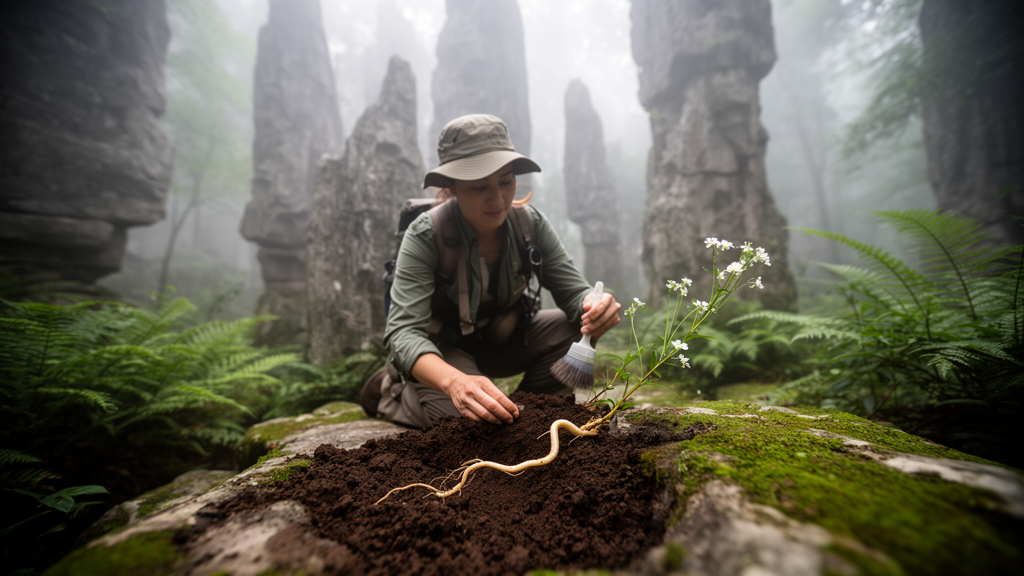
A morphological study has identified Ophiorrhiza saxatilis as a new species in the coffee family, Rubiaceae, from karst forest in Guizhou Province, China. The subshrub was discovered in the Maolan National Nature Reserve in March 2025 and observed with fruit during a follow-up survey in May. Researchers compared its leaves, branches, flowers, fruits and other traits with published species and preserved herbarium specimens before formally recognizing it as an undescribed member of Ophiorrhiza.
The type locality is in Libo County, within the Qiannan Buyi and Miao Autonomous Prefecture, at 25°17′N, 107°55′E and an elevation of 960 m. The holotype and isotype were collected on 8 May 2025, and all voucher specimens of the new species were deposited in the Herbarium of the College of Forestry at Guizhou University. Its Chinese name, 岩生蛇根草, and the epithet “saxatilis” refer to its habitat on rocky karst slopes and in rock crevices.
For the field measurements, researchers selected flowers, leaf blades, petioles and young branchlets as core morphological characters. They recorded observations from 18 mature flowering individuals in the type population and randomly sampled 10 fully expanded mature leaves from each individual. Living plants were examined in their natural habitat, after which supplementary descriptions and calibration were completed with collected specimens in the laboratory. Taxonomic characteristics were compared with the Flora Reipublicae Popularis Sinicae, Flora of China and records from the Chinese Virtual Herbarium and National Specimen Information Infrastructure.
The analysis included 12 preserved specimens representing the new species and its close relative Ophiorrhiza lignosa, with six specimens of each taxon, including the holotypes. Nine characters with stable interspecific differences were screened for trait variation and principal component analysis. The researchers also used Gower’s general similarity coefficient for trait-variation analysis and principal coordinates analysis, implemented with the vegan and ggplot2 packages in R. The principal coordinates analysis showed clear morphological separation between the two species.
Several measured traits distinguish O. saxatilis from O. lignosa. The new species has thinly leathery leaves that are linear or narrowly oblong, 2–8 cm long and 0.5–1.2 cm wide, with acute apices. Its petioles measure 2–5.8 mm, compared with 6–20 mm in O. lignosa, and its bracteoles are 5–6 mm long rather than 1.5–3 mm. Young branches are uniformly pubescent in the new species and bifariously pubescent in O. lignosa. The abaxial leaf surface of O. saxatilis is pubescent throughout, whereas that of O. lignosa is puberulent only along the midrib and secondary veins.
Floral characters provide further diagnostic separation. The white corolla lobes of O. saxatilis have ridges, compared with purple, unridged lobes in O. lignosa, and the stamens are inserted at the base of the corolla tube rather than near its middle. The new species is distylous, with long-styled flowers bearing styles 6–8 mm long and short-styled flowers bearing styles 2–4 mm long. O. lignosa is described as monomorphic with pin flowers, and its long-styled flowers have styles 10–11 mm long. The leaves also differ in the color of the abaxial midrib, which is purple in the new species and green in its relative.
O. saxatilis is described as a subshrub reaching 1 m tall, with gray, terete, woody older branches and pubescent young branches that become obscurely four-angled when dry. Its terminal inflorescences are relatively small and many-flowered, with pubescent peduncles 1–2 cm long and helicoid axes up to 1 cm long. The white tubular corolla is glabrous outside, with a white villous ring at the middle of the tube and a pubescent throat. Its capsules are mitriform, 6–8 mm wide and 2.5–3 mm tall, while the seeds are angular. Flowering occurs from February through April, followed by fruiting from April through June.
At present, O. saxatilis is known only from forests on karst hills in Libo County at approximately 960 m. The habitat has high rock exposure, poor and barren soil, and low soil-water retention capacity. Field surveys found the species mainly in the middle and upper parts of karst hills, with approximately 150 scattered individuals observed near the surveyed area. Because the investigation of population size, distribution and potential threats was not comprehensive, the authors proposed categorizing the species as Data Deficient under the IUCN framework rather than assigning a more specific conservation category.
The study expands the documented taxonomic diversity of Ophiorrhiza, a genus of 384 species that is considered to have considerable pharmacological importance and is a natural source of the anticancer monoterpene indole alkaloid camptothecin. China has 85 recorded species, primarily in its southern and southwestern regions, while New Guinea and Southeast Asia are the genus’s principal centers of diversity. The authors describe distinctly woody stems as relatively unusual in a genus otherwise composed mainly of creeping or erect herbs, and suggest that the trait in O. saxatilis may reflect long-term adaptation to karst conditions. The paper does not directly test that evolutionary interpretation, and the new species’ known distribution and conservation status remain poorly characterized.
Subject of Research: Morphological identification and limited conservation assessment of a new Ophiorrhiza species from Guizhou karst forest
Article Title: Ophiorrhiza saxatilis ( Rubiaceae ), a new species from Guizhou, China
Article References: Li, G.-L., An, M.-T., Wu, X., Yu, J.-H., Qiu, J., Liu, S.-F., & Tan, C.-J. (2026). Ophiorrhiza saxatilis (Rubiaceae), a new species from Guizhou, China. PhytoKeys, 278, 27-37. https://doi.org/10.3897/phytokeys.278.197480
Image Credits: AI Generated
DOI: 10.3897/phytokeys.278.197480
Keywords: Ophiorrhiza saxatilis, new species, Rubiaceae, plant taxonomy, morphology, Guizhou, karst forest, Maolan Nature Reserve, Data Deficient, China, Ophiorrhiza, saxatilis
Cite Scienmag News
Margaret Porter. (October 20, 2026). Morphological study identifies new Ophiorrhiza species in Guizhou karst; population data remain limited. Scienmag. https://scienmag.com/morphological-study-identifies-new-ophiorrhiza-species-in-guizhou-karst-population-data-remain-limited/
Margaret Porter. "Morphological study identifies new Ophiorrhiza species in Guizhou karst; population data remain limited." Scienmag, 20 October 2026, https://scienmag.com/morphological-study-identifies-new-ophiorrhiza-species-in-guizhou-karst-population-data-remain-limited/. Accessed 20 October 2026.
Margaret Porter. "Morphological study identifies new Ophiorrhiza species in Guizhou karst; population data remain limited." Scienmag. October 20, 2026. https://scienmag.com/morphological-study-identifies-new-ophiorrhiza-species-in-guizhou-karst-population-data-remain-limited/


