


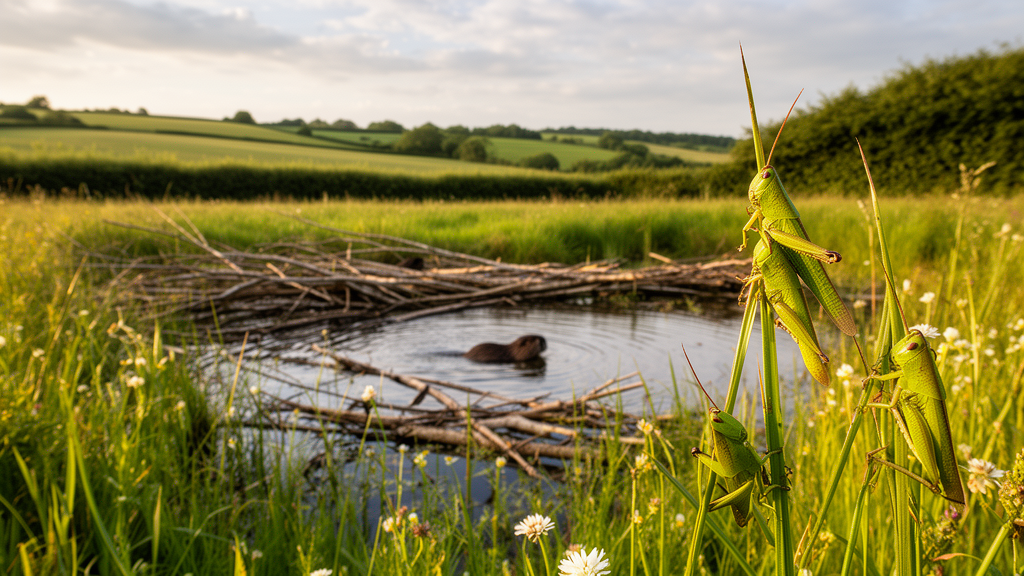
A one-season observational comparison at Spains Hall in Finchingfield, Essex, found higher abundance of three Orthoptera species in fenced beaver enclosures than in adjacent post-arable control meadows. The researchers surveyed the sites in summer 2024, 15 to 18 months after a pair of Eurasian beavers was released into each enclosure in March 2023. The study did not measure the assemblages before the release, so the results cannot establish that beaver activity caused all the observed differences.
The study examined two 20-hectare beaver enclosures and two unfenced control meadows beside Finchingfield Brook. Both controls were post-arable grasslands unaffected by beavers. The enclosure fields had previously grown spring barley, winter beans and winter wheat with nitrogen fertiliser, and cropping ceased after 2018. Narrow unploughed strips beside the brook had provided some Orthoptera habitat during the arable period, so the monitored contrast concerned the alteration of re-establishing grassland by beavers rather than colonisation of an entirely treeless starting point.
Researchers established 16 transects, each 1 metre wide and 100 metres long, with four in each enclosure and control replicate. Two transects ran on each side of the brook, within 10 metres of the bank top. Each transect was surveyed once in June, July, August and September 2024 at 2 kilometres per hour. Adult Orthoptera were recorded visually and acoustically, while nymphs flushed from a 1-metre band were grouped because early instars were difficult to distinguish. Vegetation height and plant composition were measured in September.
Nine Orthoptera species were recorded in both the beaver enclosures and controls, representing 33% of British native species according to the study. Roesel’s bush-cricket, Roeseliana roeselii, produced 684 adult detections, or 41% of the total, followed by Pseudochorthippus parallelus with 564 detections, or 33%, and Chorthippus brunneus with 130, or 8%. The two groundhoppers, Tetrix subulata and T. undulata, accounted for 62 and 57 detections respectively. The survey also detected the Essex Red Data List common green grasshopper Omocestus viridulus, the long-winged conehead Conocephalus fuscus and the dark bush-cricket Pholidoptera griseoaptera.
Two-way analysis of variance found moderate statistical evidence that the lesser marsh grasshopper C. albomarginatus, the slender groundhopper T. subulata and the common groundhopper T. undulata were more abundant in the enclosures than in the controls, with p-values of 0.03, 0.02 and 0.05, respectively. Evidence for higher species diversity in the enclosures was weak (F = 6.7, p = 0.06), while species richness did not differ significantly. Weak evidence also indicated higher abundance of C. fuscus and T. subulata on the east side of the brook. For T. subulata within the enclosures, the east–west difference was stronger (F = 11.2, p = 0.03).
Acoustic monitoring detected all seven stridulating species. It recorded 570 acoustic detections of R. roeselii compared with 114 visual detections, illustrating the value of the method for species that are difficult to see in tall vegetation. The authors nevertheless noted that visual methods can under-record some cryptic species, particularly C. fuscus in vegetation taller than 50 centimetres. The combined use of visual flushing and acoustic detection therefore improved coverage but did not provide a direct, species-by-species measurement of absolute population abundance.
Beaver activity differed markedly between the enclosures. Enclosure B contained six dams, two lodges and six felled trees. Water impounded behind a dam spilled onto the eastern floodplain, creating a new channel and wetland pools. Groundhoppers were observed on dry mud beside the new channel in June, disappeared after flow returned during heavy rain in July, and reappeared in August and September as flows receded and exposed mud returned. They were recorded beside pooled water throughout the four surveys. Enclosure A had five felled trees but no dams or lodges; groundhoppers there were less frequent and occurred on wet muddy ground around a winter pool and flooded tractor ruts.
Vegetation was lower in the enclosures than in the controls. Mean heights were 54.5 and 74.1 centimetres on the east and west sides of the enclosures, compared with 81.9 and 78.0 centimetres in the controls. Only 12.5% of control measurements were below 50 centimetres, compared with 43.5% in the enclosures. Linear regression found a strong negative relationship between vegetation height and C. brunneus abundance, a moderate negative relationship for T. subulata, and a moderate negative relationship between vegetation height and species diversity. These associations were consistent with more diverse assemblages in shorter swards, but the study did not experimentally manipulate vegetation height.
Plant composition also differed. False oat, Arrhenatherum elatius, timothy, Phleum pratense, and common bent, Agrostis capillaris, were more frequent in the enclosures, while cock’s-foot, Dactylis glomerata, Yorkshire fog, Holcus lanatus, and tall fescue, Lolium arundinacea, were more numerous in the controls. The authors interpret the resulting mosaic of short grass, tall vegetation, pools and bare mud as habitat capable of supporting species with different preferences. The findings remain preliminary because the study included only two replicates per treatment, covered a single adult season and did not collect pre-release baseline data. Fences confined the beavers to small areas and may also have altered deer movement and grazing in surrounding controls, limiting direct application to open release sites.
Subject of Research: Observational comparison of Orthoptera assemblages in post-arable beaver enclosures and adjacent control meadows
Article Title: Initial response of Orthoptera to beaver ( Castor fiber ) reintroductions in post-arable enclosures
Article References: Gardiner, T., & Crisp, E. (2025). Initial response of Orthoptera to beaver (Castor fiber) reintroductions in post-arable enclosures. Journal of Orthoptera Research, 34(2), 213-222. https://doi.org/10.3897/jor.34.154843
Image Credits: AI Generated
Keywords: Orthoptera, Eurasian beaver, ecosystem engineering, post-arable land, groundhoppers, grasshoppers, bush-crickets, rewilding, field study, Essex, Initial, response
Cite Scienmag News
Gavin Prescott. (October 20, 2026). One-season field study links beaver enclosures to higher abundance of three Orthoptera species. Scienmag. https://scienmag.com/one-season-field-study-links-beaver-enclosures-to-higher-abundance-of-three-orthoptera-species/
Gavin Prescott. "One-season field study links beaver enclosures to higher abundance of three Orthoptera species." Scienmag, 20 October 2026, https://scienmag.com/one-season-field-study-links-beaver-enclosures-to-higher-abundance-of-three-orthoptera-species/. Accessed 20 October 2026.
Gavin Prescott. "One-season field study links beaver enclosures to higher abundance of three Orthoptera species." Scienmag. October 20, 2026. https://scienmag.com/one-season-field-study-links-beaver-enclosures-to-higher-abundance-of-three-orthoptera-species/


