


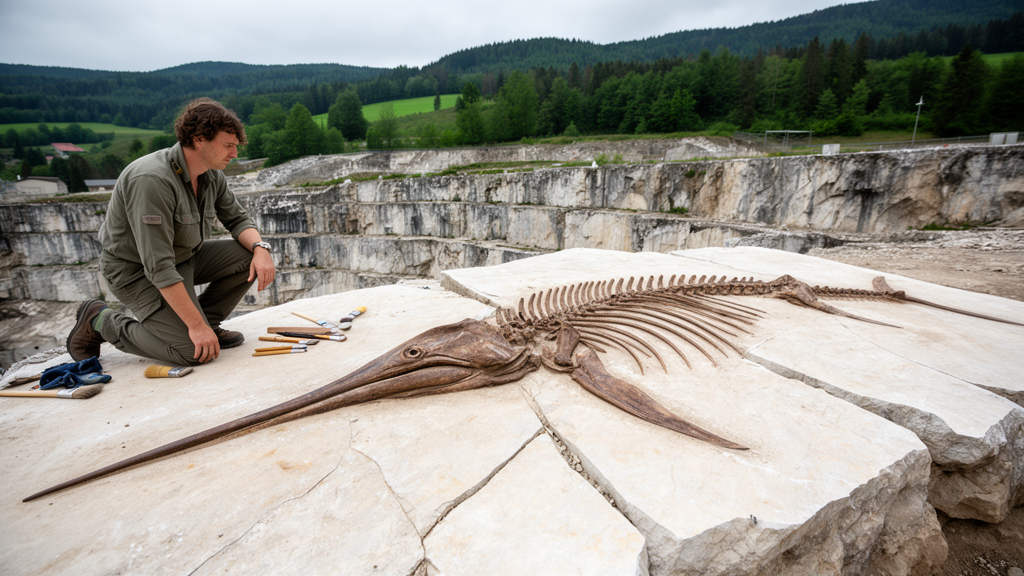
A comparative paleontology study of three marine-reptile fossils from the Mistelgau clay pit in Bavaria supports the establishment of Eurhinosaurus mistelgauensis as a new species. The specimens are distinguished from previously described Eurhinosaurus material chiefly by the shape of the basioccipital at the rear of the skull and by unusually thick, robust ribs.
The descriptive study examined UMO BT 011 221.00, UMO BT 011 235.00 and UMO BT 011 240.00, all held in the collection of the Urwelt-Museum Oberfranken in Bayreuth. The authors combined a bone-by-bone anatomical assessment, comparisons with specimens examined firsthand in four European collections, measurements with calipers and linear-regression estimates of body size. Statistical analyses were conducted in R 4.4.2 using the ggplot2 package. The work also addressed the unsettled taxonomy of Eurhinosaurus, including disagreement over the validity of E. longirostris, E. huenei and E. quenstedti.
All three fossils came from the lower Jurensismergel Formation in the early Upper Toarcian. UMO BT 011 235.00 was recovered from the Vitiosa Subzone of the Haugia variabilis Zone, directly above a belemnite battlefield. UMO BT 011 221.00 and UMO BT 011 240.00 came from the Grammoceras thouarsense Zone and Subzone. The latter specimens therefore represent the youngest known stratigraphic occurrence of the genus.
UMO BT 011 221.00, designated the holotype of the new species, was excavated in 2007. It is an almost complete, semi-articulated skeleton preserving much of the skull, vertebral column, girdles and limbs in three dimensions, although the skull roof and palatal bones are missing and much of the vertebral column is disarticulated. UMO BT 011 235.00, discovered in 2014, is another nearly complete skeleton with a laterally compressed skull and substantial articulation on its right side. The third fossil, UMO BT 011 240.00, is much more fragmentary and consists principally of both premaxillae with articulated teeth and associated rib fragments. Their three-dimensional preservation enabled detailed documentation of delicate cranial and postcranial anatomy, although differences in preservation and viewing angles restricted direct comparisons.
The principal species-level distinction lies in the basioccipital. In the Mistelgau specimens, its ventral extracondylar area extends strongly from front to back but has little downward projection, so it is not visible behind the occipital condyle in posterior view. The condyle is also large, prominent and convex, forming the entire posterior surface of the basioccipital. The dorsal ribs are also distinctive: they are markedly thick and robust, generally rounded in cross-section and lack longitudinal grooves along their shafts. These contrasts were judged significant at species level even though compression and other taphonomic effects complicate comparisons among German Eurhinosaurus fossils.
The authors retained Eurhinosaurus as the generic assignment because the specimens share a combination of features including a lower jaw considerably shorter than the skull, an unpaired internal carotid foramen in the parabasisphenoid, a pelvic girdle with unfused pubis and ischium, a long body with more than 44 presacral vertebrae, sheathed-bicapitate dorsal ribs and ossified haemal arches in the anterior caudal vertebrae. The revised generic diagnosis adds the rib and haemal-arch characters, while excluding fin-element notching because its presence and number are highly variable among Eurhinosaurus specimens. Basioccipital morphology was removed from the genus-level diagnosis and treated as species-level because the Mistelgau condition differs from that documented in other named species.
Specific comparison was constrained by the poor description and preservation of the older English and German material. The Mistelgau rib condition differs from the Whitby holotype of E. longirostris, while the basioccipital differs from material assigned to E. quenstedti and other southwestern German specimens. The authors therefore concluded that referral to a previously named species could not be sustained and proposed Eurhinosaurus mistelgauensis for all three fossils. Despite their different horizons, the specimens were assigned to one species because their preserved anatomy showed no consistent taxonomic differences; differences in humeral form were considered more likely pathological than species-level.
The study also documented the epipterygoids, representing their first record in Eurhinosaurus. In the holotype, the left epipterygoid has a small bony bridge and foramen, whereas the corresponding bridge is absent from the right element without clear evidence of damage. An unusual cervical rib was interpreted as probably showing pseudarthrosis. A zone of subsidence on the left humerus of UMO BT 011 235.00 was interpreted as indicative of avascular necrosis, while the deeply pitted and flattened proximal humeri of UMO BT 011 221.00 could not be diagnosed confidently without histological analysis.
Several limitations constrain the conclusions. Disarticulation prevents exact vertebral counts, while incomplete skulls prevent calculation of the overbite and several proportional characters used to distinguish ichthyosaurs. Some bones are too damaged for secure identification, and preservation differs among the Mistelgau fossils and between Mistelgau and other European localities. The researchers also caution that compression can alter rib shape and that some proposed diagnostic characters in earlier studies of Eurhinosaurus may reflect taphonomy rather than anatomy. The species designation therefore rests principally on the distinctive basioccipital and rib combination in the available Mistelgau material, within a genus whose taxonomy remains subject to broader specimen-level revision.
Subject of Research: Description and taxonomic assessment of three Upper Toarcian Eurhinosaurus specimens from Mistelgau, Germany
Article Title: A new Eurhinosaurus ( Ichthyosauria ) species from the Lower Jurassic (Toarcian) of Mistelgau (Bavaria, Southern Germany)
Article References: Spicher, G. E., Miedema, F., Heijne, J., & Klein, N. (2025). A new Eurhinosaurus (Ichthyosauria) species from the Lower Jurassic (Toarcian) of Mistelgau (Bavaria, Southern Germany). Fossil Record, 28(2), 249-291. https://doi.org/10.3897/fr.28.154203
Image Credits: AI Generated
DOI: 10.3897/fr.28.154203
Keywords: Eurhinosaurus mistelgauensis, ichthyosaur fossils, comparative anatomy, paleontology, Upper Toarcian, Mistelgau, new species, basioccipital morphology, fossil taphonomy, Eurhinosaurus, Ichthyosauria, species
Cite Scienmag News
Ophelia Keating. (October 20, 2026). Three Upper Toarcian ichthyosaur fossils support a new Eurhinosaurus species. Scienmag. https://scienmag.com/three-upper-toarcian-ichthyosaur-fossils-support-a-new-eurhinosaurus-species/
Ophelia Keating. "Three Upper Toarcian ichthyosaur fossils support a new Eurhinosaurus species." Scienmag, 20 October 2026, https://scienmag.com/three-upper-toarcian-ichthyosaur-fossils-support-a-new-eurhinosaurus-species/. Accessed 20 October 2026.
Ophelia Keating. "Three Upper Toarcian ichthyosaur fossils support a new Eurhinosaurus species." Scienmag. October 20, 2026. https://scienmag.com/three-upper-toarcian-ichthyosaur-fossils-support-a-new-eurhinosaurus-species/


