


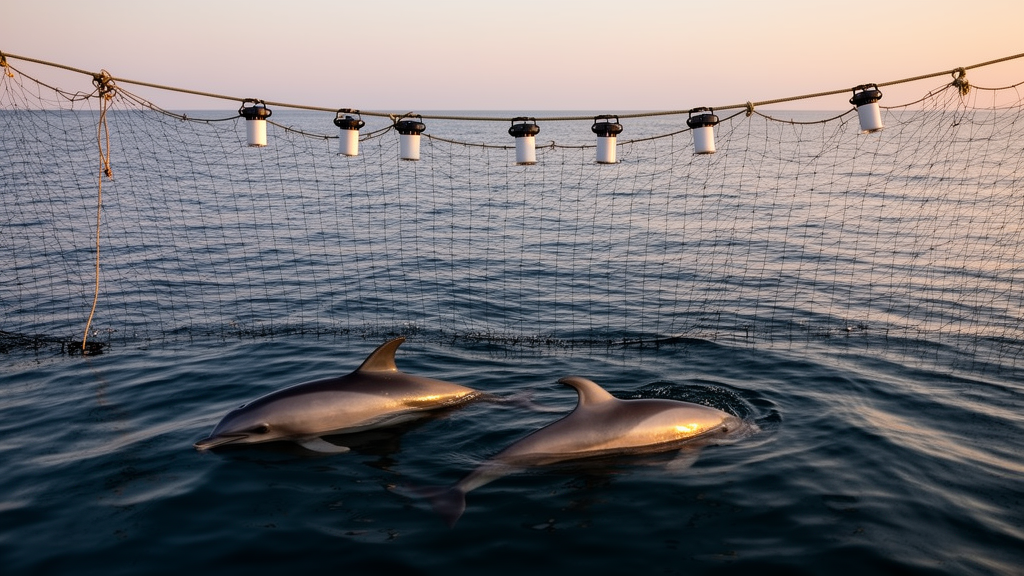
A new four-year study conducted in Bulgarian waters between 2019 and 2022 and published in Nature Conservation has now tested three commercially available acoustic deterrent devices, known as pingers, during standard turbot fishing operations, and the results reveal a striking technical divide: only one of the three models, the PAL Wideband pinger, produced a statistically significant reduction in cetacean bycatch, cutting it by 74 percent. The trials encompassed 57 hauls across eight licensed fishing vessels operating from ports along the Bulgarian Black Sea coast, including Balchik, Nessebar, Primorsko, Tsarevo, and Sinemorets. Bycatch was recorded in 61 percent of all hauls, accounting for 189 cetaceans in total: 182 harbour porpoises, five bottlenose dolphins, and two common dolphins.
Independent onboard observers documented 79 percent of the hauls, while fishermen on smaller boats with limited capacity self-reported the remaining 21 percent, a difference that showed up in the data as well, with bycatch recorded in 64 percent of observer-monitored hauls but only 42 percent of self-reported ones. The overwhelming share of the bycatch, 96 percent, consisted of harbour porpoises, underscoring that the turbot gillnet fishery is the critical threat for this subspecies. Pingers are instruments that, when immersed in water, broadcast an acoustic signal, typically at 130 to 150 dB re 1 μPa at 1 m, lasting about 300 ms and repeating every 4 seconds, a standard established through US and EU regulations.
The Future Oceans NETGUARD 10 kHz pinger, at 132 dB, was designed as a porpoise deterrent, while the Future Oceans NETGUARD 70 kHz pinger, at 145 dB, is marketed as a dolphin pinger. The PAL Wideband pinger, produced by F3 Maritime Technology in Germany, operates across a broad frequency band from 20 to 160 kHz at 145 dB and is positively buoyant, meaning it floats and helps keep the net open, a mechanical advantage unique among the tested models. The statistical analysis relied on standardised fishing effort, calculated as days multiplied by square kilometres of net surface, to account for differences in soaking time, net length, and net height among fishermen.
Bycatch levels were expressed as individuals per unit of effort, and nonparametric tests, including the pairwise Mann-Whitney U test and the Kruskal-Wallis H test, were applied in SPSS to detect significant differences between active and control nets and among years. For the Future Oceans 10 kHz pingers, tested in 17 trials, the total bycatch reduction was 23.16 percent, but this result was not statistically significant. For the Future Oceans 70 kHz pingers, tested in 6 trials, bycatch in active nets was actually higher than in controls, yielding a negative reduction of 23.75 percent, again without statistical significance.
Only the PAL Wideband pingers, tested in 6 trials, produced a significant result, with a 73.71 percent reduction in bycatch (Mann-Whitney U test, p < 0.05). The authors also point to the possibility of temporal hearing loss in Black Sea porpoises, which are known to suffer mass infestations of the parasitic nematode Stenurus minor in the internal ear, a well-documented cause of hearing impairment. Population-specific echolocation characteristics may further explain why a device tuned to Baltic porpoise signals was not simply transplanted, but rather a wideband programmable version was tested instead.
The study's results diverge substantially from most reported pinger outcomes worldwide. Along the Pacific coast of Washington State, bycatch reductions ranged from 85 to 97 percent, while on the US Atlantic coast a 92 percent reduction was observed. In the southern Black Sea around Sinop in Türkiye, Dukane NetMark 1000 pingers, 10 kHz devices with significant harmonics up to 100 kHz, reduced harbour porpoise bycatch by 98 percent in turbot gillnets.
The same model reportedly reduced bycatch by 87 percent around Ireland and 77 percent in the Bay of Fundy, Canada. By contrast, trials of AquaMark 100 and 200 pingers in eastern Turkish waters around Rize found no effectiveness, attributed to biotic and abiotic factors in the marine environment as well as technical parameters including frequency and signal strength. The Bulgarian results align more closely with the Turkish findings than with the North American or Sinop outcomes, suggesting that local conditions and device design interact in complex ways.
The PAL Wideband results are comparable to the approximately 80 percent reduction in porpoise bycatch reported in the Baltic Sea during initial trials of the original Porpoise Alerting Device between 2014 and 2016, which analysed 3,094 net strings set during 929 trips. In the Baltic study, PAL effectiveness increased when device spacing was reduced to less than 200 m. The Bulgarian researchers reduced PAL spacing to 140 m, a factor that appears to enhance device performance, though the sample size was considerably smaller, comprising only six trials across 13 trips.
The total number of porpoises bycaught was nonetheless higher in Bulgarian waters, which the authors attribute to the higher density of the species in Bulgarian Black Sea waters compared to the German Baltic Sea. The high frequency of bycatch during observed hauls indicates the trials were highly representative of the threat the fishery poses. Based on the statistically significant 74 percent reduction achieved with PAL Wideband pingers, a recommendation was submitted to Bulgarian national authorities, including the Ministry of Environment and Water and the Executive Agency for Fisheries and Aquaculture, and presented to international organisations including ACCOBAMS, ICES, and the General Fisheries Commission of the Mediterranean (GFCM) of the FAO.
The GFCM subsequently launched a large-scale trial of PAL Wideband pingers across the Black Sea in 2023 and 2024 through the CetaByM pilot project. Across 95 trials in Bulgaria, Romania, and Türkiye, the devices reduced harbour porpoise bycatch by 69 percent without affecting turbot catches, with 47 porpoises bycaught in total, 36 in control nets and 11 in PAL-equipped nets. Notably, 55 percent of all bycaught porpoises during CetaByM were recorded in Bulgarian trials, which accounted for only 16 percent of all trials, highlighting Bulgarian waters as a critical habitat for the subspecies.
The authors argue that the urgent implementation of a basin-wide Black Sea harbour porpoise Conservation Plan, mandating PAL Wideband pingers in the turbot fishery, is essential for the effective conservation of this threatened subspecies across all Black Sea countries. Effective control and monitoring to ensure compliance with pinger spacing and placement requirements are critical, since a review of pinger use along the northeastern US coast identified non-compliance with recommended spacing and device malfunctions as primary causes of reduced mitigation, in some cases even producing higher bycatch rates when porpoises detected acoustically marked zones as the end of an obstacle. Implementation will require dedicated funding, with the EU Maritime and Fisheries Fund appearing as the most appropriate source for EU member states Bulgaria and Romania, while the four non-EU countries bordering the Black Sea will need national and regional financial contributions.
The financial resources required for widespread pinger deployment would constitute only a small fraction of the fund's investments in fishing infrastructure. Commercial exploitation of Black Sea cetaceans in the twentieth century, which continued until 1983, is estimated to have taken between 4 and 5 million individuals, significantly depleting their numbers. Despite legal protection under the EU Habitats Directive 92/43/EEC and the Marine Strategy Framework Directive, cetaceans in the Black Sea still face pollution, biological invasions, overfishing, and bycatch.
Conservation efforts for the harbour porpoise in European waters are failing despite high conservation status designations, and recent basin-wide bycatch estimates raise serious concerns about the long-term viability of the subspecies. The study's central message is explicit: not all pingers are effective in mitigating Black Sea harbour porpoise bycatch, and this finding must be considered when designing targeted mitigation strategies.
Subject of Research: Conservation science
Article Title: Can pingers mitigate the bycatch of the endangered Black Sea Harbour Porpoise?
Article References: Popov, D., Meshkova, G., Dimitrov, H., & Panayotova, M. (2026). Can pingers mitigate the bycatch of the endangered Black Sea Harbour Porpoise?. Nature Conservation, 63, 1-15. https://doi.org/10.3897/natureconservation.63.183768
Image Credits: AI Generated
DOI: 10.3897/natureconservation.63.183768
Keywords: harbour porpoise, bycatch, pingers, Black Sea, turbot fishery, acoustic deterrent devices, mitigate, endangered, Black, Harbour, Porpoise, scientific research
Cite Scienmag News
Margaret Porter. (October 20, 2026). Research report: Can pingers mitigate the bycatch of the endangered Black Sea Harbour Porpoise? Scienmag. https://scienmag.com/research-report-can-pingers-mitigate-the-bycatch-of-the-endangered-black-sea-harbour-porpoise/
Margaret Porter. "Research report: Can pingers mitigate the bycatch of the endangered Black Sea Harbour Porpoise?" Scienmag, 20 October 2026, https://scienmag.com/research-report-can-pingers-mitigate-the-bycatch-of-the-endangered-black-sea-harbour-porpoise/. Accessed 20 October 2026.
Margaret Porter. "Research report: Can pingers mitigate the bycatch of the endangered Black Sea Harbour Porpoise?" Scienmag. October 20, 2026. https://scienmag.com/research-report-can-pingers-mitigate-the-bycatch-of-the-endangered-black-sea-harbour-porpoise/


