


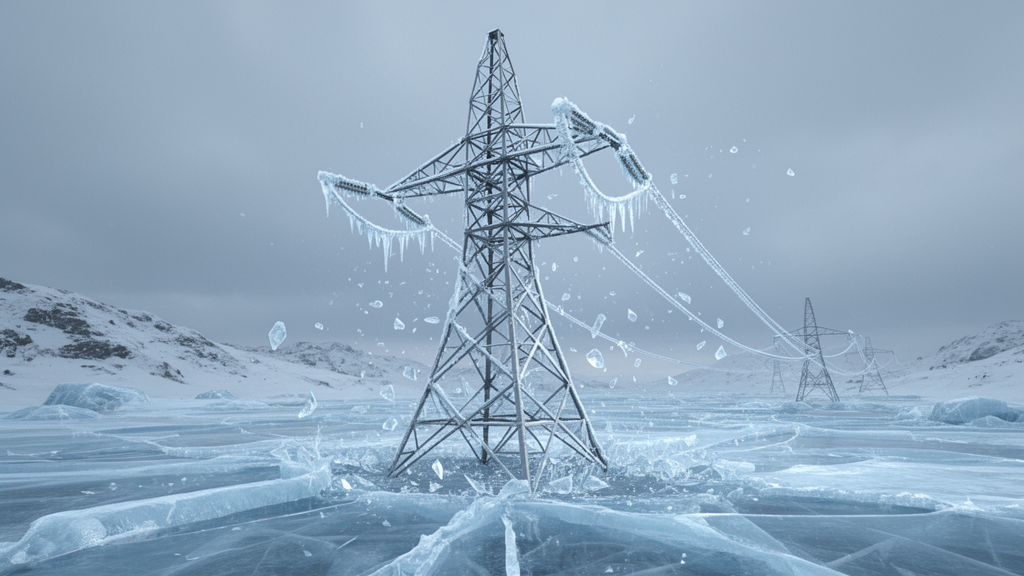
Transmission towers carrying ice can undergo markedly stronger dynamic responses during earthquakes, according to a probabilistic study based on 216 strong ground-motion records from the 2023 East Anatolian Fault Zone in Türkiye. The researchers found that ice-covered structures had an average acceleration amplification factor of 2.74, while the maximum exceeded 6.0, indicating that additional mass and changes in structural dynamics can intensify inertial forces and resonance risks when seismic shaking coincides with icing.
The research examined transmission tower systems as a coupled ice-earthquake problem rather than evaluating icing and earthquakes only as separate hazards. This focus addresses a gap identified by the authors in earlier work, which often concentrated on single-hazard scenarios. The analysis considered how ice density and the type of ground motion affect the nonlinear response and seismic fragility of transmission towers. Earthquake recordings were obtained from the Turkish Accelerometric Database and Analysis System, providing a strong-motion data set for the probabilistic evaluation.
Particular attention was given to pulse-like and long-period ground motions, two motion characteristics that the study compared with more general ground motions. These records were used to examine whether the dynamic response of iced towers depended not merely on earthquake intensity but also on the nature of the shaking. The study combined ground-motion information with structural analysis and damage assessment to evaluate how ice accretion alters the seismic behavior of transmission tower systems.
Damage patterns varied with both ice density and ground-motion type. Higher ice density correlated with more significant structural damage, particularly in the study’s Rare Earthquake scenarios. The effect of motion type was intensity-dependent: during high-intensity earthquakes, the probability of damage to ice-covered towers was significantly higher under pulse-like and long-period ground motions than under general ground motions. The reported amplification is therefore associated with the combined loading condition analyzed by the model, while the damage analysis shows that records with different dynamic characteristics can produce markedly different outcomes for iced structures.
These findings come from model-based structural and probabilistic analyses using the selected strong-motion records, rather than from observations of a specific tower collapse or a direct survey of damaged transmission infrastructure. The study does not establish the frequency with which damaging ice-earthquake combinations occur in the field, and it does not report field measurements of a particular failure. Its scope is instead the dynamic response, damage patterns and seismic fragility of transmission towers under coupled ice-covered and earthquake action. The authors present the results as theoretical and data-based support for designing transmission towers with higher seismic performance and for controlling safety risks in extreme conditions where icing and strong shaking may occur together.
Subject of Research: Seismic fragility of transmission towers under coupled ice and earthquake loading
Article Title: Seismic evaluation of transmission tower structures under coupled ice-earthquake action
Article References: Fang, D., Liu, S., Sun, W., & Wang, H. (2026). Seismic evaluation of transmission tower structures under coupled ice-earthquake action. Natural Hazards, 122(22), Article 690. https://doi.org/10.1007/s11069-026-08472-4
Image Credits: AI Generated
DOI: 10.1007/s11069-026-08472-4
Keywords: transmission towers, ice accretion, earthquake hazards, ground motion, seismic fragility, structural dynamics, Türkiye, pulse-like motion, long-period motion, Seismic, evaluation, transmission
Cite Scienmag News
Violet Maxwell. (October 20, 2026). Seismic evaluation of transmission tower structures under coupled ice-earthquake action. Scienmag. https://scienmag.com/seismic-evaluation-of-transmission-tower-structures-under-coupled-ice-earthquake-action/
Violet Maxwell. "Seismic evaluation of transmission tower structures under coupled ice-earthquake action." Scienmag, 20 October 2026, https://scienmag.com/seismic-evaluation-of-transmission-tower-structures-under-coupled-ice-earthquake-action/. Accessed 20 October 2026.
Violet Maxwell. "Seismic evaluation of transmission tower structures under coupled ice-earthquake action." Scienmag. October 20, 2026. https://scienmag.com/seismic-evaluation-of-transmission-tower-structures-under-coupled-ice-earthquake-action/


