


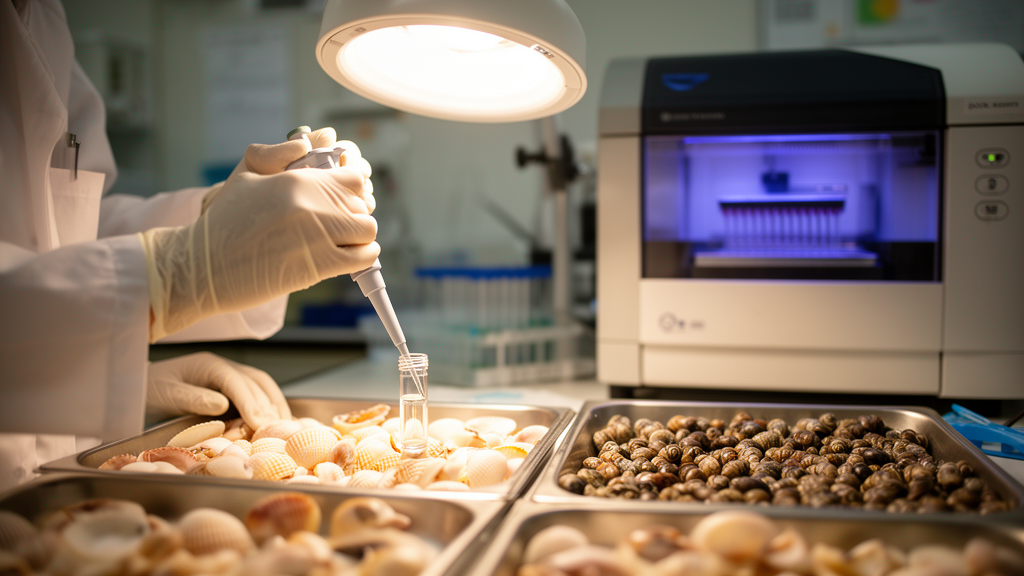
Yet when it comes to DNA-based identification, they have been largely left behind: only about 10% of estimated mollusc species are represented in public DNA barcode databases. The project, known as MOLCA (Barcoding de la Malacofauna Continental de Catalunya), was launched in 2016 and involved years of fieldwork across Catalonia, Andorra, and the French Pyrenees, primarily between 2017 and 2022. For Catalonia specifically, the MOLCA project contributes 334 of the 411 mollusc barcodes currently available in the Barcode of Life Database (BOLD), roughly 80% of all entries and nearly 100% of the non-marine records.
The dataset includes 40 species and subspecies previously absent from public databases and covers nearly half of the 357 nominal species listed in the most recent regional checklist. Technically, the team amplified the COI fragment using the universal Folmer primer pair LCO1490/HCO2198, with alternative primers deployed for problematic samples. Sequences were quality checked, translated into amino acids using the invertebrate mitochondrial genetic code to detect stop codons, and screened for nuclear mitochondrial pseudogenes (NUMTs).
No stop codons, insertions, deletions, or anomalous base compositions were found, indicating that all sequences represent functional mitochondrial COI. The dataset yielded 289 unique haplotypes, 417 variable sites, and 393 parsimony informative sites, with nucleotide frequencies consistent with previously published mollusc values. The central analytical tool was the barcode gap analysis, which compares genetic variation within a species against divergence to its nearest neighbour.
A barcode gap exists when intraspecific divergence lies below interspecific divergence, allowing sequences to be reliably assigned to species. Of the 107 species analysed with two or more sequences, 95 (88.8%) exhibited a clear barcode gap, supporting the efficacy of DNA barcoding for mollusc species discrimination. Mean divergence increased hierarchically with taxonomic rank: 3.59% within subspecies, 3.82% within species, 7.38% among species within genera, and 12% among genera within families.
However, the study also exposed the limits of single-marker taxonomy. Twelve species lacked a barcode gap, and nine nominal species showed intraspecific divergences exceeding 10%, including Clausilia bidentata (24.52%) and Abida secale (26.2%). This extraordinary mitochondrial variation, long recognised in land snails and often attributed to their hermaphroditism, longevity, and strong population structure, was primarily detected among geographically isolated populations separated by mountain ranges such as the Parc Natural del Cadí-Moixeró.
Conversely, some species pairs showed unusually low interspecific divergence, including Deroceras agreste and D. reticulatum at 0%, suggesting recent divergence, taxonomic over-splitting, or hybridisation. To probe species boundaries more deeply, the researchers focused on two of the region's most species-rich genera, Abida and Chondrina, compiling 524 barcode sequences from BOLD and their own data. Four species delimitation methods were applied: ASAP, which examines pairwise genetic distances; PTP and its multi-rate variant mPTP, which model speciation on phylogenetic trees; and RESL, the network-based algorithm behind BOLD's Barcode Index Numbers.
The methods produced starkly different numbers of Molecular Operational Taxonomic Units, from 95 (mPTP) to 280 (ASAP), and mutual agreement was limited, with at most 84% of species boundaries shared between any two approaches. Match ratios between molecular units and nominal species ranged from just 5.84% to 9.09%, indicating substantial disagreement between mitochondrial lineages and current shell-based taxonomy. Neither Abida nor Chondrina was monophyletic, with the Pyrenean species Abida partioti nesting within Chondrina.
The Abida secale complex, once proposed as a classic ring species, was divided into multiple genetically distinct clades, and the subspecies A. secale elegantissima clustered outside the main group, suggesting it may deserve elevation to species rank. The authors caution that some sequences retrieved from BOLD could not be independently verified, so misidentification cannot be fully excluded. These findings underscore that shell morphology, historically pivotal to land snail taxonomy, does not reliably reflect evolutionary lineages in these genera.
Some subspecies may represent phenotypic variants rather than independently evolving lineages, while others could be shallow divergent lineages shaped by incomplete lineage sorting or introgression. Resolving these boundaries will require integrative frameworks combining shell morphology, soft body anatomy, ecology, and multilocus or genomic data. The conservation stakes are high.
Freshwater molluscs are the most endangered group evaluated in Europe, with 44% of species assessed as threatened, and 20% of assessed terrestrial molluscs also face serious threats. The new barcode library, with complete voucher metadata, provides a robust benchmark for environmental DNA monitoring, early detection of population declines, and the identification of invasive species such as Cochlicella acuta, illustrating how molecular tools can underpin biodiversity conservation planning across the region.
Subject of Research: Biodiversity
Article Title: A DNA barcode reference library of terrestrial and freshwater molluscs of Catalonia, northeastern Iberian Peninsula
Article References: Enguídanos-García, A., Cadevall, J., Capdevila, M., Corbella, J., Guillén, G., Orozco, A., Bros, V., Prieto, M., Uribe, F., & Arnedo, M. A. (2026). A DNA barcode reference library of terrestrial and freshwater molluscs of Catalonia, northeastern Iberian Peninsula. Zoosystematics and Evolution, 102(3), 829-843. https://doi.org/10.3897/zse.102.159613
Image Credits: AI Generated
Keywords: DNA barcoding, molluscs, Catalonia, COI gene, species delimitation, biodiversity conservation, land snails, freshwater molluscs, Abida, Chondrina, MOTUs, BOLD database
Cite Scienmag News
Margaret Porter. (October 20, 2026). Research report: A DNA barcode reference library of terrestrial and freshwater molluscs of Catalonia, northeastern Iberian Peninsula. Scienmag. https://scienmag.com/research-report-a-dna-barcode-reference-library-of-terrestrial-and-freshwater-molluscs-of-catalonia-northeastern-iberian-peninsula/
Margaret Porter. "Research report: A DNA barcode reference library of terrestrial and freshwater molluscs of Catalonia, northeastern Iberian Peninsula." Scienmag, 20 October 2026, https://scienmag.com/research-report-a-dna-barcode-reference-library-of-terrestrial-and-freshwater-molluscs-of-catalonia-northeastern-iberian-peninsula/. Accessed 20 October 2026.
Margaret Porter. "Research report: A DNA barcode reference library of terrestrial and freshwater molluscs of Catalonia, northeastern Iberian Peninsula." Scienmag. October 20, 2026. https://scienmag.com/research-report-a-dna-barcode-reference-library-of-terrestrial-and-freshwater-molluscs-of-catalonia-northeastern-iberian-peninsula/


