


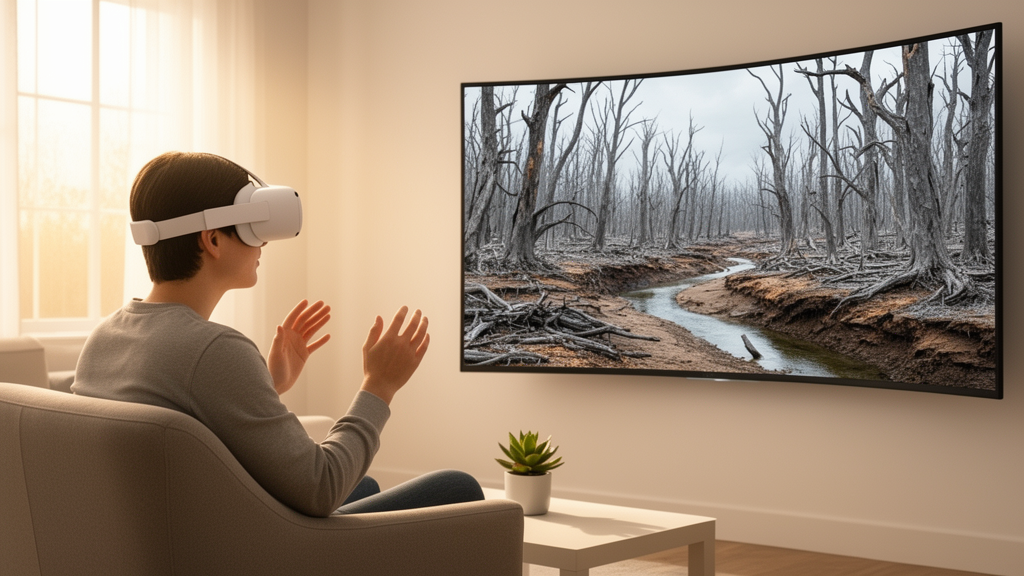
Students who viewed an immersive virtual-reality simulation of degraded natural environments four times reported higher environmental awareness two months later than students who viewed it once, according to a randomized laboratory experiment. The study measured awareness and pro-conservation behavioral intention immediately after exposure and again at a two-month follow-up.
The study initially enrolled 174 university students; 171 completed both assessments. Participants were randomly assigned to a single exposure or repeated exposure. Those in the repeated condition viewed the same 360-degree video four times, with 24-hour intervals between sessions, while those in the single condition viewed it once. All participants then completed the initial questionnaire, and all were invited to complete a second questionnaire two months later.
The immersive VR content showed degraded natural environments, including a beach overrun with plastic waste, deforested forests giving way to arid soil, landscapes obscured by atmospheric pollution, and drained wetlands that had previously supported biodiversity. Environmental awareness was assessed with a four-item, seven-point scale developed by Trivedi et al. Pro-conservation behavioral intention was measured with three items on a seven-point scale ranging from very unlikely to very likely, covering volunteering for nature protection, motivating family and friends to volunteer, and informing oneself about nature protection and related environmental issues. A 15-item scale assessed love and care for nature at the two-month follow-up.
Mixed analysis of variance found a significant main effect of exposure type on environmental awareness: participants exposed repeatedly had higher scores overall than those exposed once, with means of 4.70 and 3.59, respectively. There was also a significant effect of time, as awareness was lower at two months than immediately after exposure, with overall means of 3.75 and 4.53. The exposure-by-time interaction was significant. Awareness fell from 4.15 to 3.03 in the single-exposure group, whereas the change from 4.91 to 4.48 in the repeated-exposure group was not statistically significant. At follow-up, the repeated-exposure group still had a higher mean awareness score than the single-exposure group, 4.48 versus 3.03.
Repeated exposure was also associated with higher pro-conservation behavioral intention overall, with means of 3.94 for the repeated group and 3.55 for the single group. However, intention declined over time in the overall sample, from a mean of 3.98 immediately after exposure to 3.51 two months later. The interaction between exposure type and time was not significant, so the analysis did not show that repetition changed the trajectory of conservation intentions. In other words, the repeated group had higher intention scores overall, but not a distinctively different pattern of change from the single group.
A moderated mediation analysis based on 5,000 bootstrap samples examined the relationships among exposure type, awareness and intention at two months. Exposure type was positively associated with environmental awareness, with a coefficient of 0.47, and awareness was positively associated with pro-conservation intention, with a coefficient of 0.28. The direct association between exposure type and intention was not significant, whereas the indirect association through awareness was significant. This pattern was consistent with statistical mediation by environmental awareness in this sample, rather than demonstrating that VR directly changed conservation intentions.
Love and care for nature significantly and positively moderated the association between awareness and pro-conservation intention, with an interaction coefficient of 0.19. In the analysis, stronger feelings of love and care for nature were associated with a stronger relationship between environmental awareness and stated intention to engage in conservation actions. Because these feelings were measured only at the two-month follow-up, the study did not establish when or how the relationship developed.
Several limitations constrain the interpretation. No pre-test was administered for environmental awareness or pro-conservation intention, so baseline differences could not be controlled and the results represent post-exposure differences rather than clearly established causal changes caused by VR. The sample consisted of university students from one country, limiting generalizability, and the authors noted that fatigue or habituation to repeated presentation of the same message could have affected responses. One participant discontinued because of cybersickness, and two others did not complete the follow-up because of health problems. The study also measured intentions rather than observed environmental behavior, so it does not establish whether the virtual reality experience produced durable changes in people’s conduct. Within these bounds, the findings associate repeated immersive exposure to degraded nature with higher environmental awareness at two months, while showing no evidence that repetition produced a different trajectory of pro-conservation intentions.
Subject of Research: Longitudinal experiment testing repeated immersive VR exposure to degraded nature among university students
Article Title: The long-term effect of repeated exposure to degraded nature via immersive virtual reality on environmental awareness and pro-conservation behavioral intention: A longitudinal approach
Article References: Nouri, I., Chaabane, K., & Bouzaabia, R. (2026). The long-term effect of repeated exposure to degraded nature via immersive virtual reality on environmental awareness and pro-conservation behavioral intention: A longitudinal approach. Nature Conservation, 63, 337-356. https://doi.org/10.3897/natureconservation.63.176597
Image Credits: AI Generated
DOI: 10.3897/natureconservation.63.176597
Keywords: immersive virtual reality, environmental awareness, pro-conservation intentions, degraded nature, behavioral intention, nature connectedness, longitudinal study, virtual reality experiment, long-term, effect, repeated, exposure
Cite Scienmag News
Margaret Porter. (October 20, 2026). Repeated immersive VR exposure linked to higher environmental awareness after degraded-nature simulation among university students. Scienmag. https://scienmag.com/repeated-immersive-vr-exposure-linked-to-higher-environmental-awareness-after-degraded-nature-simulation-among-university-students/
Margaret Porter. "Repeated immersive VR exposure linked to higher environmental awareness after degraded-nature simulation among university students." Scienmag, 20 October 2026, https://scienmag.com/repeated-immersive-vr-exposure-linked-to-higher-environmental-awareness-after-degraded-nature-simulation-among-university-students/. Accessed 20 October 2026.
Margaret Porter. "Repeated immersive VR exposure linked to higher environmental awareness after degraded-nature simulation among university students." Scienmag. October 20, 2026. https://scienmag.com/repeated-immersive-vr-exposure-linked-to-higher-environmental-awareness-after-degraded-nature-simulation-among-university-students/


