


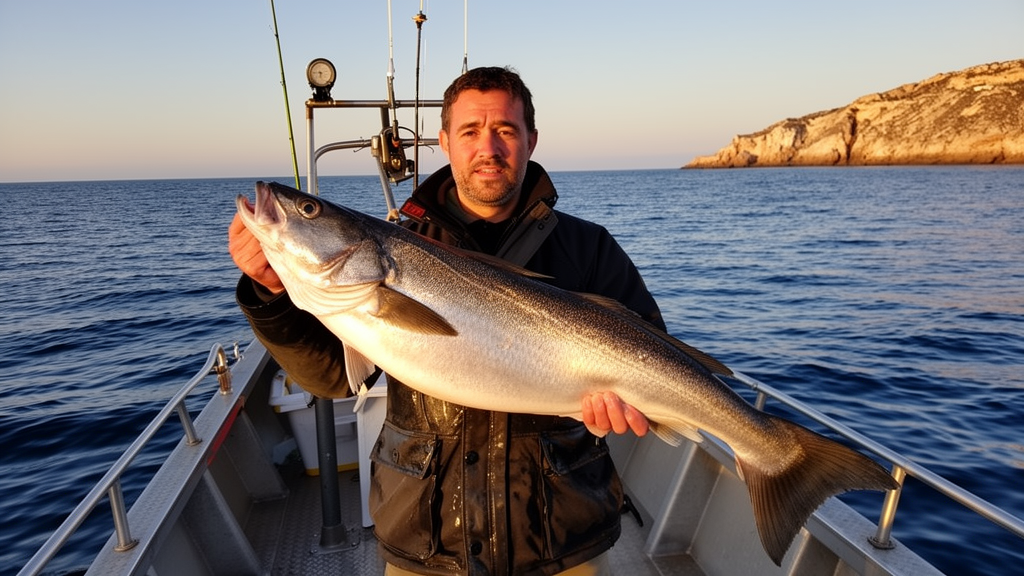
Two specimens of the tropical-affinity Benguela hake, Merluccius polli, were identified in commercial landings in Spain’s Gulf of Cádiz in 2022, providing the northernmost confirmed records of the species in the Northeast Atlantic. The study combined opportunistic sampling at fish auctions with an analysis of official sales data, finding that M. polli also accounted for more than 95% of the black hake biomass recorded at the Cádiz auction from 2022 through 2024.
This observational research was based on two specimens detected during routine inspections at local fish auctions. The first was landed at El Puerto de Santa María on 18 February 2022 after capture the previous day by the trawler MT Narcisa y Antonio at approximately 145 m depth in local fishing grounds. It measured 47 cm total length and weighed 0.42 kg. The second was landed at Bonanza in Sanlúcar de Barrameda on 27 July 2022 by the trawler MT Nuevo Gran Poder. It measured 62 cm and weighed 1.30 kg. Both had been caught by vessels operating in the Gulf of Cádiz rather than arriving as African-origin imports.
Identification followed published morphological criteria based on meristic characters, including gill-raker counts, and pigmentation of the caudal fin. Both specimens had a dark submandibular fold and oral cavity and a caudal fin with a characteristic white margin. The first specimen had 11 gill rakers, within the expected range for M. polli and distinct from the reference counts of eight for European hake, Merluccius merluccius, and 13 for Senegalese hake, M. senegalensis. Reference specimens showed that the Senegalese hake had a uniformly dark caudal fin without a white margin, while the European hake had a pale oral cavity and a uniformly dark tail.
The records extend the known northern limit of M. polli beyond the Canary Islands to the Gulf of Cádiz, near 36°N. The species has historically been associated with Atlantic waters from Mauritania to Angola and with deeper slope waters of roughly 300–1,000 m. Its capture on the outer continental shelf at about 145–146 m is also shallower than its commonly reported core distribution. The authors interpret the geographic displacement as consistent with “tropicalization” and the poleward movement of warm-water species observed around the Gulf of Cádiz and Strait of Gibraltar, although the two records alone cannot establish a sustained population expansion.
The study also emphasizes limits on the morphological identification. Recent phylogenetic work indicates cryptic diversity within Merluccius, and hybridization and introgression between M. polli and M. senegalensis have been documented in their native range. Because the fish were sold immediately after inspection, no tissue was collected for molecular analysis. Although the specimens showed no intermediate phenotypic features, the authors state that hybrids cannot be ruled out. The records therefore depend on morphological determination rather than independent genetic confirmation.
For the market analysis, the researchers retrieved monthly first-sale records from the Technological Platform for Identification, Fisheries and Aquaculture, or IDAPES, covering the Cádiz auction from 2000 to 2024. The records provided landed weight in kilograms and revenue in euros for M. merluccius, M. polli and M. senegalensis. Because the two African species had historically been labeled inconsistently, records for 2000–2021 were pooled as Merluccius species to avoid misclassification bias. From 2022 onward, systematic morphological examination supported species-specific analysis.
Once the species were recorded separately, M. polli overwhelmingly dominated the black hake category from 2022 to 2024, while M. senegalensis appeared sporadically and in very low quantities. This creates a contrast between the species observed in local waters and the composition of imports entering the regional market. The market result does not itself demonstrate that the two Gulf of Cádiz specimens came from local populations; rather, it shows that fish marketed as black hake in Cádiz were predominantly another species imported from Northwest African fishing grounds.
Pooled black hake landings peaked at several thousand tonnes annually in the early 2000s and declined toward the early 2010s. The authors attributed the decrease primarily to a reduction in the number of Galician vessels landing black hakes in Cádiz, which fell to four active vessels, rather than to an abrupt change in stock availability. Volumes partly recovered during the mid-2010s but remained below and were more variable than those of the early series. Inflation-adjusted black hake prices were comparatively stable, while M. polli generally commanded intermediate prices after 2022, below those of M. merluccius.
The findings show that pooled catch and market records can obscure species-specific dynamics and complicate monitoring of the local hake fishery. Historical labeling may have masked the contribution of M. polli and possible changes involving M. senegalensis, while the appearance of morphologically similar congeners in mixed landings requires careful auction and vessel reporting. The authors also recommend combining port sampling with genetic material collection to clarify the identity of suspect specimens. The evidence establishes two confirmed northern occurrence records and a market dominated by M. polli, but it does not yet show whether the captures were isolated vagrants or evidence of an established Gulf of Cádiz population.
Subject of Research: Occurrence and market dominance of Benguela hake in Spain’s Gulf of Cádiz
Article Title: On the occurrence of a tropical-affinity species Merluccius polli ( Actinopterygii , Gadiformes , Merlucciidae ) in the Gulf of Cádiz (SW Spain) and market-driven implications for the black hake fishery
Article References: de Carvalho-Souza, G. F., Lobato Gómez, C., & González-Ortegón, E. (2026). On the occurrence of a tropical-affinity species Merluccius polli (Actinopterygii, Gadiformes, Merlucciidae) in the Gulf of Cádiz (SW Spain) and market-driven implications for the black hake fishery. Acta Ichthyologica et Piscatoria, 56, 195-202. https://doi.org/10.3897/aiep.56.186812
Image Credits: AI Generated
Keywords: Benguela hake, Merluccius polli, Gulf of Cádiz, range expansion, tropicalization, fisheries monitoring, species misidentification, Cádiz fish auction, IDAPES, commercial landings, occurrence, tropical-affinity
Cite Scienmag News
Juliet Wilcox. (October 20, 2026). Opportunistic study reports Benguela hake in the Gulf of Cádiz and dominance in Cádiz black hake sales. Scienmag. https://scienmag.com/opportunistic-study-reports-benguela-hake-in-the-gulf-of-cadiz-and-dominance-in-cadiz-black-hake-sales/
Juliet Wilcox. "Opportunistic study reports Benguela hake in the Gulf of Cádiz and dominance in Cádiz black hake sales." Scienmag, 20 October 2026, https://scienmag.com/opportunistic-study-reports-benguela-hake-in-the-gulf-of-cadiz-and-dominance-in-cadiz-black-hake-sales/. Accessed 20 October 2026.
Juliet Wilcox. "Opportunistic study reports Benguela hake in the Gulf of Cádiz and dominance in Cádiz black hake sales." Scienmag. October 20, 2026. https://scienmag.com/opportunistic-study-reports-benguela-hake-in-the-gulf-of-cadiz-and-dominance-in-cadiz-black-hake-sales/


