


A scoping review identified 128 publications describing tools and educational interventions intended to strengthen health workers’ competencies and address gender bias in sexual and reproductive health and rights care. The mapped evidence comprised 25 toolkits, manuals or curricula and 103 intervention reports representing 100 unique intervention approaches.
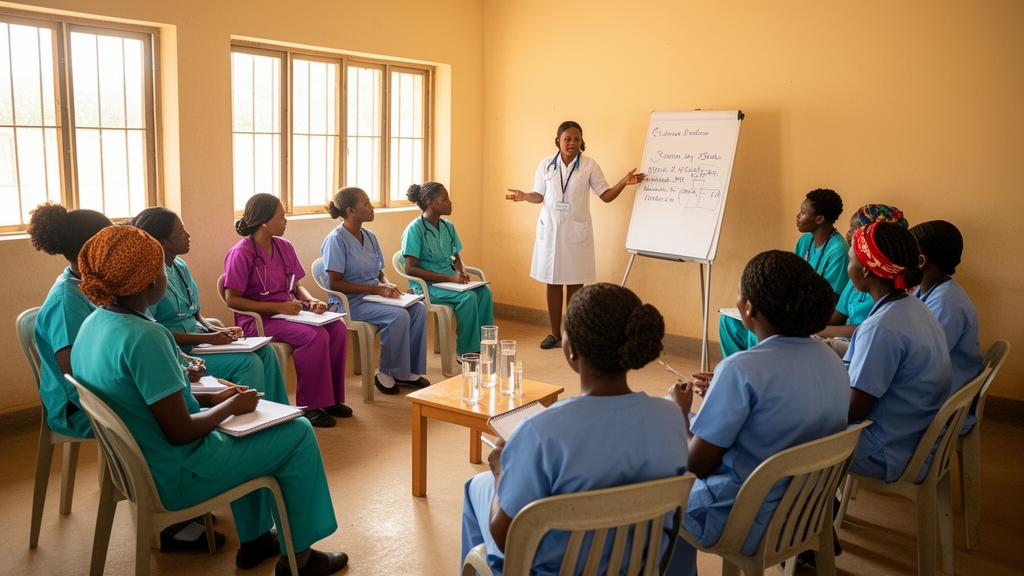
The review found that most approaches combined several learning methods rather than relying on a single strategy. Among the 100 interventions, didactic instruction appeared in 98, experiential learning in 90, and reflective or values-based learning in 80. Reinforcement through mentorship, follow-up sessions, peer support or quality-improvement cycles was reported in 61 interventions.
Researchers used the Arksey and O’Malley scoping-review framework and followed the Preferred Reporting Items for Systematic Reviews and Meta-Analysis Extension for Scoping Reviews. Searches covered MEDLINE, CINAHL, Embase, CENTRAL, ERIC, PsycINFO and Google Scholar, as well as organizational websites and grey literature, for material published from January 1, 2000, through November 25, 2025.
Eligible sources involved health workers or trainees providing sexual and reproductive health care and described training materials, curricula, toolkits or educational approaches intended to strengthen competencies related to gender norms, bias, values, stigma, or equitable, respectful and rights-based care. The search yielded 7,774 records; after removal of 803 duplicates, 6,971 underwent title-and-abstract screening and 259 full-text reports were assessed. Two reviewers independently screened and extracted data, resolving discrepancies through discussion and, when necessary, a third reviewer.
Among the 100 interventions, 64 primarily targeted frontline physicians, nurses and midwives, 17 exclusively targeted preservice trainees and 11 included both providers and trainees. A further eight included multidisciplinary or nonclinical participants. Delivery was in person for 66 interventions, online for 15 and blended for 18; one used an adaptable format. All interventions included individual-level components, while 86 included interpersonal components and 69 included structural components.
Maternal and newborn health was the most common intervention domain, with 52 of 100 interventions addressing respectful or person-centered maternity care. Gender norms, equity and rights appeared in 31, gender-based or intimate partner violence in 25, and LGBTQ+ inclusive care in 22. Content domains were not mutually exclusive, so these percentages do not sum to 100%. The 25 toolkits most often addressed gender norms, equity and rights, in 15 cases, and abortion care and stigma, in 11.
Equitable, respectful and rights-based care was a principal emphasis across the literature. Gender-transformative elements were identified in 66 of 100 interventions, while system-level elements appeared in 70. Among the toolkits, 24 emphasized equitable or rights-based care, 20 included gender-transformative elements and 23 included system-level elements. The review mapped these features but did not establish whether any training approach improved care or patient outcomes.
The evidence base was uneven across regions, sexual and reproductive health topics and intervention types. North America accounted for 33 of the 100 interventions, Africa for 25 and Asia for 18, with fewer reported in other areas. The review may also have missed training implemented in practice but not documented or tools inaccessible without registration or professional membership. Variable definitions and reporting of gender, equity, rights-based and gender-transformative approaches complicated comparisons, while some classifications required reviewer judgment.
No formal critical appraisal of methodological quality or risk of bias was conducted because the goal was to map the range and characteristics of available evidence rather than assess effectiveness. The authors identified opportunities for more consistent integration of gender-transformative and system-level strategies, including organizational support, leadership, accountability and reinforcement. Because this was a scoping review without a comparative effectiveness analysis, its results describe what training materials and interventions have been reported, not whether they produce better clinical outcomes.
Subject of Research: Gender-bias training tools and educational interventions for sexual and reproductive health care workers
Article Title: Addressing gender bias in sexual and reproductive health care: A scoping review of training tools and interventions
Article References: Oringanje, C., Meremikwu, J., Okusanya, B., Oringanje, C. M., Chibuzor, M., Aquaisua, E., Okoro, A., Ndukwu, D., & Meremikwu, M. M. (2026). Addressing gender bias in sexual and reproductive health care: A scoping review of training tools and interventions. PLOS One, 21(10), e0359704. https://doi.org/10.1371/journal.pone.0359704
Image Credits: AI Generated
DOI: 10.1371/journal.pone.0359704
Keywords: scoping review, gender bias, sexual and reproductive health, health worker training, gender-transformative care, rights-based care, reflective learning, simulation, respectful maternity care, health systems, Addressing, gender
Cite Scienmag News
Courtney Benton. (October 20, 2026). Scoping review maps 128 sources on gender bias training in sexual and reproductive health care. Scienmag. https://scienmag.com/scoping-review-maps-128-sources-on-gender-bias-training-in-sexual-and-reproductive-health-care/
Courtney Benton. "Scoping review maps 128 sources on gender bias training in sexual and reproductive health care." Scienmag, 20 October 2026, https://scienmag.com/scoping-review-maps-128-sources-on-gender-bias-training-in-sexual-and-reproductive-health-care/. Accessed 20 October 2026.
Courtney Benton. "Scoping review maps 128 sources on gender bias training in sexual and reproductive health care." Scienmag. October 20, 2026. https://scienmag.com/scoping-review-maps-128-sources-on-gender-bias-training-in-sexual-and-reproductive-health-care/

